7 New Bullet Train Corridors on Indian Railways
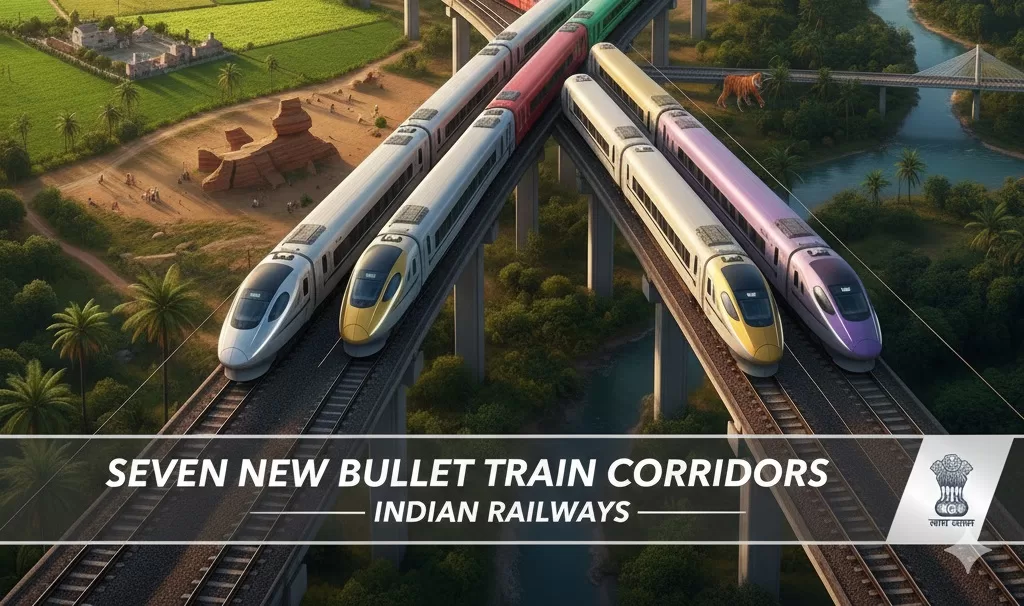
In a big push towards modern rail travel, the government has announced plans for 7 new bullet train corridors across the country. This move clearly shows that Indian Railways is serious about high-speed rail and wants to expand it beyond the Mumbai–Ahmedabad corridor.
For regular passengers, railway enthusiasts, and anyone who travels frequently between major cities, this announcement is a pretty exciting one.
What exactly has been announced?
In simple terms, the government plans to develop seven high-speed rail corridors, covering nearly 4,000 kilometres. These routes will connect important cities across North, South, West and East India.
The idea is to cut down travel time drastically and offer an alternative that’s faster than conventional trains and more convenient than short-haul flights.
The proposed bullet train routes
Here are the seven corridors that have been announced:
- Mumbai – Pune
- Pune – Hyderabad
- Hyderabad – Bengaluru
- Hyderabad – Chennai
- Chennai – Bengaluru
- Delhi – Varanasi
- Varanasi – Siliguri
What stands out is that these routes connect cities with heavy passenger traffic. Routes like Mumbai–Pune and Chennai–Bengaluru already see huge daily movement, so high-speed rail makes practical sense here.
How fast will these trains be?
These trains are expected to run at around 300 kmph or more. That’s proper bullet train speed, not semi-high-speed.
One of the biggest benefits of these corridors will be the dramatic drop in journey times:
- Mumbai to Pune: ~48 minutes (currently 3–4 hrs)
- Pune to Hyderabad: ~1 hr 55 mins
- Chennai to Bengaluru: ~1 hr 13 mins
- Bengaluru to Hyderabad: ~2 hrs
- Chennai to Hyderabad: ~2 hrs 55 mins
- Delhi to Varanasi: ~3 hrs 50 mins
- Varanasi to Siliguri: ~2 hrs 55 mins
At that point, many passengers might prefer trains over flights, especially considering airport security checks and delays.
Why Indian Railways is pushing bullet trains now
This isn’t just about speed. Bullet train projects bring multiple long-term benefits:
- Economic growth along routes – new business hubs develop around stations
- Better connectivity between states
- Reduced load on highways and airports
- Cleaner and more energy-efficient travel
High-speed rail also creates jobs during construction and later during operations and maintenance.
The planning and execution of these new routes will be handled by National High Speed Rail Corporation Limited (NHSRCL), which is also working on the Mumbai–Ahmedabad bullet train.
Latest Mumbai‑Ahmedabad Bullet Train Updates
- बुलेट ट्रेन को मिली रफ्तार:2027 में गुजरात से शुरुआत, 2029 में मुंबई होगी एंट्री; किराए पर आया ये अपडेट – Bullet Train Gains Momentum: Launching From Gujarat In 2027, Reaching Mumbai In 2029 – Amar Ujala Hindi News Live
- Delay of over four years pushes up bullet train project cost by 83% – The Times of India
- Mumbai Bullet Train Project: Railways Eyes Multi-Modal Connectivity with Local Trains, Metro at Key Stations
Why these 7 corridors are priority
1. Northern & Eastern Corridors
- Delhi – Varanasi: This 813 km corridor connects the national capital to the spiritual hub of Varanasi. It is expected to pass through Noida, Mathura, Agra, Kanpur, Lucknow, Ayodhya, and Prayagraj, reducing travel time to about 3 hours and 50 minutes.
- Varanasi – Siliguri: Linking Uttar Pradesh to West Bengal, this route serves as a gateway to the Northeast. It is planned to pass through Patna (Bihar) and potentially Muzaffarpur and Purnia, cutting a 14-hour journey down to less than 3 hours.
2. Western & Central Corridors
- Mumbai – Pune: A vital link between India’s financial capital and its IT/manufacturing hub. This corridor will reduce the commute to just 45 minutes.
- Pune – Hyderabad: Connecting the tech ecosystems of Maharashtra and Telangana, this route is expected to pass through Solapur and Kalaburagi, with a travel time of roughly 1 hour and 55 minutes.
3. Southern Triangle Corridors
- Hyderabad – Bengaluru: Linking the two biggest technology powerhouses in the south, this route will cut travel time to approximately 2 hours.
- Hyderabad – Chennai: This corridor connects Telangana to the Tamil Nadu capital via the new capital of Andhra Pradesh, Amaravati, with a projected travel time of 2 hours and 55 minutes.
- Chennai – Bengaluru: One of the busiest business routes in India, this high-speed link will reduce travel time to just 1.5 hours, passing near industrial hubs like Sriperumbudur and Hoskote.



1 Comment
💰 USDC Refund After Dump Claim Compensation >>> telegra.ph/Compensations-03-29-3?hs=6248734d8f735d50ea533cef49bf191c& 💰 · April 12, 2026 at 8:50 am
wy7tlv