Category Archives: Railway Board

Indian Railways ends appointment of TADK, Bungalow Peon

Policy of Appointment of TADK on the Railways: 01/12/2020

RBE 102/2020: Vide Railway Board Letter No. E(NG)II/2020/SB/5, dated 01.12.2020, Railway Board has issued policy letter for appointment of TADK on the Railways.

  • Engagement of fresh face substitute as TADK is discontinued with effect from 06.08.2020.
  • Existing posts and incumbent TADKs will continue…
  • TADK posts may be filled by regular Railway employees…

For more detail & latest policy letter on TADK

Policy on TADK/Bungalow Peon –RBE 102/2020 dated 01/12/2020

Immediate stop on appointment of TADK

In reply of an un-starred question in Lok Sabha, the Minister of Railways submitted that The Ministry of Railways has stopped appointment of TADK with immediate effect vide its order dated 06.08.2020. 

Now, officers of Indian Railways will not have facility of appointing Telephone Attendant-cum-Dak Khalasis (TADKs).

Reply submitted by the Railway Minister in Lok Sabha

Un-starred question no. 1645 of Lok Sabha, answered by Minister of Railways on 21.09.2020 as follows…

(a).
Q. The number of khalasis or bungalow peons working at the residence of senior officials as on date along-with the criteria for appointment as khalasis and their nature of duties and emoluments paid;

Ans. There are 4227 Telephone Attendant cum Dak Khalasis (TADK)/Bungalow peons working in Indian Railways as on date. Initial engagement of bungalow peons/TADK is made as fresh face substitute with the personal approval of the General Manager on verification and recommendation by the concerned officer. These candidates are required to meet educational qualification, age and medical fitness criteria for appointment prescribed for direct recruitment of Level-1 (erstwhile Group D) employees. These appointees are paid in Pay Level-1 of Seventh Central Pay Commission’s pay matrix starting at ₹18000 and allowances as admissible. TADKs assist officials to whom they are attached. Their duties include attending to calls, recording movement of dak/files, assisting an officer in camp office, and doing official duties related to breakdowns, disaster management, field inspections and other line duties.

(b).
Q. Whether the Government has received complaints of abuse and ill treatment of these khalasis by officers;

Ans. No complaints of abuse or ill treatment of bungalow peons/TADK by the officers have been reported. However, few instances of grievances of TADKs have been reported by the Zonal Railways which are examined and redressed according to departmental rules and procedure.

(c).
Q. If so, whether the Government had formed a Joint Secretary level committee to review the policy and if so, its outcome thereof;

Ans. Yes, Sir. A committee of Executive Directors was constituted to examine alternative mechanisms in place of existing one for appointment of TADK. The committee has since submitted its report and it has been considered by the Ministry of Railways.

(d).
Q. Whether the Government is now considering to bar new appointments to the post of khalasis; and

Ans. The Ministry of Railways has stopped appointment of fresh face substitute as TADK with immediate effect vide its order dated 06.08.2020.

(e).
Q. if so, the details thereof?

Ans. The Ministry of Railways has stopped appointment of fresh face substitute as TADK with immediate effect vide its order dated 06.08.2020.

Duties of TADK in Railway, Bungalow Peons
  • Railway officers have to work round the clock i.e. 24 X 7 X 365 days, hence assistance is required like personal assistant, helper and caretaker.
  • TADKs assist officials to whom they are attached.
  • Their duties include attending to calls,
    • recording movement of dak/files,
    • assisting an officer in camp office, and
    • doing official duties related to breakdowns, disaster management, field inspections and other line duties
  • To attend the telephones of officers at their residence.
  • To work as Dak khalasi for delivering letters and parcel posts to other offices.
  • Assisting officers in various office works at home.
  • Managing the camp offices at officer’s residence.
  • The TADK assists him in not only sorting out the papers, but also run to control offices to deliver positions. They deliver the control positions on time to the houses of other officers & supervisors also.
Policy of Appointment of TADK: RBE No. 64/2020

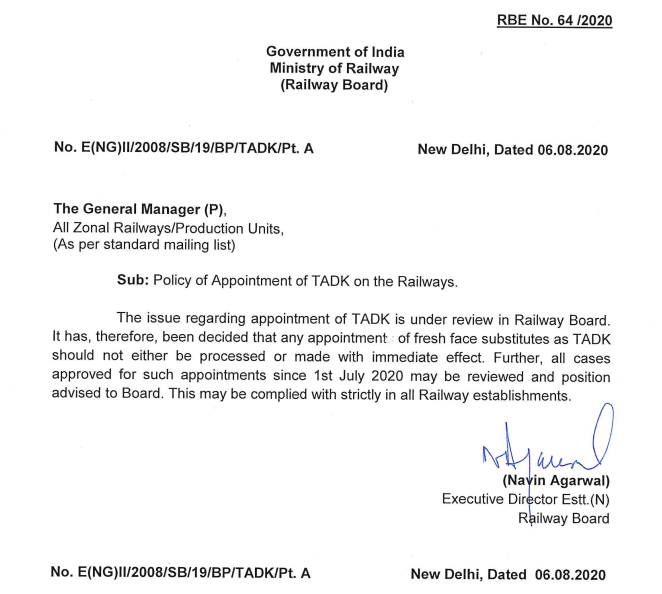
Vide Railway Board’s letter No. E(NG)II/2008/SB/19/BP/TADK/Pt. A, dated 06.08.2020, Railway board issued order on “Policy of Appointment of TADK on the Railways”. This order was to completely ban the appointment of bungalow peons in railways in future.

As per RBE No. 64/2020: The issue regarding appointment of TADK is under review in Railway Board. It has, therefore, been decided that any appointment of fresh face substitutes as TADK should not either be processed or made with immediate effect. Further, all cases approved for such appointments since 1st July 2020 may be reviewed and position advised to Board. This may be complied with strictly in all Railway establishments.

Officer associations represented against the ban on Bungalow peons. And requested Railway board to restore the facility of TADK as per existing practice.

FACT: As on date.There are 4227 Telephone Attendant cum Dak Khalasis (TADK)/Bungalow peons working in Indian Railways

FROA wrote to CEO & CRB for Retention of TADK/ Bungalow Peon

The proposed review of the present selection process of TADK has led to sense of anguish and apprehension amongst the officers fraternity. Zonal federations have requested to continue with the existing system

FROA in its letter to CEO & CRB, requested that the present system of selection of TADKs has been in vogue since long and has several inherent advantages. A TADK selected through the officer concerned imparts a sense of safety, confidence, trust and privacy for the families of the officers.

FROA further mentioned that, this issue should hence be seen not only from the point of view of officers, but also of the welfare and security of their families during course of discharge of officers duties. Moreover, similar selection procedure already exists in several Judicial and Civil administrations.

Representation submitted by South Central Railway officer’s Association

SCROA wrote letter to Chairman of Railway Board to withdraw the letter dated 06.08.2020. Association further requested to restore the facility without making any changes in the engagement process of TADK.

SUB: Policy on appointment of TADK facility attached to the Railway officers.

Ref:  No. RBE No.64/2020: letter no-E (NG)II/2008/SB/19/BP/TADK/Pt. A dt. 06.08.2020.

With reference to above, Railway officers are deeply shocked and anguished over the sudden decision of Railway Board stopping the facility of TADK/Bungalow peon. In this regard, a virtual meeting was held on 07.08.2020 and officers associations have passed the following resolution.

  1. Railway officers, due to the nature of their duties, have to work round the clock i.e. 24 X 7 X 365 days and most of the times, they have to be in the field, i.e. away from their family, either for restoration of works, which are related to safety of the train operations or for commissioning of new projects/works.
  2. Due to round the clock duties, they are not in a position to provide adequate support at their home front. To mitigate the officer’s sufferings to some extent, the facility of TADK has been provided and the system is functioning very smoothly to the satisfaction of the officer availing the facility.
  3. Strong misconceptions exist among various persons regarding TADK facility for the Railway officers with the thoughts of British legacy and luxury etc., A Proper understanding of Railway working system can only enable person to appreciate and understand the real necessity of extending this facility.
  4. The present policy of engagement of TADK is also quite streamlined. Since the officers are away from the family members, especially children, a person, with whom the officer is having the trust & confidence only, can be engaged and any change in the existing system will definitely have devastating effect on the family members of the officers.
  5. Besides this, TADK (Bungalow peons) are SSC qualified and being selected after due verification process of personnel branch and also being inducted in the main stream i.e various departments of Railways in safety category. These TADKs will have at least 4 to 5 yrs of general experience in railway working. Past experience shows that These TADKs are more loyal towards Railway and having feeling of Railway family.
  6. Already, one major decision of merging the cadre of all the Railway services has been taken as a part of ambitious  transformation to bring all the services under one umbrella .i.e. Indian Railways Management Service (IRMS) amidst many apprehensions and officers have not come back to normalcy. That being reality, another decision has been taken unilaterally, without understanding the field necessity of the officers, to abolish the practice of engaging TADK, which is highly  demoralising and dampening the working spirit of the officer’s fraternity.
  7. The facility of the TADK is a minor one when comparing the sacrifices being made by the Railway officers. In fact, there is a demand to extend this facility to all the officers, including Assistant /Junior & Senior scale also, since they also sacrifice similarly.
  8. Every Railway official understands the dire need of the austerity measures in view the financial conditions arisen owing to Covid-19 pandemic and they are sweating a lot to bring the system out of the dire straits. At this stage, stopping this kind of trivial things not only paralyses the officers which will have impact on the administration.
  9. Revenue enhancement and expenditure control can be brought into the system by adopting right suggestions emanating from field, streamlining the procedures and right sizing of the organisation. But, taking up such paltry and unilateral measures have deep impact on officer’s performance and eventually have adverse impact on train working.
  10. The nature of TADK job involves the close interaction with family members of the officer concerned. Hence, the selection process should involve the respective officer as the selected candidate should be loyal and trust worthy while discharging his duties.
  11. Misuse of TADK facilities like other facilities not only by the Railway officials but by other officials is a matter of concern, and is individual choice. Such instances flared up in past in Railways, and for this concern officials have been suitably punished under well established DAR rules.  This type of act by some individual officials   cannot be cited as a reason to curtail the privilege to entire fraternity. Most importantly, rules can be further formed or strengthen to curb such type of wrong practices by the wrong doers. In this regard suggestions may be sought from the officer fraternity.
  12. Finally, Railway services are provided with meagre privilege/facilities like Bungalow peon/TADK service and Pass. These are only minor privileges where talented aspirants in the market are looking at joining in the Railway services.

Also Read Minutes of Meeting of SCROA with FROA held on 22.09.2020

Covering Topics
  1. TADK Issue
  2. Violation of 50:50 Recruitment Rule
    • By Curtailing of Direct Recruitment
    • By Transferring the Group-A Vacancies to Group’B’
  3. Delayed date of Joining of Direct officers effecting DITS and Future Promotion Aspects

Under the circumstances, Railway Board is requested to restore the facility without making any changes in the engagement process of TADK, which will boost the morale of the officer’s fraternity, who are always dedicating their life and services to the betterment of the Railway Organisation.

Submitted   for the   kind consideration please.

President/SCROA

REPRESENTATION SUBMITTED BY EAST CENTRAL RAILWAY OFFICERS ASSOCIATION

Vide letter No. ECROA/2020/Aug-1, Dated: 07.08.2020, ECROA, Hajipur wrote letter to the Chairmen of Railway Board for continuation of existing appointment policy of TADK.

Sub: Continuation of existing appointment policy of TADK on the Railways.

 Officers of ECR have represented and protested against unilateral change in subject matter circulated vide above referred letter. The issues in details are as below:-

  1. Unlike other Central Government offices, nature of the job in Railways warrants availability of officers 24x7x365 & they are required to be on toe on most of the time. It can be illustrated as below:
  • Review of previous day’s performance is presented to the Railway officer in the form of morning position.
  • Co- ordination has to be done with control, officers in the field, supervisors in the frontline and colleagues for the residual problems of the previous day and to plan for the present day otherwise train operations will come to a grinding halt in a matter of days. This entire activity is performed on Railway Telephone, DOT Telephone and now also on the Mobile & may last well above two hours on a normal day.
  • The TADK assists him in all this except in the use of mobile phones. In no other service such a requirement exists on a regular basis. Hence, TADK acts as a substitute to the requirements of camp office set-up. 
  • The TADK assists him in not only sorting out the papers, but also run to control office for delivering and fetching papers & to the houses of other officers and supervisors for this purpose. He often serves the duties of errand for the officers.
  • Railway operations are round the clock and need to be monitored accordingly. The TADK is an unavoidable help to the officer in this entire stretch of back-breaking work. That is the reason the TADK’s working hours are essentially intermittent, i.e. he is available for twelve hours during the day with the officer in the morning, in the afternoon and again in the evening with extended breaks in between. The railway officer, however, continues his work without any rest.
  • Railway officer has to perform several duties in the night including inspections of stations, workshops, yards and trains along with travel on the footplate of a locomotive or on trolleys frequently as a specified assigned duty. He needs an assistant to carry his papers, measuring instruments and implements.
    • A Railway Officer is required to attend to accidents and mishaps including traffic disruptions caused by natural calamities and social unrests for which he often has to move at night and remain at site for days without a break, even foregoing sleep and rest. A TADK needs to travel with him to attend to not only the officer’s needs, but to act as a messenger on the spot, carry his papers and implements etc.  

 As illustrated above, such sudden and unilateral decisions without due consultation with the officer’s bodies, severely affects the morale and motivation of officers at the field level. Moreover, if this facility is withdrawn or nature changed, it may have adverse effect to the serving as well as bright prospective candidates to the Railway service. 

  1. The present appointment policy regarding TADK is quite streamlined. Since TADK has to be with the officer all the time, hence element of personal choice is inevitable for the sake of trust. In case, other mode of selection is adopted then the assigned person may not be having trust of officer and may interfere officer’s work as well as personal affairs. Moreover, the existing system of absorption also renders TADK loyal as it instills sense of secure future for him, thereby maintaining his devotion for the system.
  2. The selection of TADK is subject to official scrutiny at various levels in the Personnel Department and due care is always being taken before personal approval & sanction of GM. 
  3. Appointment of TADK is a completely transparent system, if any malpractice is noticed, the same is investigated by Vigilance and there are instances when officers have been punished. 
  4. The policy is in prevalence since a long time and serving well. Changing the policy at this time when COVID-19 pandemic is spreading gives a feeling of helplessness among officers. Therefore, it is requested to kindly recall the above mentioned letter and restore the previous practice. In case of any change, Officers’ Bodies and Association must be taken into confidence. 

     Submitted for kind consideration please. 

(K.D. Ralh)

President/ECROA & PCE/ECR

Representation submitted by other officer associations

NWROA mentioned in his representation that, the decision taken vide letter referred above is a retrograde step. If this facility is withdrawn or mode of selection is changed then it shall have adverse impact on 24* 7 availability and efficient discharge of the duty by the officers which in turn shall affect the performance of Railways.

The nature of the Job of a TADK spreads into the most private space of the officer. Personal selection ensures that the officer and his family are most comfortable with the individual who has been appointed.

Any previously unknown appointee may not be in concordance with the concerned officer and may not extend the sense of safety and security of the family. As such it would ultimately lose the very functional utility of the TADK. It is also a time verified fact that the TADKs who have been absorbed after their tenure are highly sought after in the field as they are more disciplined, productive and assimilating. This is because they are chosen after due scrutiny based on their most sincere psychological attitude for their duties and rigorously trained for their future job personally by the officer concerned and therefore well acquainted to discharge Railway duties.

It is pertinent to mention that selection of TADK is not an arbitrary procedure, rather there are clearly laid down guidelines including eligibility criteria with completely transparent system.

Representations submitted by RDSO officer association

Officers of RDSO are agitated on this unilateral change in above mentioned policy. A meeting of Officers’ Association of RDSO was held today and issues regarding TADK were discussed in detail. The following resolution has been passed:

  1. Such sudden and unilateral decisions without due consultation with the officer’s bodies, severely affects the morale and motivation of officers. Moreover, it is one of the attractions of the aspirants to join Railway services on preference. If this facility is withdrawn or nature changes, it may have adverse effects on the serving as well as bright prospective candidates to the Railway service.
  2. The present policy regarding TADK is quite streamlined. The person of officer’s choice is being kept at the house. In case, another mode of selection is adopted then the assigned person may not be having trust of the officer and may interfere with the officers work as well as personal affairs and there is a huge chance of the officers family getting suffered.
  3. The selection of TADK is subject to official scrutiny at various levels in the Personnel Department and due care is always being taken before personal approval and sanction of GM.
  4. It is a completely transparent system, if any malpractice is noticed, same are being investigated by Vigilance and there are instances when officers are punished.
  5. The policy has been in prevalence since a long time and serves well, changing the policy at this time when COVID-19 pandemic is spreading is giving a kind of helplessness among officers. Therefore, it is requested to kindly recall the above mentioned letter and restore the previous practice. In case of any change, Officers’ Bodies and Association must be taken into confidence.
  6. As confirmed by your good self that the entitlement of TADK will continue ‘as it is’ through whatsapp message, course correction of the wrong perception created in general public by publicity of above in Newspaper and Social Media, is needed and necessary rejoinder in this regard may also be issued at Railway Board level.

Submitted for kind consideration please.

Read More about…

On Privatisation of Indian Railways…

On Railway Recruitment Boards (RRB)…

On Railway Services and their cadre…

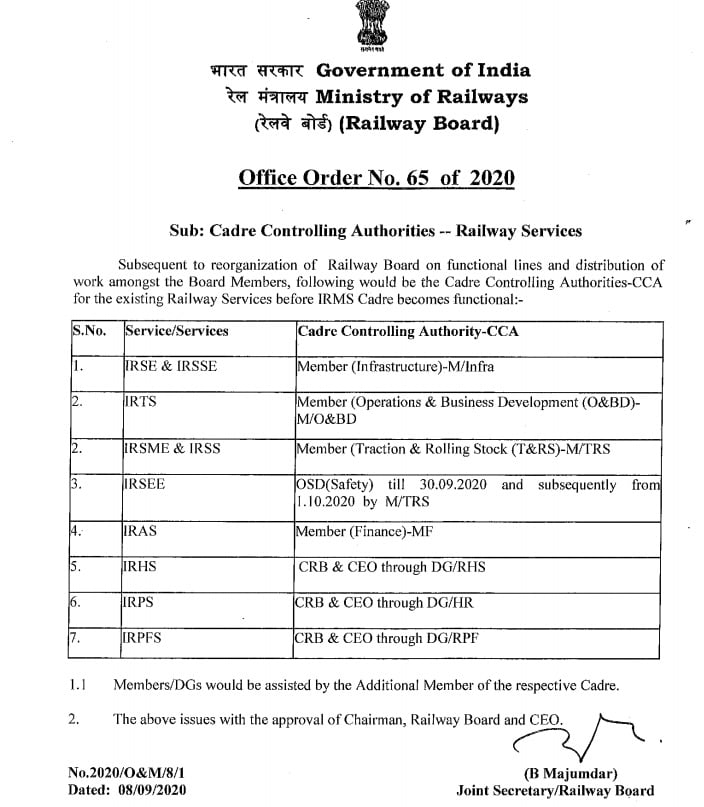
Cadre Controlling after Restructuring, OO. 65 of 2020

Office Order No. 65 of 2020: Cadre Controlling Authorities of Railway Services

Subsequent to reorganization of Railway Board on functional lines and distribution of work amongst the Board Members, following would be the Cadre Controlling Authorities (CCA) for the existing Railway Services before IRMS Cadre becomes functional:-

SN Service Cadre Controlling Authority – CCA
1. IRSE &
IRSSE
Member (Infrastructure)- M/lnfra
2. IRTS Member (Operations & Business Development)
M/O&BD
3. IRSME &
IRSS
Member (Traction & Rolling Stock)
4. IRSEE OSD(Safety) till 30.09.20 &
subsequently 1.10.20 by M/TRS
5. IRAS Member (Finance)-MF
6. IRHS CRB & CEO through DG/RHS
7. IRPS CRB & CEO through DG/HR
8. IRPFS CRB & CEO through DG/RPF
  • Members/DGs would be assisted by the Additional Member of the respective Cadre.

Now, Member/Infra, will head Engineering and S&T departments just like Member Engineering in old days. Member (Operations & Business Development) will be incharge of Traffic department just like Member Traffic. So, these orders are more or less in tune with present structure of top management of Railway board.

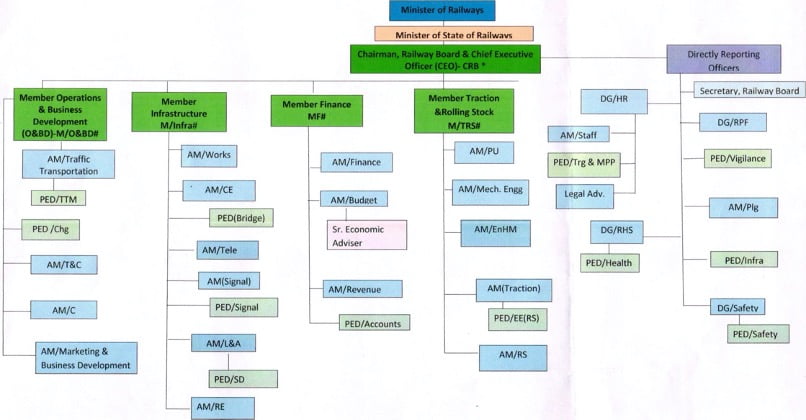
Revised Organisation Structure of Railway Board

Please read in details about revised organisation structure of Railway board in the process of restructuring…click

Read More About…

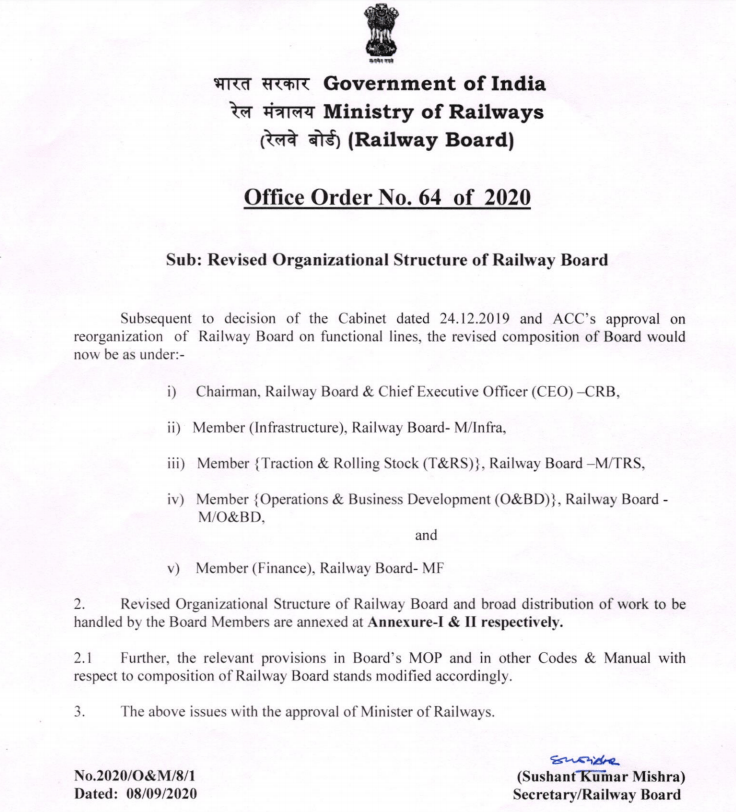
Revised Organizational Structure of Railway Board

Office Order No. 64 of 2020

Subsequent to decision of the Cabinet dated 24.12.2019 and ACC’s approval on reorganization of Railway Board on functional lines, the revised Structure of Board would now be as under:-

  1. Chairman, Railway Board & Chief Executive Officer (CEO) —CRB,
  2. Member (Infrastructure), Railway Board- M/lnfra,
  3. Member (Traction & Rolling Stock), Railway Board —M/TRS,
  4. Member (Operations & Business Development), Railway Board M/O&BD, and
  5. Member (Finance), Railway Board- MF

Revised Organizational Structure of Railway Board and broad distribution of work to be handled by the Board Members are annexed at Annexure-I & Il respectively.

Annexure-I : Organisation Structure of Railway Board
Click on the image to view in full size.
Annexure-II : Broad Distribution of work to be handled by the Board Members
Chairman Railway Board & Chief Executive Officer(CEO)- CRB
  • HR
  • Safety
  • Security
  • Health
  • Planning
  • Infrastructure
  • Vigilance
  • Efficiency & Research
  • Public Relations
  • Heritage
  • Secretary’s Branches
  • Transformation Cell &
  • Corporate Co-ordination
Member (Infrastructure), Railway Board- M/lnfra.
  • Works,
  • Civil Engineering
  • Bridges
  • Signal & Telecom
  • Land & Amenities
  • Station Development &
  • Railway Electrification
Member (Traction & Rolling Stock), Railway Board- M/TRS
  • Production Units
  • Mechanical Workshops
  • Coaches
  • Locomotives
  • Train sets
  • Environment and House Keeping
  • Electrical Maintenance of Coaching Stock
  • Traction Distribution
  • Power Supply &
  • Renewable Energy
  • Materials Management
Member (Operations & Business Development), Railway Board-M/O&BD
  • Traffic Transportation
  • Coaching
  • Tourism & Catering
  • Commercial
  • Non-Fare Revenue
  • Marketing & Business Development &
  • IT
Member (Finance), Railway Board- MF
  • Accounts
  • Finance
  • Budget
  • Revenue,
  • Stat. & Econ &
  • Economic Unit.

Read more About

Vinod Kumar Yadav appointed as CEO, Railway Board

VK Yadav, the current chairman of the Railway Board appointed as first CEO.

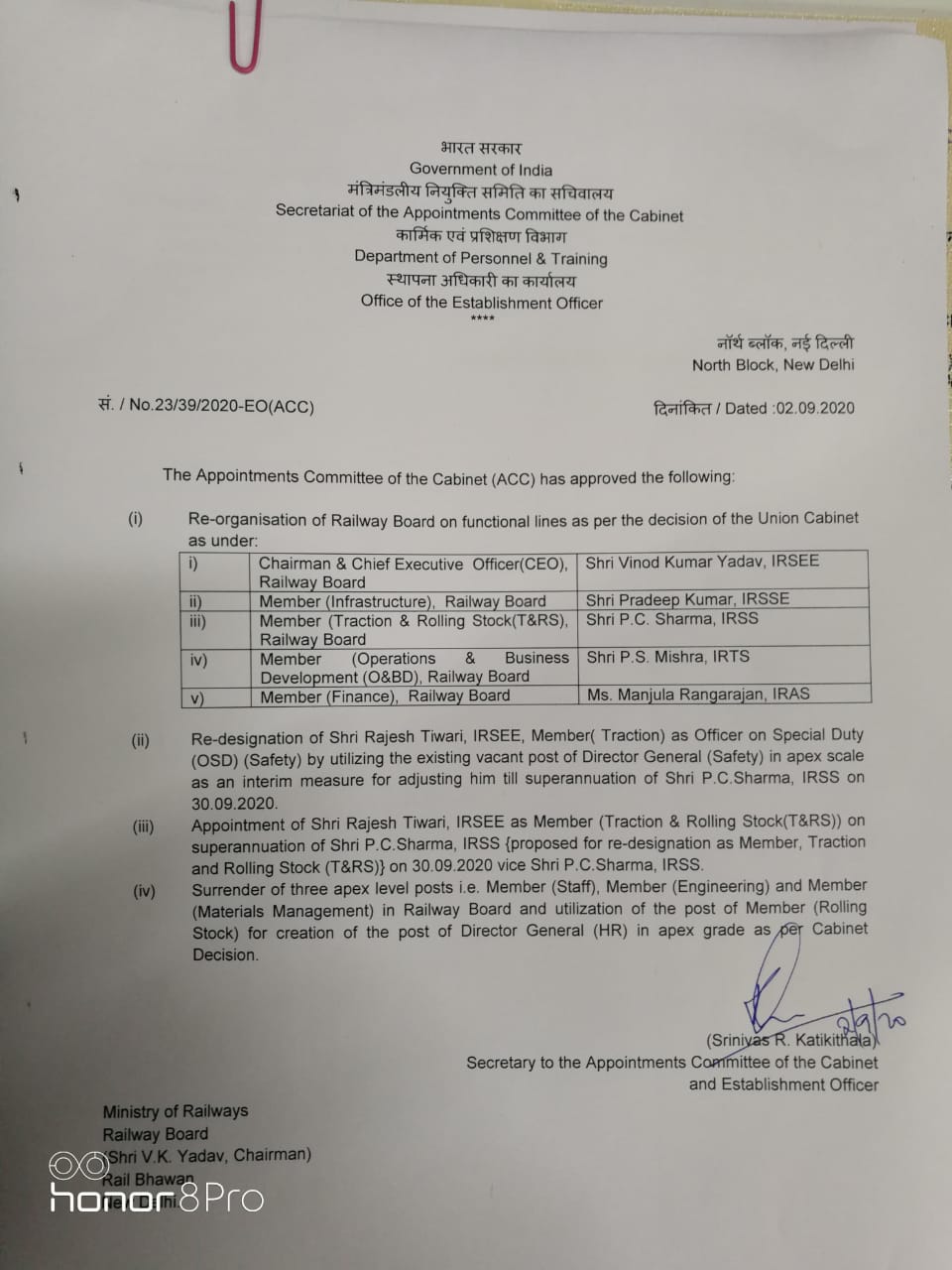
The appointments committee of the cabinet (ACC) on Wednesday (02.09.2020) formally approved the restructuring of the Railway Board and approved the appointment of Vinod Kumar Yadav, the current chairman of the Railway Board as its first Chairman & Chief Executive Officer (CEO), Railway Board.

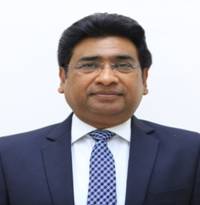
Vinod Kumar YadavJan-1959IRSEE 1980

With this restructuring, Indian Railways will now have only a five member railway board; who will act as “Chief Executive Officer (CEO)” along with four members responsible for Infrastructure, Operations & Business Development, Rolling Stock and Finance respectively.

While Yadav has been appointed Chairman and Chief Executive Officer (CEO); Pradeep Kumar, IRSSE (1981 Batch) has been appointed Member, Infrastructure; PC Sharma, IRSS has been appointed Member, Traction and Rolling Stock; PS Mishra, IRTS has been made Member, Operations and Business Development; Manjula Rangarajan, IRAS has been appointed Member, Finance.


Sri Vinod Kumar Yadav also known as V.K. Yadav is 1980 batch IRSEE officer and current Chairman and CEO of the Indian Railway Board. He is an engineer holding BE in electrical engineering from University of Allahabad’s Motilal Nehru Regional Engineering College (now Motilal Nehru National Institute of Technology, Allahabad) (1980) who later did an MBA from Australia’s La Trobe University (2004).

More about Shri Vinod Kumar Yadav, IRSEE-1980 batch

Earlier, Shri Vinod Kumar Yadav, IRSEE (1980 Batch) was reappointed as Chairman, Railway Board, in the rank of Ex-Officio Principal Secretary to Government of India. The Appointments Committee of Cabinet (ACC) approved the re-employment of Shri Vinod Kumar Yadav as Chairman, Railway Board for a period of one year w.e.f 01.01.2020.

Shri Vinod Kumar Yadav was appointed as Chairman, Railway Board (Ministry of Railways) and ex-officio Principal Secretary to Govt. of India on 01.01.2019. Prior to this assignment, Shri Yadav had worked as General Manager, South Central Railway.

Academic Qualifications

His academic qualifications including a Masters Degree in Business Administration –MBA (Technology Management) from La Trobe University, Australia and a Bachelors Degree in Engineering (Electrical Engineering) from Allahabad University, Uttar Pradesh. He holds immense experience in the fields of Project Management, General Management, Industrial Policy Formulation, Foreign Collaboration & Foreign Direct Investment, Management of Sector Specific International Technical Programmes and Co-ordination of World Bank and Japan International Cooperation Agency (JICA) Funding.

Shri VK Yadav held several important executive and managerial positions

During the course of his illustrious career, Shri Vinod Kumar Yadav held several important executive and managerial positions on Indian Railways and on deputation to various Organizations. In Indian Railways, his assignments included serving as Chief Electrical Engineer, Planning/Traction Distribution, Northern Railway; Divisional Railway Manager, Lucknow Division, North Eastern Railway and Additional Divisional Railway Manager (Operation), Delhi Division, Northern Railway.

Amongst the assignments he held on deputation are – Executive Director, Railway Electrification Projects, Rail Vikas Nigam Limited (RVNL), New Delhi; Group General Manager (Electrical), Dedicated Freight Corridor Corporation of India Limited; Project Director, International Centre for Advancement of Manufacturing Technology at United Nations Industrial Development Organization (UNIDO); he was also Director, Department of Industrial Policy & Promotion, Ministry of Industry, Government of India.

He also held an important foreign assignment as Deputy Manager (Electrical), IRCON at Turkey, where he was instrumental in planning, execution and commissioning of Railway Electrification Project for Turkish Railway.

Shri Vinod Kumar Yadav is recipient of the first ever “Best Transformation Initiative Award” of the Ministry of Railways.

Read More about…

ACC has approved IRMS implementation for Railway Board

The Appointments Committee of the Cabinet (ACC) has approved the IRMS orders

IRMS implementation has started with Re-organisation of Railway Board on functional lines as per the decision of the Union Cabinet as under:

  I.          

Chairman & Chief Executive Officer(CEO). Railway Board

Shri Vinod Kumar Yadav, IRSEE

     II.          

Member (Infrastructure), Railway Board

Shri Pradeep Kumar, IRSSE

    III.          

Member (Traction & Rolling Stock (T&RS) Railway Board

Shri P.C. Sharma, IRSS

   IV.          

Member (Operations & Business Development (O&BD), Railway Board

Shri, P.S. Mishra, IRTS

     V.          

Member Finance Railway Board

Ms. Manjula Rangarajan, IRAS

(ii)        Re-designation of Shri Rajesh Tiwari. IRSEE, Member( Traction) as Officer on Special Duty (OSD) (Safety) by utilizing the existing vacant post of Director General (Safety) in apex scale as an interim measure for adjusting him till superannuation of Shri P.C. Sharma, IRSS on 30.09.2020.

(iii)        Appointment of Shri Rajesh Tiwari. IRSEE as Member (Traction & Rolling Stock(T&RS)) on superannuation of Shri P.C.Sharma, IRSS {proposed for re-designation as Member, Traction and Rolling stock (T&RS)} on 30.09.2020 vice Shri P.C.Sharma, IRSS.

(iv)        Surrender of three apex level posts i.e. Member (Staff), Member (Engineering) and Member (Materials Management) in Railway Board and utilization of the post of Member (Rolling Stock) for creation of the post of Director General (HR) in apex grade as Cabinet Decision.

VK Yadav, the current chairman of the Railway Board appointed as first CEO.

The appointments committee of the cabinet (ACC) on Wednesday formally approved the restructuring of the Railway Board and approved the appointment of VK Yadav, the current chairman of the Railway Board as its first CEO.

Its beginning of Restructuring of the Railway

With this restructuring, Indian Railways will now have only a five member railway board; who will act as “Chief Executive Officer (CEO)” along with four members responsible for Infrastructure, Operations & Business Development, Rolling Stock and Finance respectively.

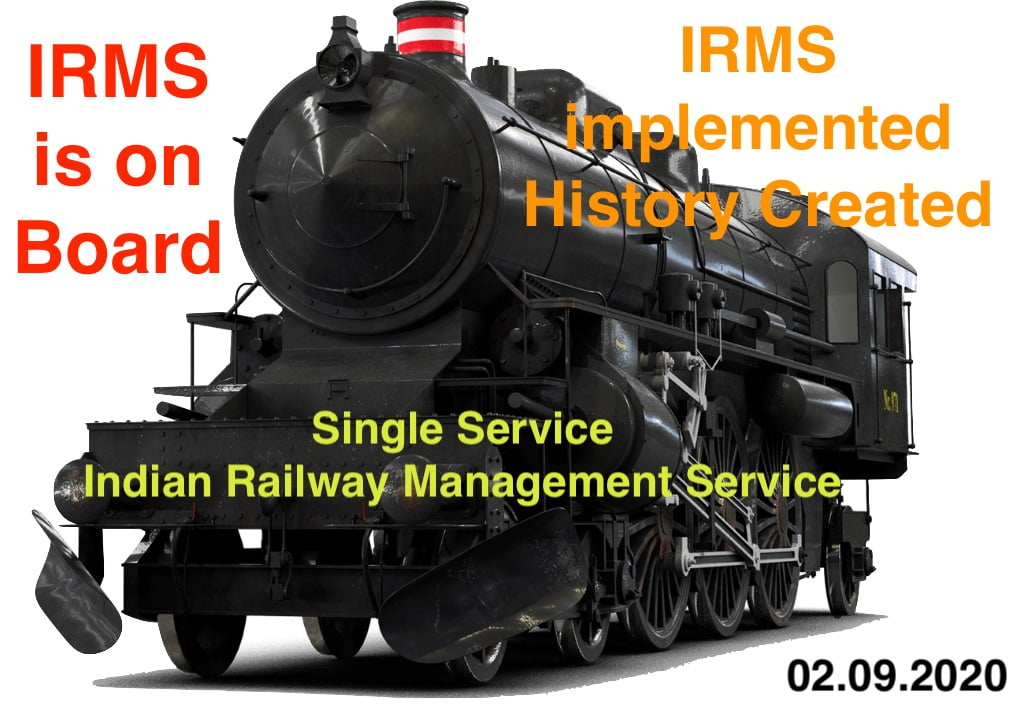
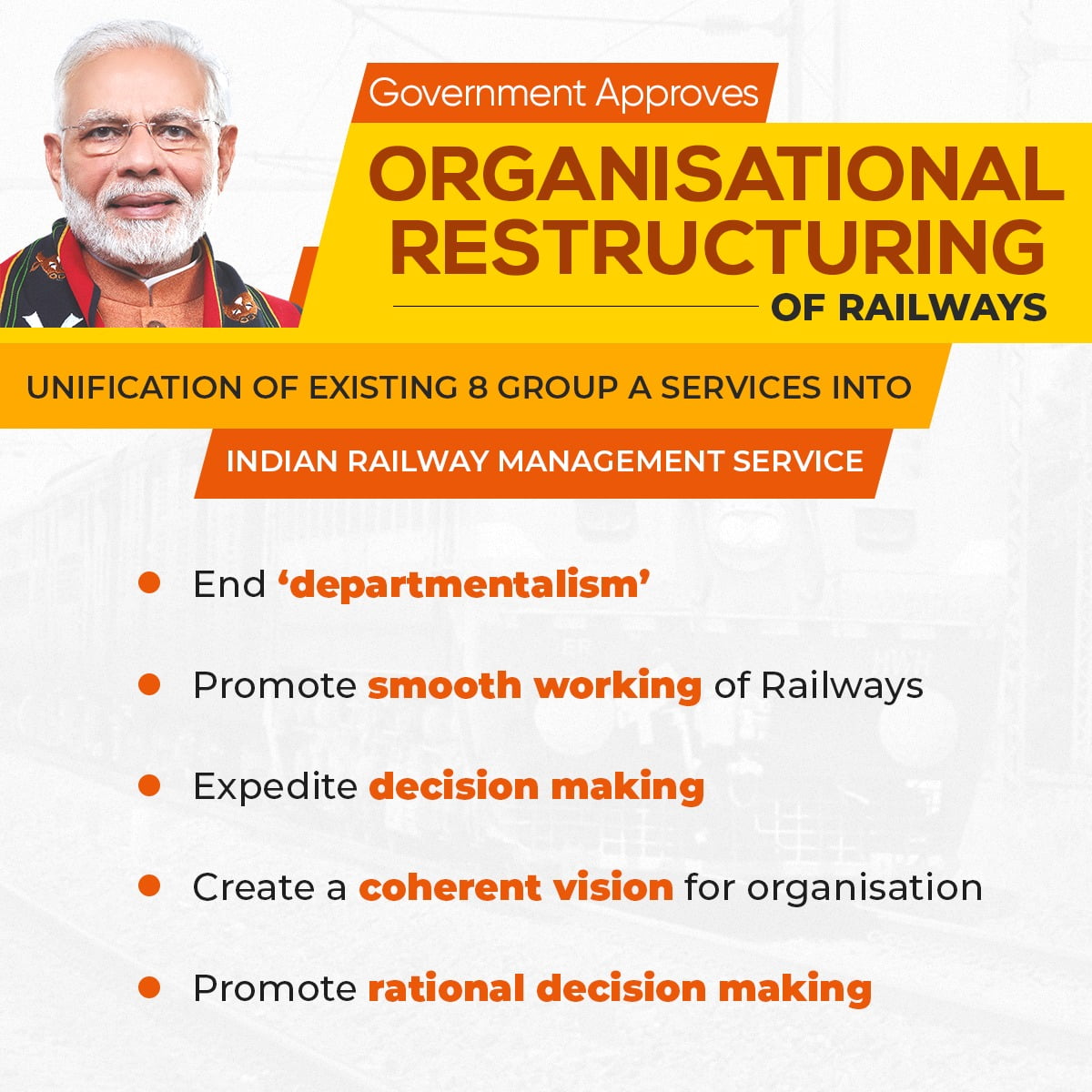
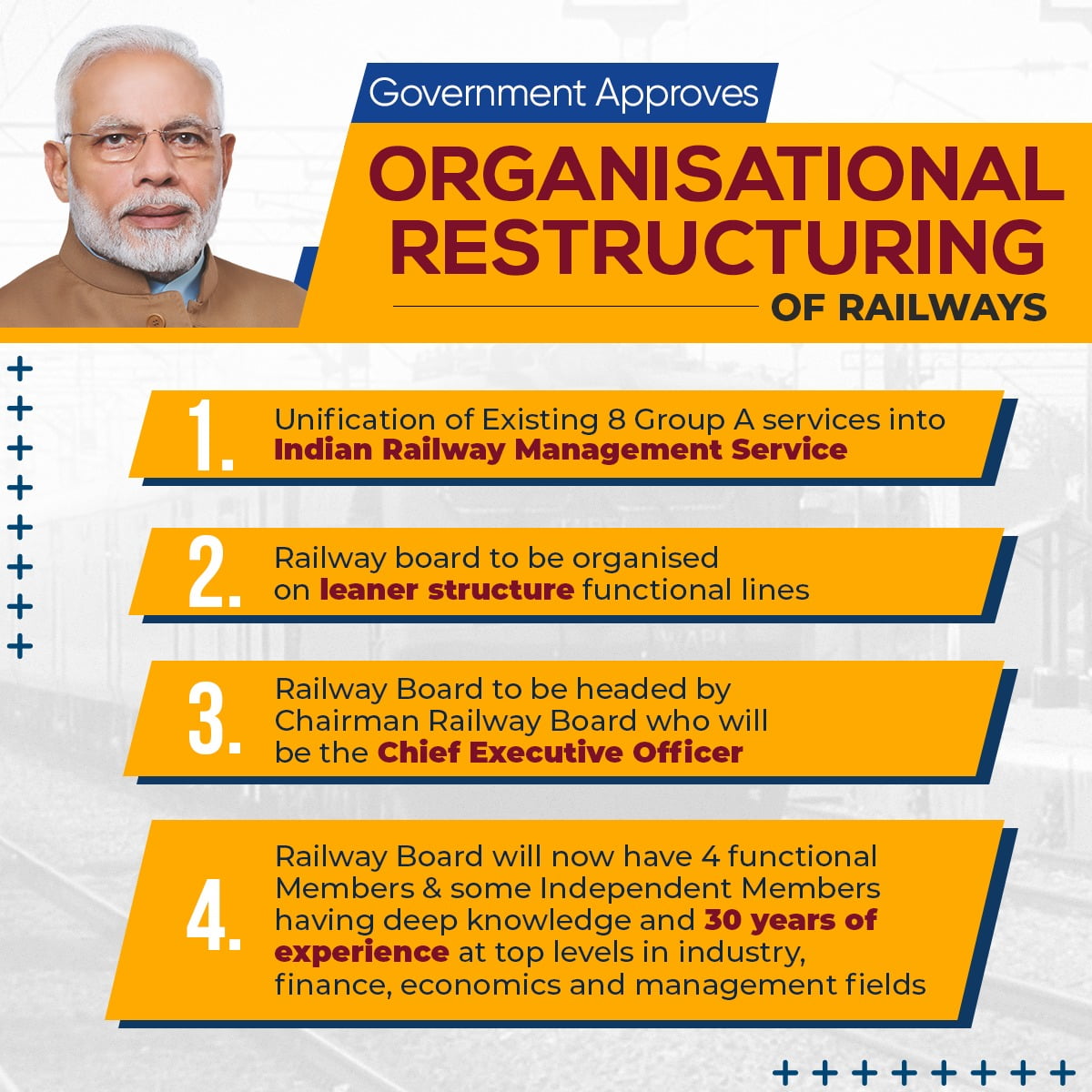
Unification of the existing eight Group A services of the Railways into a Central Service called Indian Railway Management Service (IRMS).IRTS, IRPS, IRAS, IRSE, IRSEE, IRSME, IRSSE & IRSS will be merged and will be called as IRMS.

End of Departmentalism

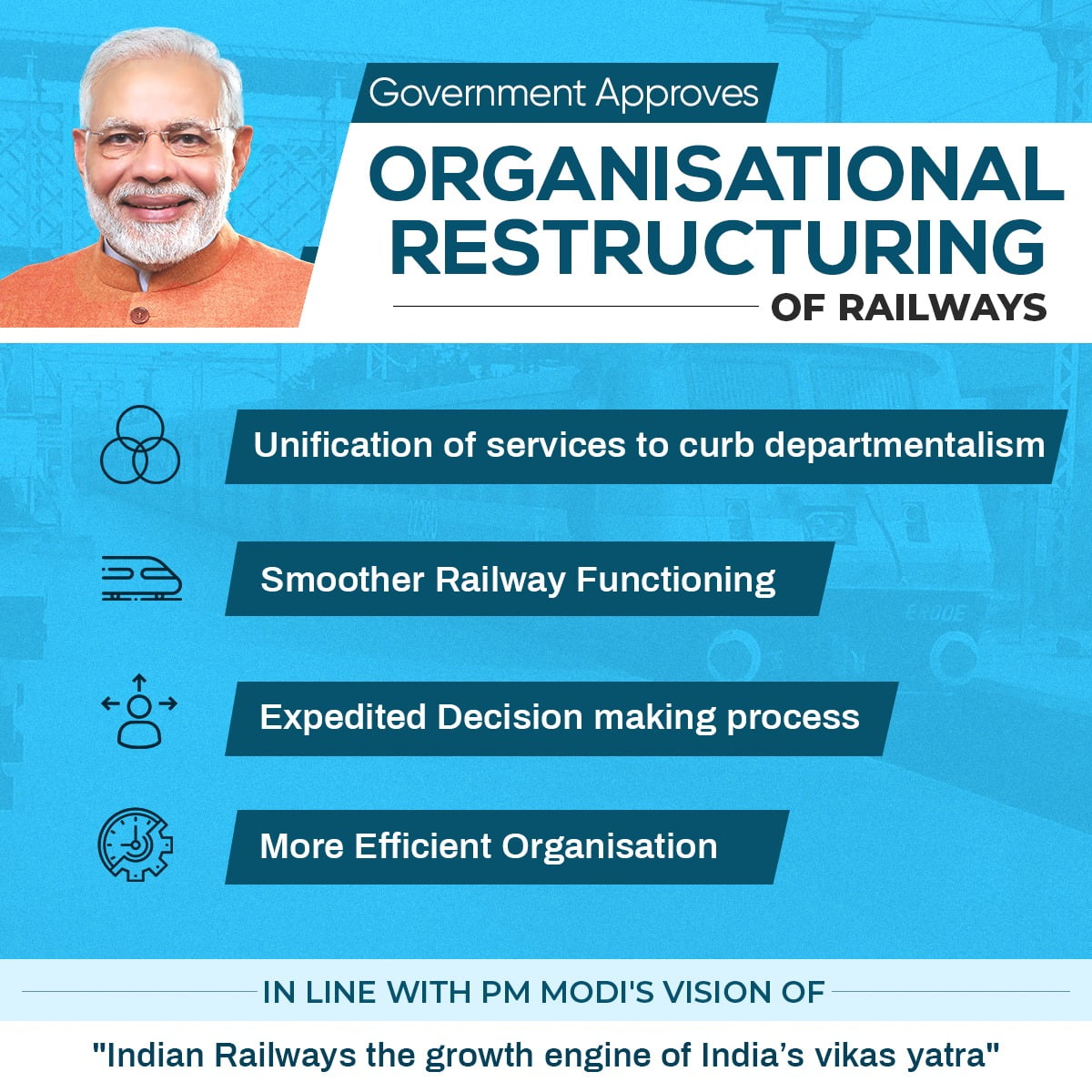
Restructuring of Railway will end departmentalism, promote smooth working of railways, expedite decision making, create a coherent vision for organisation and promote rational decision making.

Railway board will no longer be organised on departmental lines, and replaced with a leaner structure organised on functional lines

Cabinet approves merger of railway cadres

Restructuring of Indian Railways

Unification of the existing eight Group A services of the Railways into a Central Service called Indian Railway Management Service (IRMS).

IRTS, IRPS, IRAS, IRSE, IRSEE, IRSME, IRSSE & IRSS will be merged and will be called as IRMS.

End of Departmentalism

Unification of services will end ‘departmentalism’, promote smooth working of Railways, expedite decision making, create a coherent vision for organisation and promote rational decision making

Railway board will no longer be organised on departmental lines, and replaced with a leaner structure organised on functional lines

Chairman Railway Board will be the Chief Executive officer

Railway Board to be headed by Chairman Railway Board (CRB) who will be the Chief Executive Officer (CEO) with 4 Members and some Independent Members

Unification of services has been recommended by various committees for reforming Railways

Reforms undertaken with overwhelming support and consensus of Railway officers, at a two-day conference “Parivartan Sangoshthi” held on 7th & 8th December, 2019

Other important announcements made by MR

The modalities and unification of the services will be worked out in consultation with DoPT and
Posted On: 24 DEC 2019 4:21PM by PIB Delhi
The Union Cabinet chaired by Prime Minister Narendra Modi has approved a transformational organisational restructuring of the Indian Railways. This historic reform will go a long way in achieving Government’s vision of making Indian Railways the growth engine of India’s vikas yatra.

The reforms include:

Unification of the existing eight Group A services of the Railways into a Central Service called Indian Railway Management Service (IRMS)
Re-organisation of Railway Board on functional lines headed by CRB with four Members and some Independent Members
The existing service of Indian Railway Medical Service (IRMS) to be consequently renamed as Indian Railway Health Service (IRHS)

Railways has an ambitious programme to modernise and provide the highest standards of safety, speed and services to the passengers with a proposed investment of Rs. 50 lakh crore over the next 12 years. This requires speed and scale, and a unified, agile organisation to work single-mindedly on this task and capable of responding to challenges. Today’s reforms are in a series of reforms that have been undertaken under the present Government including merger of Rail Budget with Union Budget, delegation of powers to empower GMs and field officers, allowing competitive operators to run trains etc.

To meet next level challenges and deal with various existing difficulties there was a need to take this step. Unlike Railway systems the world over, which have been corporatized, Indian Railways is managed by the Government directly. It is organised into various departments such as Traffic, Civil, Mechanical, Electrical, Signal & Telecom, Stores, Personnel, and Accounts etc. These departments are vertically separated from top to bottom and are headed by a Secretary level officer (Member] in the Railway Board. This organization of the department runs deep down to the grassroot level of the Railways. Unification of services will end this ‘departmentalism’, promote smooth working of Railways, expedite decision making, create a coherent vision for organisation and promote rational decision making.

Unification of services has been recommended by various committees for reforming Railways including – the Prakash Tandon Committee (1994), Rakesh Mohan Committee (2001), Sam Pitroda Committee (2012) and Bibek Debroy Committee (2015).

This reform has been undertaken with the overwhelming support and consensus of Railway officers, at a two-day conference “Parivartan Sangoshthi” held in Delhi on 7th and 8th December, 2019. To act on this sentiment, and create confidence in Railway officers that their suggestions are valued, Railway Board held an Extraordinary meeting of the Board during the conference on 8th December, 2019 itself, and recommended a number of reforms including the ones mentioned.

It is now proposed to create a unified Group A’ service called “Indian Railways Management Service” (IRMS) from the next recruitment cycle. Creation of the new service will be done in consultation with DoPT and UPSC to facilitate recruitment in the next recruitment year. It will enable Railways to recruit engineers/non-engineers as per need, and offer equality of opportunity to both categories in career progression. The modalities and unification of the services will be worked out by the Ministry of Railways in consultation with DoPT with the approval of Alternate Mechanism to be appointed by Cabinet in order to ensure fairness and transparency. The process shall be completed within a year.

The newly recruited officers will come from Engineering and non-Engineering disciplines as per need and posted as per their aptitude and specialisation to allow them to specialise in one field, develop an overall perspective, and prepare them to take up general management responsibilities at senior levels. Selection for the general management positions shall be through a merit-based system.

Railway board will no longer be organised on departmental lines, and replaced with a leaner structure organised on functional lines. It will have a Chairman, who will act as ‘Chief Executive Officer (CEO)’ along with 4 Members responsible for Infrastructure, Operations & Business Development, Rolling Stock and Finance respectively. The Chairman shall be the cadre controlling officer responsible for Human resources (HR) with assistance from a DG (HR). 3 Apex level posts shall be surrendered from Railway Board and all the remaining posts of the Railway Board shall be open to all officers regardless of the service to which they belonged. The Board will also have some independent Members (the number to be decided by competent authority from time to time), who will be highly distinguished professionals with deep knowledge and 30 years of experience including at the top levels in industry, finance, economics and management fields. The Independent Members will help Railway Board in setting a strategic direction. The restructured Board will start functioning after approval of the Board taking due care to ensure that officers are posted in the restructured Board or adjusted in the same pay and rank till their retirement.

*****

Railway Board to ‘right size’ by transferring 25% officials to zones

There are 200 officials in the Railway Board and Now, Board will transfer 50 officers to the zonal railways to reduce the size and improve the efficiency.

Too many officers are adversely affecting the efficiency

This time Railway Board is seriously rethinking to reduce its size to 150 officials. 25% officers of Director and above levels (50) will be transferred to various zonal railways.

There are too many officers in Board. Thus, to increase the efficiency & right sizing the board, this is much needed step.

This was also the part of Minister Piyush Goyal’s 100-day agenda and a top priority for present Chairman of Railway Board.

Interestingly, the plan was first mooted by the BJP government in 2000 in the leadership of the Atal Bihari Vajpayee, but could not got implemented.

The Bibek Debroy Committee on Indian Railways in 2015

In the past also, the Bibek Debroy Committee on Indian Railways recommended the restructuring of the Board. Overstaffed Railway is adversely affecting the efficiency of the organisation.

Summary of the Bibek Debroy Committee on IR

  • The Committee was constituted on September 22, 2014 to prepare a blueprint for reforming Indian Railways.
  • The Committee submitted its final report in June 2015.
  • Failure of private participation.
  • Need for an independent regulator
  • Financing of Railways is a challenge
  • Restructuring of zones
  • Focus on core activities
  • Accounting reforms

Report Summary

There are many Directors & Members post at the apex level of Railway because board is having many Directorates.

ESE 2018- Allocation of various services

Allocation of Engineering services

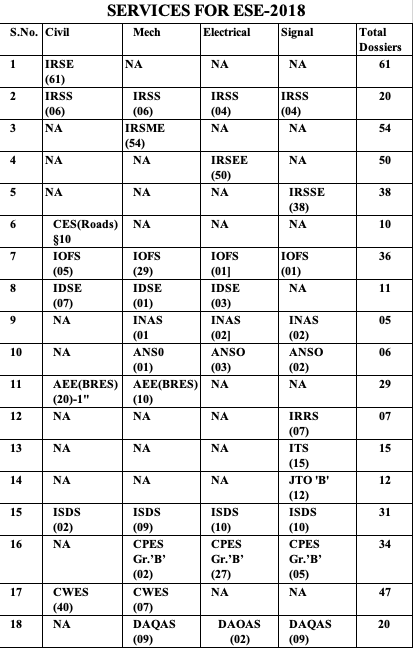
The UPSC has forwarded a list of finally recommended candidates on the basis of Engineering Services Exam 2018. (ESE 2018- commonly known as IES services)

Against a total 583 vacancies indented for various services under four disciplines viz. Civil Engineering, Mechanical Engineering, Electrical Engineering and Electronics and Telecommunications Engineering, the commission had recommended only 511 candidates inclusive of 61 Scheduled Caste (SC), 28 Scheduled Tribes (ST), 122 other Backward Classes (OBC), and 18 Physically Handicapped candidates for appointments to various services/posts.

Complete allocation for all services- click here ESE 2018

Allotment of Railway Engineering Services-

Sr. NO.CivilMechElectricalSignalTotal
1IRSE – 61IRSME-54IRSEE-50IRSSE-38203
2IRSS- 06IRSS-06IRSS-04IRSS-0420

Engineering Services Examination is conducted annually for selection of officers for the engineering services that meet the technical and managerial functions in various fields of Engineering of the Government of India. Like in most countries, the Government of India recruits its civil servants and officials on the basis of merit, and middle management positions in the bureaucracy are filled through competitive exams. Many candidates take these exams, competing for limited posts. IES officers are selected by the union government on the recommendations made by the Union Public Service Commission (UPSC). A combined three-stage competitive examination (Prelims, Mains and Personality test), called the Engineering Services Examination (ESE), is conducted by the UPSC for recruitment to the Indian Engineering Services.

Cadre Review of 8 organized Group ‘A’ Services in Railways

Today (19.02.2019), the Union Cabinet, chaired by the Prime Minister Narendra Modi has approved the proposal for Cadre Review of 8 organized Group ‘A’ Services in Railways namely Indian Railway Accounts Service (IRAS), Indian Railway Personnel Service (IRPS), Indian Railway Traffic Service (IRTS), Indian Railway Service of Engineers (IRSE), Indian Railway Service of Electrical Engineers (IRSEE), Indian Railway Service of Mechanical Engineers(IRSME), Indian Railway Stores Service (IRSS), Indian Railway Service of Signal Engineers (IRSSE).

Cabinet has also approved encadrement of the post of Member(staff) a cadre post for IRPS and re-designation of the posts of Director General (Signal & Telecom), Director General (Stores) and Director General (personnel) as Member(S&T), Member (Materials Management) as Director General (Safety) respectively.

This Cadre Review was pending since 2012 and will benefit 900 officers of these services.

Cadre Structure – Post Cadre Review Cadre

Sr. No.Posts after Cadre Review
1.   IRPS
2.  IRSS
3.  IRAS
4.  IRSSE
5.  IRSEE
6.  IRTS
7.  IRSE
8.  IRSME

Formation of JAG Panel 25.09.2018

RB asking APARs for Batches 2007 & 2008 for JAG confirmation

After Supreme court judgement, the Seniority fixed vide RBE-33/2018 is on the way for implementation.

And RBoard has asked to all Zonal Railways and units for….

In continuation of Railway Board’s letter of even number dated 26.08.18, list of Senior Scale/IRSSE officers who are under consideration for JAG empanelment is attached. It is requested to kindly forward the complete APARs/ APAR dossiers upto March 2018 if due from your Railways. If any officer is shown as working/holding lien on some other Railway in the list but is actual working on your Railway, their APARs/APAR dossiers may also be sent.

2. While forwarding APARs for year ending Mar’09 onwards to Railway Board, it may please be ensured that a copy of the APAR has been given to the officer and the representation, if any, received was disposed of promptly and the decision of the competent authority has been indicated in the APAR. If no representations have been received from the officer within stipulated time, kindly attach the letter for the same.

3. SC/ST Status, DAR position in respect of above officer may also please be sent.

JAG Panels formed by the RB