In R K Kushwaha V/s Railway case, the Supreme court given its final judgment on 07.09.2018, and after reading the court order, it may be concluded that the case was not in favour of Direct officers at all.
<
The Supreme Court dispose of the appeal of Direct recruits by holding that the CAT had only directed that instead of ‘DITS’, the ‘year of allotment’ should be the determining factor/criteria for determining the inter se seniority.
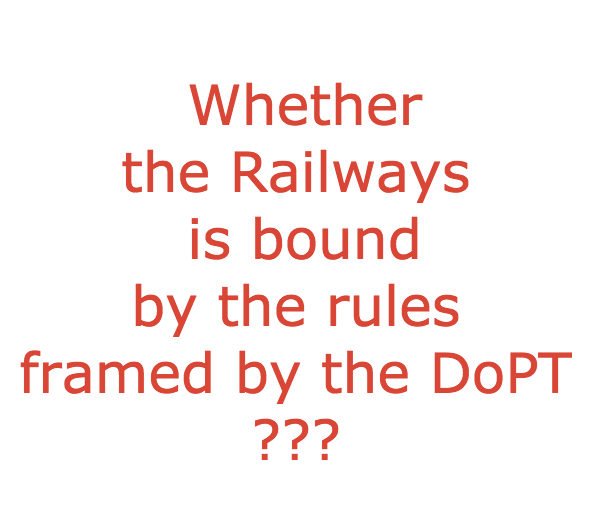
In a legal battle between promotees and direct recruits, most importantly the Supreme Court has said that DoPT Rules don’t apply to Railways. Further, the Court has held that the Railways is not bound by the memorandum issued by the Department of Personnel and Training (DoPT) and are empowered to frame its own rules to lay down the service conditions of its employees.
“We also hold that the IREM has statutory force and has been issued in exercise of powers vested under the proviso to Article 309 of the Constitution.”
The CAT rightly dismissed the contempt petition holding that the entire discussion with reference to N.R. Parmar’s case was regarding removing the arbitrariness due to ‘DITS’ and bringing it in line with the concept of vacancy year/allotment year which does away with the problem.
However, SC has mentioned about Rule 334 several times, and also said that it will not examine it as it was not asked to. It is only because direct recruits had nowhere ever challenged the validity of the rules granting weightage of 5 years service while granting seniority to promotees. Thus, direct recruit can still challenge the Rule 334 of ante dating as it is yet to pass the judicial scrutiny.
Seniority list circulated by board after CAT-Patna order
Another thing which supreme court have mentioned that, the work of promotees before promotion & after viz a viz direct officers are same and due to this reason, they are given antedating seniority.
Download the SC order 22733_2017_Judgement_07-Sep-2018
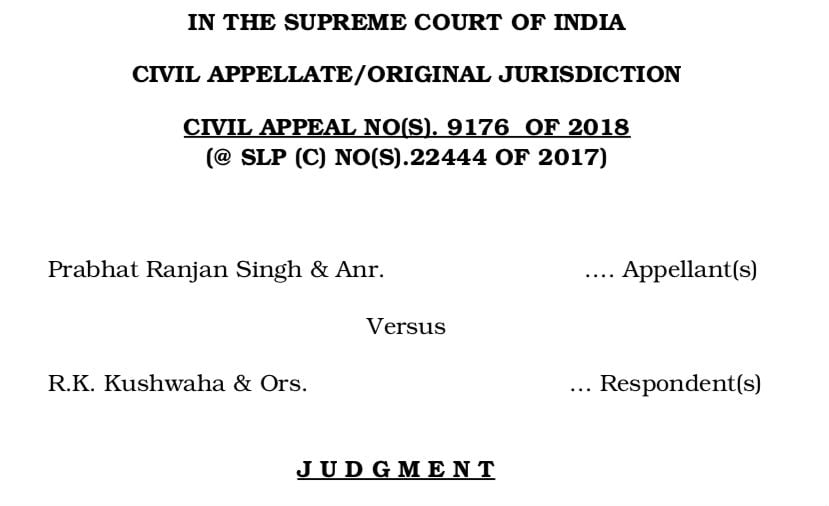
Order of Supreme Court dated 07.09.2018 reproduced below
REPORTABLE IN THE SUPREME COURT OF INDIA
CIVIL APPELLATE/ORIGINAL JURISDICTION
CIVIL APPEAL NO(S). 9176 OF 2018 (@ SLP (C) NO(S).22444 OF 2017)
Prabhat Ranjan Singh & Anr. …. Appellant(s) Versus
R.K. Kushwaha & Ors.
… Respondent(s)
WITH
CONTEMPT PETITION (C) NO. 717 OF 2018
IN SLP (C) NO(S).22444 OF 2017
CONTEMPT PETITION (C) NO. 732 OF 2018 IN SLP (C) NO(S).22444 OF 2017
SLP (C) NO(S). 4144 OF 2018 T.C. (C) No. 52 OF 2018
JUDGMENT Deepak Gupta J.
1. Leave granted in appeal arising out of SLP (C) No(s). 22444 of 2017.
2. This is yet another battle, in the seemingly never ending war between promotees and direct recruits.
3. In the Indian Railways, there is a service known as the Indian Railway Service of Signal Engineers (for short ‘the IRSSE’). This is a GroupA service. Recruitment to the service is by two modes – 50% by direct recruitment and 50% by promotion from amongst GroupB officers in the feeder services. The direct recruits are selected through an examination conducted by the Union Public Service Commission (for short ‘the UPSC’).
4. On 23.10.2007, the Ministry of Railways issued a requisition to the UPSC for filling up vacancies in the GroupA service. The test was to be conducted in the year 2008 and the recruitment was known as the Engineering Services Examination, 2008. Shri R.K. Kushwaha, hereinafter referred to as ‘the direct recruit’, was successful in the said examination. He was duly selected and joined service on 14.12.2009. Some officers, who were working in the GroupB service of the Signal and Telecommunication Department of the Indian Railways were promoted vide order dated 12.08.2014 to GroupA service with effect from 08.05.2014. These officers were given benefit of weightage of 5 years of service rendered in GroupB service in terms of Rule 334 of the Indian Railways Establishment Manual (for short ‘the IREM’), Vol.1 and their relevant date for fixation of seniority was fixed as 08.05.2009.
5. The relevant portion of the order dated 12.12.2014 fixing the seniority of the 87 promotee officers reads as follows:
“2.All the 87 officers will be placed in the seniority list below the junior most direct recruit (DR) IRSSE officer of Engineering Service Examination (ESE) 2007 batch (earliest date of joining 15.12.2008), and above the senior most Direct Recruit IRSSE officers of Engineering Service Examination of 2008 batch (earliest joining 14.12.2009), whose interse seniority has already been circulated.”
Resultantly the promotee officers were placed en bloc senior to all the direct recruits.
6. Shri R.K. Kushwaha, a direct recruit, filed O.A. No. 050/00260/2015 before the Patna Bench of the Central Administrative Tribunal (for short ‘the CAT’) challenging the seniority given to the promotee officers vide order dated 12.12.2014. The petition was disposed of vide order dated 01.04.2015 directing the Chairman of the Railway Board to consider the representation of Shri R.K. Kushwaha dated 19.03.2015 within a period of two months. The Chairman vide speaking order dated 09.06.2015 rejected the plea of Shri R.K. Kushwaha to fix the seniority of the direct recruits from the date of sending of the requisition. According to the Chairman, the seniority of the Junior Scale, GroupA officers of the eight organised railway services including the IRSSE was to be fixed in terms of the provisions contained in the IREM Vol1 which had the approval of the President under Article 309 of the Constitution of India.
7. Shri R.K. Kushwaha thereafter filed a fresh O.A. being O.A. No. 460 of 2015 claiming the following reliefs :
“8.1 That your Lordships may graciously be pleased to quash and set aside the impugned orders dated 09/12.06.2015 passed by the Respondent No.1 together with order dated 12.12.2014 passed by the respondent No. 4 as contained in Annexure A/8 and A/4 respectively which are contrary to the order passed by Hon’ble Supreme Court of India in NR Parmar Case and DOPT OM dated 04.03.2014 as referred to above.
8.2 That your Lordships may further be pleased to direct the respondents to recast the seniority list afresh on the basis of principle laid down by Hon’ble Supreme Court of India in NR Parmar Case and DOPT OM dated 04.03.2014 as referred to above without any further delay.
8.3 That the Respondents further be directed to issue Corrigendum/amendment/Correction slip in Indian Railway Establishment Manual Volume1, henceforth in view of new Guidelines/directives of DOPT OM dated 04.03.2014 as contained in Annexure A/11 which is based on the principle/law laid down by the Hon’ble Supreme Court of India in NR Parmar Case regarding fixation of interse seniority between Direct Recruitees and Promotees Officers.
8.4 That the Respondents further be directed grant all consequential benefits in favour of the applicant including promotion in JA Grade on the basis of his seniority as per the principle laid down by Hon’ble Supreme Court of India in NR Parmar Case and DOPT OM dated 04.03.2014 as referred to above.
8.5 Any other relief or reliefs including the cost of the proceeding may be allowed in favour of the Applicant.”
8. It would be pertinent to mention that none of the promotee officers was made a party in this O.A.. Arguments were heard and judgment was reserved in the matter. Thereafter, Shri Prabhat Ranjan, who was a promotee and also the General Secretary of East Central Railway Promotee Officers Association, East Central Railway at Hajipur filed an application for impleadment. The application was taken up on 05.02.2016 and the same was allowed. The judgment which had been reserved for pronouncement was dereserved and on the same day, the CAT heard all the parties and again reserved judgment. Liberty, however, was given to the parties to file written arguments. The CAT vide its order dated 03.05.2016 partly allowed the O.A.. It rejected the prayer of Shri R.K. Kushwaha that the direct recruits were entitled to get seniority from 23.10.2007 the date on which the requisition for filling up the direct vacancies was sent, on the ground that the case of Union of India vs. N.R. Parmar & Ors.1 was not applicable in as much as the reference to the 1 (2012) 13 SCC 340 year of requisition is always with reference to the vacancy year. If the vacancies are notified well in advance and requisition made earlier to arising of the vacancies, the direct recruits cannot get or claim benefit of seniority from the date of requisition.
9. The case of the direct recruit was that the principle laid down in N.R. Parmar’s case (supra) had been recognized and
implemented by the Department of Personnel and Training (for short ‘the DoPT’) in its circular dated 04.03.2014. As per him, since requisition was issued on 23.10.2007, he should be granted seniority from the said date. The CAT held that the case of the direct recruit that he should be given seniority from 23.10.2007 is not acceptable.
10. In our view, this was, in fact, the only relief claimed by the direct recruit in his O.A. and the matter should have ended there. However, the CAT went on to examine the speaking order passed by the Chairman, Railway Board dated 09.06.2015 and examined the same in the context of the DoPT circular dated 04.03.2014 and the judgment of this Court passed in the N.R. Parmar’s case (supra).
11. The case of the Railways as well as the present appellant, who was the intervener in the O.A. was that their seniority had to be fixed in terms of the IREM Vol1, which provided that the promotees were to be given a maximum of 5 years weightage in terms of Rules 327 to 341. It is not necessary to extract all the rules. It would suffice to note that Rule 328 provided that the seniority of officers appointed to various GroupA services in the Indian Railways shall be determined on the basis of ‘date of increment in the time scale (DITS)’ which is to be determined in accordance with certain laid down principles. In the case of direct appointment, pursuant to an examination conducted by the UPSC, the DITS is to be reckoned from the date of commencement of earning increments in the regular scale. Rule 334 provides that in case of GroupB officers permanently promoted to Group A services, the DITS of the above officers would be determined by giving weightage. The said rule reads as follows:
“334 In the case of Group ‘B’ officers permanently promoted to Junior Scale of Group ‘A’ services:
- (1) xxx xxx xxx
- (2) If two or more than two officers are promoted on the same date, the following method shall be followed to determine their interse seniority within the Railway:
- (i) The relative seniority of officers of each Railway shall be in the order of their position in the panel for that Railway.
- (ii) The DITS of the above officers, shall be determined by giving weightage based on:
(a) the year of service connoted by the initial pay on permanent promotion to Group ‘A’ service; or
(b) half the total number of years of continuous service in Group ‘B’, both officiating and permanent;
whichever is more, subject to a maximum of 5 years; provided that the weightage so assigned does not exceed the total nonfortuitous service rendered by the officer in Group ‘B’.”
12. Before the CAT, it was urged by the Railways and the intervener that N.R. Parmar’s case (supra) was not applicable because weightage of 5 years, as additional years of seniority was to be given to the promotees and in this behalf reference was also made to the Indian Administrative Service (IAS) (Regulations of Seniority) Rules, 1987 wherein also State Civil Service Officers who are inducted into the IAS are given some weightage while fixing their ‘year of allotment’. The CAT held that in the scheme of IAS any vagaries or arbitrariness due to the date when the recruitment process is completed is removed whereas in the railways reference to seniority and inter se seniority on the basis of DITS is subject to unintended delays in the completion of one recruitment process or the other and this may even be due to human manipulation. The relevant portion of the order dated 03.05.2016 of the CAT reads as follows:
“19…….Therefore, the basic philosophy of NR Parmar of removing arbitrariness because of date on which an action is completed with respect to the two streams holds good in this case also. Policy making is within the domain of the Executive, but this has to be reasonable and rational. Since there is obvious scope for arbitrariness in the Railways policy, we have to intervene in judicial review. The Railways must align their policy in consonance with this fundamental philosophy of N.R. Parmar.
20. Another serious anomaly we find from the respondents action is that while the ratio described for the DR and the promotees is 50:50, they have over the years inducted promotees about three times the number of direct recruits. In the representation before the Chairman, Railway Board, the applicant has shown that from the year 2001 to 2007 against 95 direct recruits, 376 promotees have been inducted. The chairman, railway Board has justified this on the ground that as per the government instructions, direct recruitment was curtailed to onethird for those years. Such government instructions cannot alter the basic principle of laid down ratio between the DR and promotes. If downsizing was the objective, this has to be done keeping the ratio between DR and promotees intact. ……..
- xxx xxx xxx
- Thus, the provisions of the IREM determining
inter se seniority based on DITS are clearly flawed and arbitrary. Accordingly, we quash and set aside the impugned orders dated 9/12.6.2015 (Annexure A/8) and date 12.12.2014 (Annexure A/4) being contrary to the underlying principle emerging from the Hon’ble Apex Court judgment in N.R. Parmar case as well as DOPT guidelines in this regard, which mandate that wherever it is considered necessary to follow different principles for inter se seniority, consultation should be made with the DOPT. The respondent are directed to recast the seniority afresh and take necessary action to make corrections in the IREM in the light of the aforesaid observations within a period of four months from the date of receipt/production of a copy of this order.”
13. Shri Prabhat Ranjan Singh challenged the order of the CAT before the Patna High Court by filing Writ Petition No. 10669 of 2016 along with one Shri Girish Kumar. This petition was dismissed vide order dated 12.05.2017 and one of the main grounds for dismissal of the petition was that the circular of the DoPT dated 04.03.2014 was binding on the Railways. The Patna High Court went on to hold that the IREM is not statutory in nature and is only a codified set of guidelines. It further went on to hold that the power of the Railways to frame rules under Rule 201 of the Indian Railway Establishment Code (for short ‘IREC’), which is statutory in nature, is only confined to GroupC and GroupD posts. Therefore, the Railways are bound by the OM issued by the DoPT. This judgment has been challenged by Shri Prabhat Ranjan Singh.
14. It would also be pertinent to mention that pursuant to the direction issued by the CAT on 03.05.2016, the Railways amended Rules 327 to 341 of the IREM Vol1 by removing reference to ‘DITS’ and introduced the concept of ‘year of allotment’. According to the Railways, as per the amended rules inter se seniority between direct recruits and promotees shall be determined and fixed on the basis of ‘year of allotment’ and not on the basis of ‘DITS’. The amendment is applicable in all cases of fixation of inter se seniority of promotee officers from the panel of 20122013 onwards and for Direct Recruit 2006 examination onwards. Thereafter, the seniority has been refixed and only the promotee officers, who have been allotted 2008 as the ‘year of allotment’ have been given seniority over the direct recruits and those promotee officers who have been allotted 2009 as the year of allotment have been ranked en bloc junior to the direct recruits of the year 2009. Thus, the anomaly pointed out by the CAT has been removed and the system which is followed in the IAS is being applied even in the Railways.
15. This development took place on 05.03.2018, during the pendency of this petition. According to the direct recruits, the action of the Railways in placing some of the promotee officers above the direct recruits was violative of the order of the CAT and they, accordingly filed contempt petition no. 050/00070/17 before the CAT which was dismissed vide order dated 02.04.2018. The CAT held that in its order the reference to N.R. Parmar’s case (supra) was regarding removing the arbitrariness due to ‘DITS’ and bringing it in line with the concept of ‘vacancy year/allotment year’, which does away with the problem and the revised policy after amendment fixes the ‘allotment/vacancy year’ for fixing the seniority and not ‘DITS’. It also held that since this Court is seized of the matter, the parties can place their grievance regarding the legality of the revised policy before us. The contempt petition was dismissed.
16. Aggrieved by the order of the CAT, the direct recruit filed writ petition being CWJC No. 6489 of 2018 (R.K. Kushwaha v. Union of India & Ors.) before the Patna High Court for quashing/setting aside the order dated 02.04.2018 passed in the contempt petition. Vide order dated 03.05.2018, we have transferred the aforesaid writ petition to this Court.
17. We have heard learned counsel for the parties. Before us Shri P.S. Patwalia, learned senior counsel for the appellant (Prabhat Ranjan Singh) submitted that the petition has been rendered infructuous in view of the amendment to Rules 327 to 341 of the IREM Vol1. He, however, submitted that the observations made by the CAT and the High Court that the DoPT circulars are binding on the Railways and that the observations of the Patna High Court that IREM has no statutory force are wrong and are liable to be set aside. On the other hand, Shri Mukul Rohatgi and Shri Guru Krishna Kumar, learned senior counsel appearing for the direct recruits submitted that the IREM, which provided for giving weightage in seniority to the promotees, was set aside by the CAT. Therefore, by still continuing to give weightage to the promotees the contemnors have committed contempt of order of the CAT. It has also strenuously been urged before us that the rules which provide for giving weightage to the promotee officers are totally illegal and arbitrary. Shri Maninder Singh, learned Additional Solicitor General submitted that the Railways are empowered to frame their own rules. According to him, even the IREMs are issued with the concurrence of the President of India in terms of Article 309 of the Constitution of India and framed under the Constitution of India.
18. In our view, the following issues arise for decision:
I Whether the Railways is bound by the rules framed by the DoPT or it can frame its own rules and whether the IREM has statutory force?
II Whether Shri R.K. Kushwaha, the direct recruit had laid challenge to the rules, which provide for giving weightage in the seniority to the promotee officers?
III Whether the findings of the CAT in respect of N.R. Parmar’s case (supra) was limited to removing the arbitrariness only in respect of ‘DITS’?
IV Whether by issuing the memorandum dated 05.03.2018 amendment/modifying rules 327341 the Railways have violated the order issued by the CAT?
I Whether the Railways is bound by the rules framed by the DoPT or it can frame its own rules and whether the IREM has statutory force?
19. The CAT, in its order, held that the Railways are bound by the DoPT circulars. The High Court of Patna has gone further and has come to the conclusion that the Railways have no jurisdiction to frame rules for Group A & B services. The High Court has further held that the IREM rules are not statutory in nature and are only guidelines having no binding force. On the other hand learned senior counsel for the UOI has drawn our attention to the Government of India (Allocation of Business) Rules 1961 framed under Clause 3 of Article 77 of the Constitution of India. Under these Rules business has been allocated to different departments. As far as the DoPT is concerned the relevant portion reads as under:
“I. RECRUITMENT, PROMOTION AND MORALE OF SERVICES
1. ……..
2. General questions relating to recruitment, promotion and seniority pertaining to Central Services except Railways Services and services under the control of the Department of Atomic Energy, the erstwhile Department of Electronics, the Department of Space and the Scientific and Technical Services under the Department of Defence Research and Development.
- ………..
- General policy matters regarding classification of
posts and grant of gazetted status in relation to Services other than Railway Services.
5. Recruitment of ministerial staff for the Government of India Secretariat and its attached offices except that for the Department of Railways, the Department of Atomic Energy, the erstwhile Department of Electronics, and the Department of Space.
6. Appointment of nonIndians to Civil posts under the Government of India except posts under the Department of Railways, the Department of Atomic Energy, the erstwhile Department of Electronics and the Department of Space.
xxx xxx xxx
IV. SERVICE CONDITIONS
21. General questions (other than those which have a financial bearing including Conduct Rules relating to All India and Union Public Services except in regard to services under the control of the Department of Railways, the Department of Atomic Energy, the erstwhile Department of Electronics and the Department of Space).
22. Conditions of service of Central Government employees (excluding those under the control of the Department of Railways, the Department of Atomic Energy, the erstwhile Department of Electronics, the Department of Space and the Scientific and Technical personnel under the Department of Defence Research and Development, other than those having a financial bearing and in so far as they raise points of general service interest).
23(a) – (d) ……………
- …………….
- …………….
- …………….
- General policy regarding retrenchment and revision of temporary Government servants except those under the Department of Railways.”
xxx xxx xxx
20. A perusal of the Allocation of Business Rules, 1961, especially the highlighted portion leaves no manner of doubt that the Railways is specifically excluded from the ambit of the scope of business allocated to the DoPT, whether it be for classification of posts, recruitment of ministerial staff, appointment of nonindians to civil posts, fixing of service conditions, including conduct rules, general policy regarding retrenchment and revision of temporary service of the Railways etc., and as such the DoPT cannot issue binding circulars upon the Railways. We may make it clear that if the DoPT issues a circular and the Railways specifically accepts the circular or makes it applicable, then such a circular may apply but if the circular is not made specifically applicable then it has no force so far as the Railways and its employees are concerned.
21. In the same Allocation of Business Rules, 1961 while allocating business to the Ministry of Railways power has been given to it to deal with all matters including those relating to Revenue and Expenditure. Therefore, the Ministry of Railways has the power to lay down conditions of service for its employees.
22. The Ministry of Railways has a set of codified rules known as the Indian Railways Establishment Code (IREC). It is not disputed before us that as far as the IREC is concerned the same is notified under the proviso to Article 309 of the Constitution and is statutory in nature. However, it has been urged on behalf of the direct recruits that IREM does not have any statutory force. It would also be pertinent to mention that the DoPT itself has issued a office memorandum dated 16.02.2018 stating that the matters relating to recruitment, promotion & seniority in respect of Ministry of Railways do not fall within the jurisdiction of the DoPT. We need not refer to all the documents referred to because it is apparent from a bare reading of the Allocation of Business Rules, 1961, that the service conditions of the employees of the Railways are governed by the rules framed by the Railways which will not only include the IREC but also the IREM.
23. Even with regard to the IREM it has been urged by the learned ASG that these rules and the various modifications/amendments issued from time to time to the IREM are also issued under the proviso to Article 309 of the Constitution and as such they have the statutory force.
24. We have gone through the various communications with regard to the IREM and find that all of them make a mention that they have been issued in exercise of powers conferred by proviso to Article 309 of the Constitution. We may specifically refer to only one document, i.e., amendment to the IREM Rules 327 to 341 made in pursuance to the judgment delivered by the CAT on 03.05.2016. The relevant portion of the communication reads as follows:
“………
In exercise of the powers conferred by the proviso to Article 309 of the Constitution the President have further decided that principles for interseseniority of Direct Recruit Group ‘A’ officers and promotee Group ‘B’ officers inducted into Group ‘A’ Junior Scale effective from the panel year 201213, stands modified/amended as per AnnexureI.
………”
This leaves no manner of doubt that the rules under
IREM Vol.1 are also statutory rules.
25. In view of the above, there can be no manner of doubt that the Railways is not bound by the memorandum issued by the DoPT and are empowered to frame its own rules to lay down the service conditions of its employees. We also hold that the IREM has statutory force and has been issued in exercise of powers vested under the proviso to Article 309 of the Constitution.
II Whether Shri R.K. Kushwaha, the direct recruit had laid challenge to the rules, which provide for giving weightage in the seniority to the promotee officers?
26. As far as the second question is concerned we may note that we have already quoted the prayer clause of OA No.460 of 2016 filed before the CAT. In the said OA there is not even a whisper of a challenge to the policy of giving weightage to the promotees. In fact that issue was not raised before the CAT. The case set up by the direct recruits before the CAT was that since the requisition for recruitment had been issued on 23.10.2007, they should be granted seniority from that date in view of the judgment rendered by this Court in N.R. Parmar’s case (supra) read with DoPT OM dated 04.03.2014. It has been urged by Shri Guru Krishna Kumar, learned senior counsel appearing for the direct recruit that prayer 8.3 in which it is prayed that corrigendum/amendment/corrections slip be issued in IREM VolumeI is itself a prayer to quash the said IREM. We are unable to accept this contention. If the direct recruit wanted to lay challenge to the policy of giving weightage to promotees then the basis for the challenge had to be made in the original application and the rule granting such weightage had to be specifically challenged in the prayer clause. The promotees who were liable to be affected should have been arrayed as respondents. Such a challenge cannot be entertained from the back door by merely alleging that corrigendum/ amendments/corrections to the IREM be issued. Neither the corrigendum, nor the amendment or the corrections could result in the quashing of rule granting weightage. Furthermore, if prayer 8.3 is read as a whole, what is prayed is that the correction be made with a view to bring the IREM in line with DoPT OM dated 04.03.2014, which is based on the principle of law framed in N.R. Parmar’s case (supra).
27. We may also note that before us the original application filed by Shri R.K. Kushwaha has been produced in which the main case set up was that in view of the law laid down in N.R. Parmar’s case (supra) the date of sending requisition for filling up the vacancies is the date from which the direct recruits should be granted their seniority. The following averments made by Shri Kushwaha in para 4.3. of his OA are relevant:
“………
4.3 That in this regard it is submitted that while the applicant was working in GroupA service of IRSSE, several GroupB officers i.e. 87 in number has been promoted/inducted in GroupA service of IRSSE vide order dated 12.08.2014 for the panel year 201213 and 201314 w.e.f 08.05.2014, hence such promote officers are entitled to get the benefit of seniority w.e.f 08.05.2009 after giving weightage of 05 years whereas the applicant being Direct Recruitee is entitled to get the benefit of seniority w.e.f 23.10.2007 i.e. from the date of requisition for filling up the vacancies of GroupA service in view of the decision given by the Hon’ble Supreme Court of India in the case of Union of India Vs NR Parmar in which the issue of seniority in between Direct Recruitee and Promotees have been settled on 27.11.2012 against which the Union of India has also filed Civil Review and the same has been dismissed on 07.08.2013. ………”
28. This leaves no manner of doubt that the only case set up by the direct recruit was that he was entitled to seniority from 23.10.2007, the date on which requisition for filling up the direct recruit posts was sent and the promotees after being given due weightage of 05 years were entitled to seniority w.e.f. 08.05.2009. Therefore, he cannot now urge that he had laid challenge to the rule providing for grant of weightage to the promotees.
III Whether the findings of the CAT in respect of N.R. Parmar’s case (supra) was limited to removing the arbitrariness only in respect of ‘DITS’?
29. Before dealing with this issue we may note that we are not at all in agreement with the interpretation sought to be
given by the direct recruits to the decision rendered in N.R. Parmar’s case (supra), that they are entitled to seniority from the date of requisition. On a perusal of the judgment in N.R. Parmar’s case (supra), we find that in that case this
Court was dealing with those situations where the process of either direct recruitment or promotions takes an unduly long time. As per the then existing rules, the persons so appointed/promoted would get seniority from the date when they joined. This Court found that this could lead to arbitrariness on account of the fortuitous date of appointment. In certain cases, the process of recruitment by a particular mode would start much earlier but for extraneous reasons, selection by one mode would be very quick and slow by the other mode. Therefore, to eliminate this anomaly and reduce arbitrariness, this Court laid down that the date of requisition for filling up the posts by a particular recruitment process could be taken as the year to which seniority could be given to persons recruited under that process. However, the Court also clearly laid down that this would apply only if the recruitment year is the same as the year of vacancy. It is obvious that neither the promotees nor the direct recruits can be given seniority from a year when such vacancies do not even exist. The Court also laid down that the administrative authority should ensure that recruitment process should be initiated during the vacancy year itself.
30. In this behalf, we may make reference to the following observations of this Court in the case of N.R. Parmar (supra) :
“34.1. If the process of recruitment has been initiated during the recruitment year (in which the vacancies have arisen) itself, even if the examination for the said recruitment is held in a subsequent year, and the result is declared in a year later (than the one in which the examination was held), and the selected candidates joined in a further later year (than the one in which the result was declared), the selected candidates will be entitled to be assigned seniority, with reference to the recruitment year (in which the requisition of vacancies was made). The logic and reasoning for the aforesaid conclusion (expressed in the ON dated 222000) is, if the process of direct recruitment is initiated in the recruitment year itself, the selected candidate(s) cannot be blamed for the administrative delay, in completing the process of selection.
34.2. The words “initiation of action for recruitment”, and the words “initiation of recruitment process”, were explained to mean, the date of sending the requisition to the recruiting authority.”
31. In the present case though the requisition was sent in the year 2007, the vacancies related to the year 2009 and, therefore, the CAT as well as the High Court rightly held that the direct recruits were not entitled to promotion from the year 2007. The CAT only ordered that the arbitrariness which may arise due to fixation of ‘DITS’ be removed by fixing the ‘year of allotment’ as the relevant criteria.
IV Whether by issuing the memorandum dated 05.03.2018 amendment/modifying rules 327341 the Railways have violated the order issued by the CAT?
32. We have quoted the order of the CAT hereinabove and what the CAT ordered was that the IREM determining the inter se seniority based on DITS was clearly flawed and arbitrary. The order dated 09.06.2015 and 12.12.2014 were quashed and set aside being violative of the judgment of this
Court in N.R. Parmar’s case (supra) and the DoPT guidelines. As held above there was no challenge to Rule 334 which provides for giving weightage to the promotees. This Rule was not challenged directly or indirectly and the CAT has not at all dealt with this Rule. We may add that an identical rule has been held to be valid by this Court in A.K. Nigam vs. Sunil Misra2. This judgment has been noted by the CAT and yet the CAT did not discuss this judgment. It is obvious that the CAT did not go into the validity of Rule 334. All that the CAT held was that instead of the ‘DITS’ being the determining factor to determine the year of promotion, the seniority would be determined with reference to the ‘year of allotment’ following the principle of IAS Rules. The CAT rightly dismissed the contempt petition holding that the entire discussion with reference to N.R. Parmar’s case (supra) was regarding removing the arbitrariness due to ‘DITS’ and bringing it in line with the concept of vacancy year/allotment year which does away with the problem. Thus the CAT itself has clearly held that it had not at all 2 (1994) Supp.2 SCC 245 dealt with the issue whether promotees were not entitled of being granted weightage of 5 years service for determining the seniority. This question never arose before the Tribunal and as such the action of the Railways in amending the Rules to bring them in line with the judgment of the CAT by removing ‘DITS’ as the determining factor for fixing seniority and introducing the ‘year of allotment’ as the criteria for determining the seniority can in no manner be said to be violative or against the order of the CAT. In fact, the said order is totally in line with the order of the CAT.
33. We may add that lengthy arguments have been addressed on behalf of the direct recruits contending that the rule which provides that weightage be given to the promotees is arbitrary and in this regard reference has been made to the judgment of this Court in P. Sudhakar Rao & Ors. vs. U. Govinda Rao & Ors3 and it is urged that in view of this judgment the decision of this Court in A.K. 3 (2013) 8 SCC 693 Nigam’s case (supra) is no longer good law. On the other hand both the learned ASG and the senior counsel for appellants have urged that A.K. Nigam’s case (supra) still holds the field as P. Sudhakar Rao’s case (supra), was a case decided in a fact scenario where there was no provision for granting such weightage. It was also urged that the practice of giving weightage to the promotees in the Railways has been in vogue since 1955 and the railways has justified its action of giving weightage to the promotees by urging that the promotees are doing the same work in the lower post as is being done by them after promotion. Therefore, there is no change in the nature of their work after promotion and the benefit of weightage is given for the experience which they have got for doing such work. It has also been urged that most of the promotees are already getting higher emoluments than are payable to the direct recruits on their induction and this is also a factor taken into consideration for granting this weightage. We are not going into these questions. We have clearly held that there was no challenge to Rule 334 in the original application and such a challenge cannot be countenanced or entertained either in contempt proceedings or on behalf of the respondents while defending the appeal in this Court. We make it clear that we have not expressed any opinion on the rival contentions of the parties on this issue.
34. The situation as on date is that rules have been amended. These rules have to be implemented. Neither the promotees nor the direct recruits have challenged these rules. We are therefore not going into other issues raised by the parties.
35. We dispose of the appeal by holding that the CAT had only directed that instead of ‘DITS’, the ‘year of allotment’ should be the determining factor/criteria for determining the inter se seniority. We further hold that there was neither any challenge to Rule 334 of the IREM Vol. 1 in the original application nor did the CAT go into this issue. We, accordingly uphold the order dated 02.04.2018 passed by the CAT, Patna Bench dismissing the contempt petition filed by the direct recruit Mr. R.K. Kushwaha. Consequently, the Transferred Case No. 52/2018 i.e. Writ Petition being CWJC No. 6489/2018 before the Patna High Court is dismissed.
36. Applications for intervention/impleadment are rejected.
37. The contempt petitions and all pending applications shall also stand disposed of. SLP (C) NO(S). 4144 OF 2018
38. This petition is directed against the interim order dated 29.01.2018 passed by the High Court of Madhya Pradesh, Principal Bench at Jabalpur in Writ Petition No. 299 of 2018. The petition itself has been finally disposed of by the High Court vide order dated 20.03.2018 and, therefore, this petition is rendered infructuous and disposed of as such.
New Delhi September 07, 2018
………………………..J. (Madan B. Lokur)
………………………..J. (S. Abdul Nazeer)
…………………………J. (Deepak Gupta)