Notice: Function WP_Scripts::localize was called incorrectly. The $l10n parameter must be an array. To pass arbitrary data to scripts, use the wp_add_inline_script() function instead. Please see Debugging in WordPress for more information. (This message was added in version 5.7.0.) in /home4/railmu7v/public_html/wp-includes/functions.php on line 6170
Notice: Function WP_Scripts::localize was called incorrectly. The $l10n parameter must be an array. To pass arbitrary data to scripts, use the wp_add_inline_script() function instead. Please see Debugging in WordPress for more information. (This message was added in version 5.7.0.) in /home4/railmu7v/public_html/wp-includes/functions.php on line 6170
Notice: Function WP_Scripts::localize was called incorrectly. The $l10n parameter must be an array. To pass arbitrary data to scripts, use the wp_add_inline_script() function instead. Please see Debugging in WordPress for more information. (This message was added in version 5.7.0.) in /home4/railmu7v/public_html/wp-includes/functions.php on line 6170
Notice: Function WP_Scripts::localize was called incorrectly. The $l10n parameter must be an array. To pass arbitrary data to scripts, use the wp_add_inline_script() function instead. Please see Debugging in WordPress for more information. (This message was added in version 5.7.0.) in /home4/railmu7v/public_html/wp-includes/functions.php on line 6170
Skip to content
The Indian Railway Service of Signal Engineers (IRSSE) is a prestigious Group A Gazetted cadre of the Government of India. The cadre is managing the Signal & Telecom department and its operations of the Indian Railways.
Here is the updated Seniority List of Indian Railway Service of Signal Engineers (IRSSE), Directly Recruited (DR) officers, moreover, the list is update as of Nov 2025.
Starting from the UPSC batch 1979 upto probationers of batch-2019, information of the all the IRSSE batches is provided here below. Best of our efforts has been made to update the information and to provide the correct information. Hope you may find it important and helpful. Some of the batches are too short as 2 officers only and some are as big as more than 30 members. so, based on the requirement recruitment of officers has been done by UPSC.
On Indian Railways, new high speed lines are being laid to cater for demand of increasing traffic density. In various Zonal Railways high speed turnouts with thick web switches are being installed.
Salient features of TWS
The switch opening is of 160 mm as against of 115 mm of ordinary cross over.
The crossing angle has been broadened so that the train negotiating at higher speeds does not pose any danger.
The web of the switches is made thicker to make than them strong enough to withstand load of train at high speeds.
Thick Web Switches
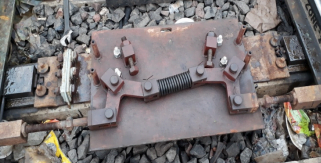
Spring setting device (SSD)
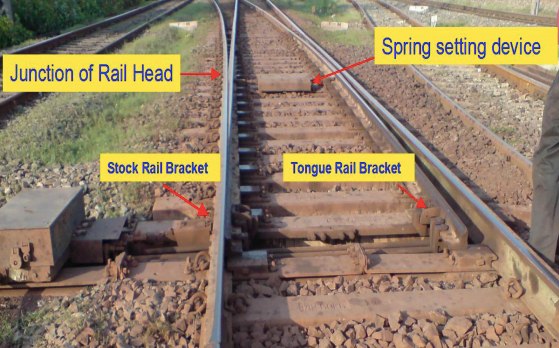
In a TWS turnout, no stretcher bar is used and hence switches are able to move independently.
A spring setting device (SSD) is provided at junction of Rail head (JOH), in lieu of stretcher bars, to assist in proper setting of switch upto JOH, which is placed between sleeper number 13 and 14.
Adjustment of locking is done by means of packing shims between switch rail and stock rail bracket. Three each of 1 mm and one of 0.5 mm shims are provided for each switch.
Joint Inspection of Points & Crossings (Thick-Web Switches)
Recently, some of the railways have raised certain issues related to maintenance of Thick Web Switch (TWS) turnouts and Track circuit insulation problems which involved issues pertaining to Track maintenance as well as signalling.
The final proforma for Joint Inspection of Points & Crossings of Thick Web Switches incorporating the suggestions by Track & Signal Directorates of RDSO is enclosed herewith. Download the Proforma.
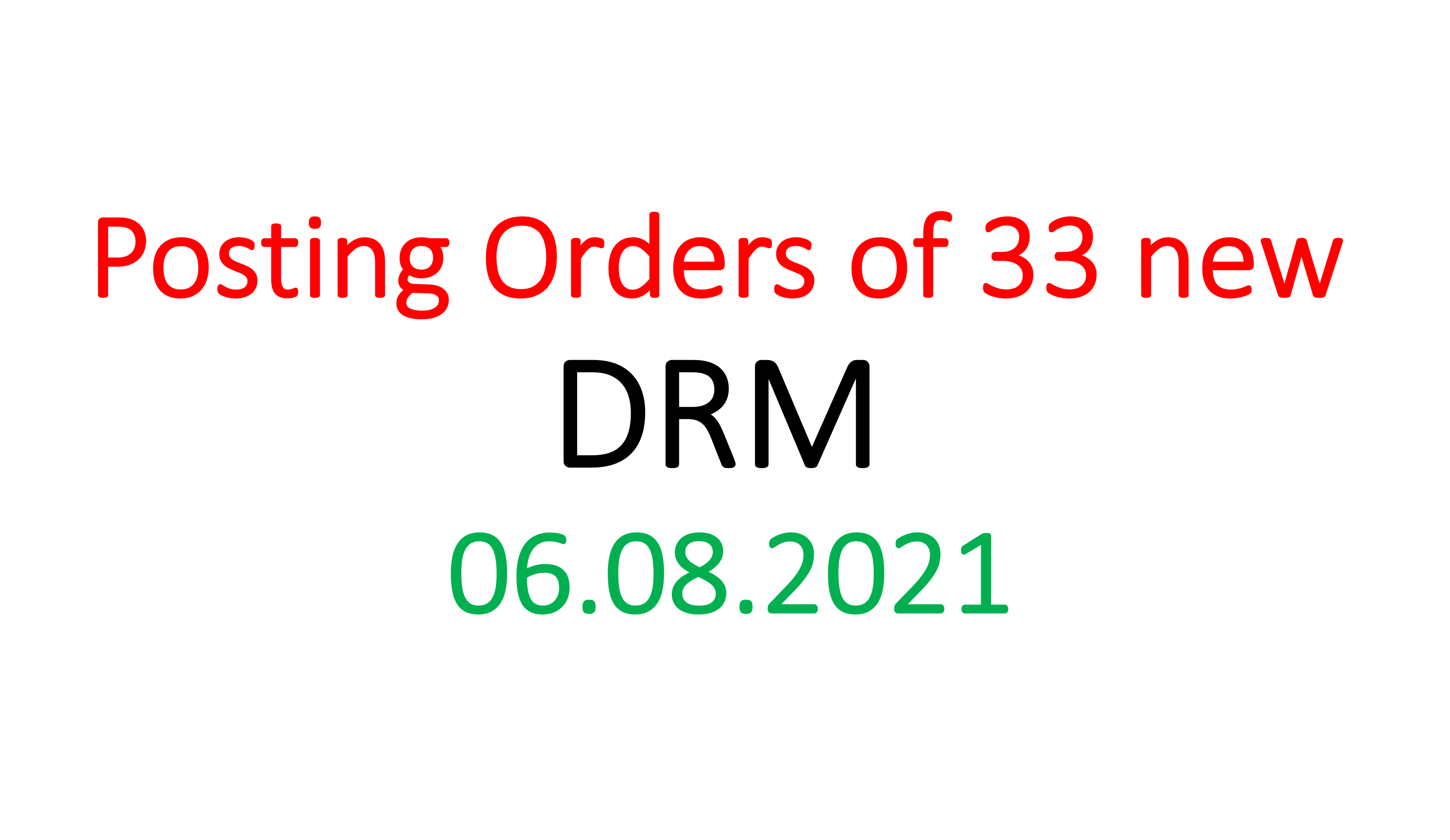
The Railway Board has issued orders to appoint 33 new Divisional Railway Managers (DRM) out of its 68 divisions. The details of new DRM postings are as follows:
Signalling System enhances safety in train operations. Upgradation and replacement of equipments in use over Indian Railways is a continuous process and is undertaken based on its condition, operational needs and availability of resources.
Major steps taken for Modernisation of Railway Signalling Systems
In order to further improve safety in train operation and generate additional line capacity, modernisation of Signalling System has been taken in hand. Following major steps have been taken,
6084 (96% of total Stations) Stations on Indian Railway have been equipped with modern Electrical/Electronic Signalling Interlocking System up to 29.02.2020.
Electronic Interlocking are being adopted on a large scale to derive benefits of digital technologies in train operation and to enhance safety. So far 1913 stations have been provided with Electronic Interlocking upto 29.02.2020.
Axle Counters for Automatic clearance of Block Section (BPAC) are provided to ensure complete arrival of train without manual intervention before granting line clear to receive next train and to reduce human element. These systems have been provided on 5661 block sections upto 29.02.2020.
In order to increase line capacity to run more trains on existing High Density Routes of Indian Railways, Automatic Block Signalling is a cost effective solution. As on 29.02.2020, Automatic Block Signalling has been provided on 3207 Route km.
Enhancing Safety at Level Crossing Gates has been a major area of concern. Safety gets enhanced by interlocking level crossings with Signals. Indian Railways have provided interlocking with Signals at 11622 Level Crossing Gates to enhance the safety at Level Crossings as on 29.02.2020.
Modernisation of Signalling System is proposed to be taken up on High Density Routes of Indian Railways including Golden Quadrilateral (GQ) and Golden Diagonal (GD) Route. The work includes provision of Modern Train Control System.
As a prelude to modernisation work of signalling system on Indian Railways, four works totaling 640 Route km at total cost of ₹ 1,609 crores have been sanctioned in Supplementary Works Programme 2018-19 in following sections for extensive trials,
Tenders for the works have since been opened and are under evaluation.
Two works of Raising of speed to 160kmph on existing New Delhi – Howrah and New Delhi – Mumbai routes have been sanctioned including modernisation of Signalling and detailed estimates are under preparation.
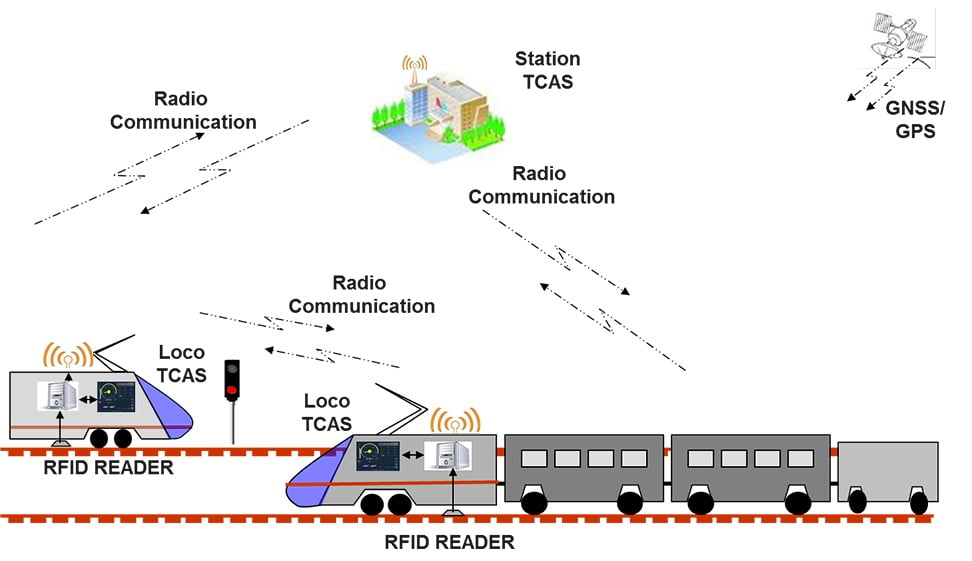
An indigenous Automatic Train Protection (ATP) System namely Train Collision Avoidance System (TCAS), has been developed by Indian Railways in association with Indian manufacturers. The system has been installed on Lingampalli – Vikarabad – Wadi & Vikarabad – Bidar section (250 Route km) of South Central Railway.
Further contract have been awarded for Train Collision Avoidance System (TCAS) works on additional 1199 Route km on South Central Railway.
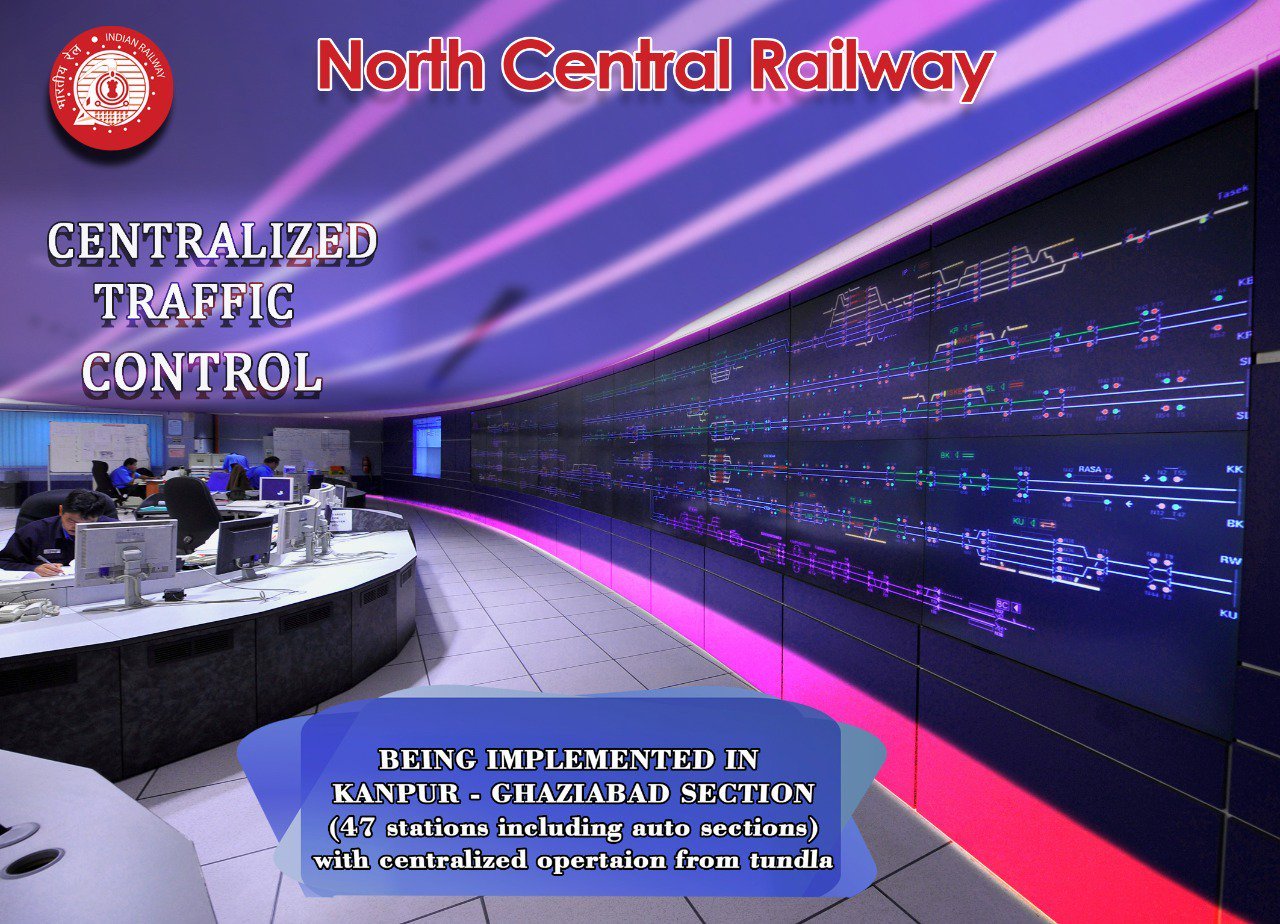
Works for implementation of Centralized Traffic Control (CTC) System to improve line capacity and efficient management of train operations from a central location covering large sections, have also been taken up.
The CTC at Tundla is operational covering 26 stations and 250 Route Km on Aligarh-Kanpur section.
Works for 12 CTCs have also been sanctioned on 8 Zonal Railways (Eastern Railway, Central Railway, Northern Railway, North Central Railway, South Eastern Railway, South East Central Railway, Southern Railway and Western Railway) covering 1829 Route Km.
Train Management System (TMS) on suburban section in Howrah Division of Eastern Railway has been commissioned on 15.11.2019 duly integrating with Control Office Application (COA) for real time train running information and chartings. It covers 22 stations over 74 Route km.
TMS work on Khurda Road Division of East Coast Railway is in progress. It covers 864 Route km with 104 stations on entire Divisions.
A work of provision of TMS for Delhi area has been sanctioned at a cost of Rs 71 CR in the works programme 2019-20.
This technological upgradation and modernisation of railway signalling systems en-route will pave safer, faster, efficient and more punctual train operations on Railway Network.
Entire GQ-GD route over South Central Railway, now fit to run at 130 Kmph Speed
A total of 2824 Kms (including Up &Down Lines) over South Central Railway Zone is now fit to run at 130 Kmph speed.
Indian Railway has started the New Year 2021 by achieving a landmark achievement by drastically enhancing the maximum speed to 130 kmph for 1,280 km length out of 1,612 Km in Golden Quadrilateral – Golden Diagonal (GQ-GD) route.
This covers the entire GQ-GD route over South Central Railway, except Vijayawada – Duvvada section, where signalling up-gradation work is in progress.
The enhanced speed limits could be achieved due to the systematic and planned strengthening of track & its infrastructure by removing bottlenecks in these sections on a fast pace. This included heavier rails, laying of 260 meters Long welded rail panels, improvement of curves and gradients among others.
Based on these improvements done by the Zone, the RDSO/Lucknow conducted oscillation trials through Confirmatory Oscillograph Car Run (COCR) consisting of instrumented coaches of all classes at 130 Kmph speed during July and October last year. During this check, in addition to track parameters, other areas like Signalling aspect, Traction distribution equipment, Locomotive& coach fitness were also checked and recorded.
Accordingly, the South Central Railway zone has received sanction to enhance the maximum speed limits to 130 kmph along the following routes:
1. Golden Diagonal (Grand Trunk) Route: 744 Route Km
i. Ballarshah to Kazipet – 234 Rkm
ii. Kazipet-Vijayawada-Gudur – 510 Rkm
2. Golden Quadrilateral Route (Chennai -Mumbai section): 536 Route Km
i. Renigunta to Gooty – 281 Rkm
ii. Gooty to Wadi – 255Rkm
Already, the maximum speed limits in the High-Density Network (HDN) between Secunderabad – Kazipet (132 Kms distance) had been enhanced to 130 kmph. Source: PIB
As such, including both the Up and Down lines in these sections, a total of 2,824 kms (1412Rkms) has now been made fit to run at a speed of 130 kmph. This covers the entire GQ-GD route over SCR, except Vijayawada – Duvvada section, where signaling up-gradation work is in progress.
It is noteworthy that despite COVID pandemic, Indian Railways has witnessed an unprecedented growth in development of infrastructure, innovation, capacity expansion of network, freight diversification. Railways has used covid challenge as an opportunity to lay the foundation for future development and next level of traveling experience for passengers.
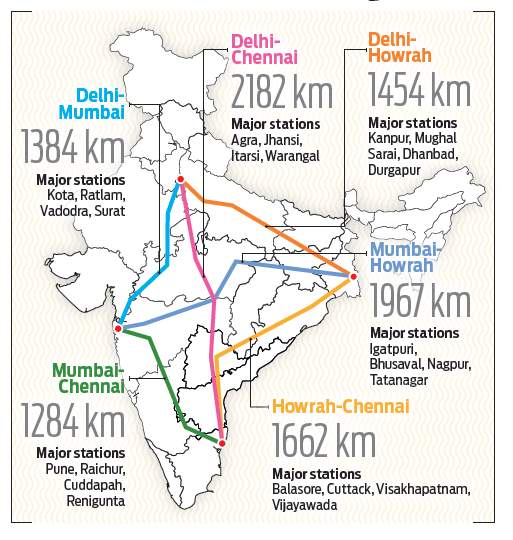
The Golden Quadrilateral & Golden Diagonal (GQ /GD) Routes are –
New Delhi – Mumbai (1384 Km) via Mathura and Vadodara
New Delhi – Chennai (2182 Km) via Nagpur, and Vijayawada
New Delhi – Howrah (1454 Km) via Kanpur and Dhanbad
Howrah – Chennai (1662 Km) via Visakhapatnam
Mumbai – Chennai (1284 Km) via Wadi and Renigunta
Mumbai – Howrah (1967 Km) via Nagpur
Length wise New Delhi – Chennai (North to South) is Longest route i.e 2182 Km, and Mumbai – Howrah (West to East) is Shortest route i.e. 1284 Km.
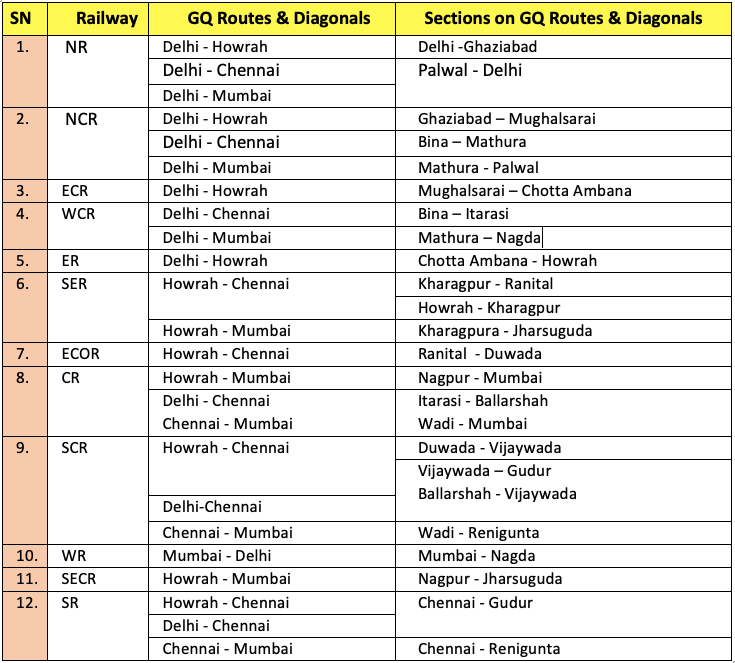
Railway wise Details of Sections on Golden Quadrilateral & Golden Diagonal Routes
Modernisation of Signalling System
Modernisation of Signalling System is proposed to be taken up on High Density Routes of Indian Railways including Golden Quadrilateral (GQ) and Golden Diagonal (GD) Route. The work includes provision of Modern Train Control System.
As a prelude to modernisation work of signalling system on Indian Railways, four works totaling 640 Route km at total cost of ₹ 1,609 crores have been sanctioned in Supplementary Works Programme 2018-19 in following sections for extensive trials,
Group ‘B’ Final seniority list as on 01.04.2018 & 01.01.2019
Railway Board, vide letter No. E(GP)2013/1/31 dated 23.12.2019, asked Zonal Railways/PUs’ for seniority lists of Group ‘B’ officers of organised services as on 01.04.2018 & 01.01.2019 for promotion to Group ‘A’. But, required seniority list of railway officers have not yet been furnished from most of the Railways so far.
Page updated on 08.10.2020…
As on date, Final seniority list of railway officers has been issued only for Traffic, Accounts, Personnel and S&T departments.
Based on these seniority lists Group ‘B’ officers are promoted to Group ‘A’ services. Group ‘A’ officers are directly recruited by the Union Public Service Commission (UPSC), and Group ‘B’ officer are promotee officers from Group ‘C’ staff.
S&T Department: Final seniority list of Group ‘B’ officers of Indian Railway
The provisional integrated seniority lists of Group ‘B’ officers of Signal & Telecom department of Indian Railways as on 01.04.2018 and 01.01.2019 were issued by Railway Board on date 11.08.2020. In response thereto, several representations were received which were examined. Also certain discrepancies have been pointed by some of the Railways. Accordingly, necessary corrections have been carried out.
The final seniority list as on 01.04.2018 (Annexure-I) and 01.01 2019 (Annexure-II) are enclosed for immediate circulation.
Traffic Department: Final seniority list of Group ‘B’ officers of Indian Railway
The provisional integrated seniority lists of Group ‘B’ officers of Traffic Department of Indian Railways as on 01.04.2018 and 01.01.2019 were issued by Railway Board on date 23.07.2020. In response thereto, several representations were received which were examined. Also certain discrepancies have been pointed by some of the Railways. Accordingly, necessary corrections have been carried out.
The final seniority list as on 01.04.2018 (Annexure-I) and 01.01 2019 (Annexure-II) are enclosed for immediate circulation.
Accounts Department: Final seniority list of Group ‘B’ officers of Indian Railway
The provisional integrated seniority lists of Group ‘B’ officers of Accounts Department of Indian Railways as on 01.04.2018 and 01.01.2019 were issued by Railway Board on date 22.06.2020. In response thereto, several representations were received which were examined. Also certain discrepancies have been pointed by some of the Railways. Accordingly, necessary corrections have been carried out.
The final seniority list as on 01.04.2018 (Annexure-I) and 1.01.2019 (Annexure-II) are enclosed for immediate circulation.
Personnel Department: Final seniority list of Group ‘B’ officers of Indian Railway
The provisional integrated seniority lists of Group ‘B’ officers of Accounts Department of Indian Railways as on 01.04.2018 and 01.01.2019 were issued by Railway Board on date 04.06.2020. In response thereto, several representations were received which were examined. Also certain discrepancies have been pointed by some of the Railways. Accordingly, necessary corrections have been carried out.
The final seniority list as on 01.04.2018 (Annexure-I) and 01.01.2019 (Annexure-II) are enclosed for immediate circulation.
Electrical Department: Provisional seniority list of Group ‘B’ officers of Indian Railway
On the basis of Group ‘B’ seniority lists of Electrical Engineering Department as on 1.4.2018 and 1.1.2019 furnished by different Railways /PUs, provisional integrated Group ‘B’ seniority Lists of Electrical Engineering Department of Indian Railways on All India basis as on 1.4.2018 and 1.1.2019 have been prepared and are enclosed at Annexure-l and Annexure-II.
Stores Department: Provisional seniority list of Group ‘B’ officers of Indian Railway
On the basis of Group ‘B’ seniority lists of Stores Department as on 1.4.2018 and 1.1.2019 furnished by different Railways /PUs, provisional integrated Group ‘B’ seniority Lists of Electrical Engineering Department of Indian Railways on All India basis as on 1.4.2018 and 1.1.2019 have been prepared and are enclosed at Annexure-l and Annexure-II.
As on date 30.09.2020, seniority lists for Mechanical and Engineering departments has not been issued for 01.04.2018 & 01.01.2019. These seniority lists are still have to be sent by Zonal railways to Railway Board.
Eligibility for promotion from Group ‘C’ to Group ‘B’ posts in Railways
The eligibility criteria for appearing in the Selections/LDCEs for promotion to Group ‘B’ posts in the Departments having organised services has been laid down in terms of Board’s letters no. E(GP) 99/2/22 dated 29.03.2010 and 06.05.2014. Consequent upon implementation of the pay structures recommended by the VII Pay Commission, the said eligibility conditions have since been reviewed by the Railway Board and it has been decided to make following changes therein:
i)For Group ‘B’ selections (70% quota), Group ‘C’ employees working in Level 6 and above in Pay Matrix with 3 years of non-fortuitous service in Level 6 and above in Pay Matrix (including non-fortuitous service rendered in the corresponding pre-revised grade pay) will be eligible.
Group ‘C’ employee working in Level 6 and above, and
3 years of non-fortuitous service in Level 6 and above
ii) For Group ‘B’ selections (30% LDCE quota), Group ‘C’ employees working in Level 6 and above in Pay Matrix with 5 years of non-fortuitous service in Level 6 and above in Pay Matrix (including non-fortuitous service rendered in the corresponding pre-revised grade pay) will be eligible.
Group ‘C’ employee working in Level 6 and above, and
5 years of non-fortuitous service in Level 6 and above
(iii) However, for Selections/LDCEs for promotion to Group ‘B’ posts in Accounts department, Group ‘C’ employees fulfilling the above mentioned conditions should also have qualified the Appendix-3 IREM Examination.
For Accounts Department employee should also have qualified Appendix-3 IREM Examination additionally.
iv) In the integrated seniority of Group ‘C’ employees eligible for Group ‘B’ selections (70% quota) in all departments having organised services except Accounts department, employees in Level 7 of the Pay Matrix will be placed above those in Level 6 of the Pay Matrix. In either category, the relative seniority of employees coming from different streams will be determined with reference to length of non-fortuitous service in Level 7 or Level 6 in the Pay Matrix, as the case may be.
v) In the integrated seniority of Group ‘C’ employees eligible for Group ‘B’ selections (70% quota) in Accounts Department, employees in Level 8 in Pay Matrix will be placed above those in Level 6 in Pay Matrix. In either category, the relative seniority of employees coming from different streams will be determined with reference to length of non-fortuitous service in Level 8 or Level 6 in Pay Matrix, as the case may be.
The Indian Railway Service of Signal Engineers (IRSSE) is a prestigious Group ‘A’ service of Indian Railways. The officers of IRSSE cadre are responsible for the overall administrative, technical and managerial functions associated with the Signal & Telecommunication (S&T) department of the Indian Railways.
For more about IRSSE Service and Officers Click Here
The contents of this website are under continuous updation and verification. If mistakes or errors are noticed, the same may kindly be brought to the notice of the WEB Master, on E-mail ID:-railministry1@gmail.com
You can post here below in the comment box anything about your batch and batchmates.
The Indian Railway Service of Signal Engineers (IRSSE) is a prestigious Group ‘A’ service of Indian Railways. The officers of IRSSE cadre are responsible for the overall administrative, technical and managerial functions associated with the Signal & Telecommunication (S&T) department of the Indian Railways.
For more about IRSSE Service and Officers Click Here
The contents of this website are under continuous updation and verification. If mistakes or errors are noticed, the same may kindly be brought to the notice of the WEB Master, on E-mail ID:-railministry1@gmail.com
You can post here below in the comment box anything about your batch and batchmates.
The Indian Railway Service of Signal Engineers (IRSSE) is a prestigious Group ‘A’ service of Indian Railways. The officers of IRSSE cadre are responsible for the overall administrative, technical and managerial functions associated with the Signal & Telecommunication (S&T) department of the Indian Railways.
For more about IRSSE Service and Officers Click Here
The contents of this website are under continuous updation and verification. If mistakes or errors are noticed, the same may kindly be brought to the notice of the WEB Master, on E-mail ID:-railministry1@gmail.com
You can post here below in the comment box anything about your batch and batchmates.
In Electronic Interlocking (EI) system, provision exists that whenever system (A) goes in error state or fails, the EI works on another system (B), but no information is relayed to concerned maintenance staff about this incidence.
In this regard, Ajmer division of NW Railway has developed a SMS generation and exception reports system for above type of EI incidences by using system (A) and system (B) healths bits with the help of fault logic of data logger. Whenever any system of EI fails, exception is generated in data logger and SMS is sent to concerned staff and officers which serves as remote monitoring of EI health & preventive action. This is provided at EI system, Westrace make at Falna station on Ajmer – Palanpur section of Ajmer division as a pilot.
This innovation shall be useful in addition to above for the cases where one system is in faulty condition and the maintenance staff is not aware of the same. Any attempt for changeover to stand-by system either due to fault or as a routine maintenance may lead to catastrophic condition.
Failure of EI of Ansaldo system…
In Ansaldo make EI systems, Vital Cut-Off Relay (VCOR) is used for monitoring the health of the EI system. For system (A), A1-VCOR, A2-VCOR, A3-VCOR… and for System (B), B1-VCOR, B2-VCOR, B3-VCOR… relays are used as per the requirement of the yard. For normal 3-Line station, System (A) consists A1-VCOR, A2-VCOR & System (B) consists B1-VCOR, B2-VCOR relays are required. These relays are normally remain in Pick-up condition.
When any of the system fails and remains fail for more than 2 minutes, respective VCOR relays drops and that signals the failure of that particular system. For stand-by systems also this relay remains in normal pick-up condition. Thus, monitoring these relays in parallel and timer of more than 2 minutes can be used for SMS generation on failure of EI system.
On failure of a safety-critical diagnostic, the DC supply to the VCOR is removed thereby opening the contacts that provide battery power to the vital output boards.
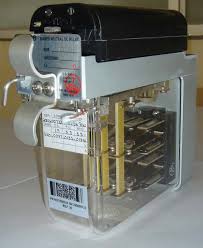
Vital cut off Relay (VCOR)
This feature of SMS generation on failure of EI should be used for all types of EI…
Do you know, how can we implement this on Medha EI system and Kyosan EI systems???