Category Archives: Railway Employees

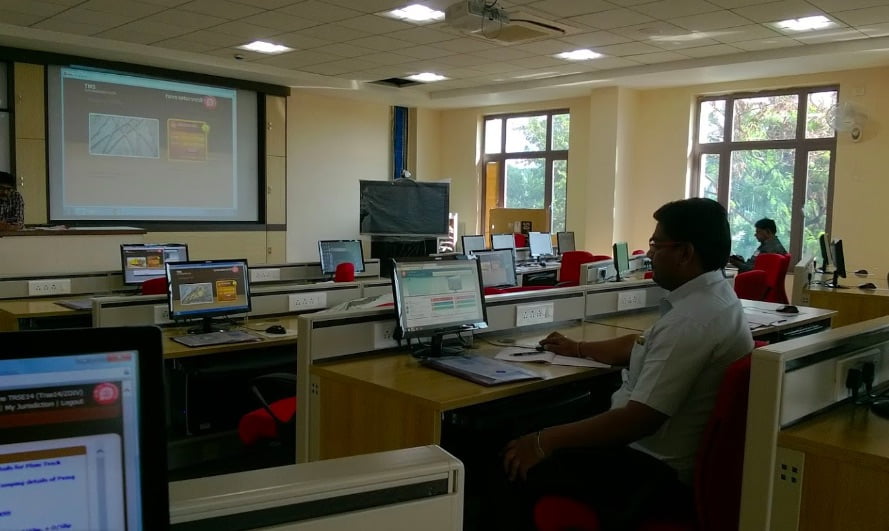
With more than 12 lakh on roll manpower, Indian Railways is one of the largest public enterprises under single management in the world. Human resource management of such a large manpower, especially deployed in 24×7 operational activities is a challenge in itself.
In the last 10 years, it may be very well observed that on the one hand the overall manpower has a decreasing trend, the productivity of Indian Railways has improved in terms of freight loading and passengers carried. This has been possible due to improved productivity of manpower as a result of extensive training and skilling of manpower. Manpower planning in Indian Railways is a continuous process which involves review of manpower keeping in view upgradation of technology and change of work practices. By this exercise, we do intake of skilled staff reducing unskilled and semi-skilled categories.

Step by Step guide for e-Pass on HRMS for Railway Employees

Guidelines for availing e-Passes/PTOs on HRMS

Content:

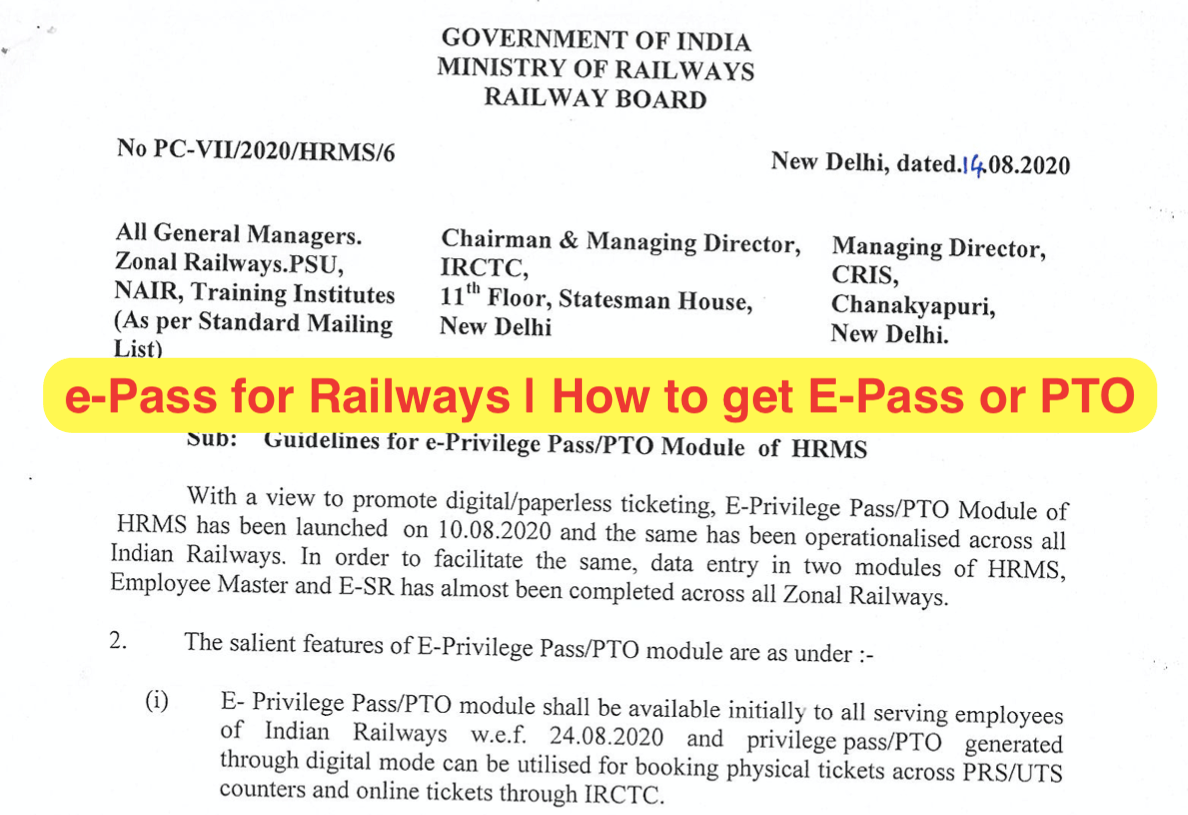
Indian Railways has launched e-Pass on HRMS Module on the 24th of August 2020 through Human Resource Management System (HRMS) Portal, which has been rolled out all over Indian Railways on 01/10/2020.

Now, the Privilege Passes and PTOs have to be applied and availed online by railway employees. With this facility Railway employee is neither supposed to come to office for applying for Pass nor has to wait for pass being issued.

The guidelines for availing e-Passes/PTOs on HRMS module are as follows:-

1.0 Step-wise instructions Login to the HRMS portal

Login to HRMS module is possible through webpage or mobile app.

>> Jump to next step if you already know how to login on HRMS.

How to use HRMS Employee Mobile Application for Indian Railway?

a) Steps for HRMS ID and login:-

  • Access the following website https://hrms.indianrail.gov.in/HRMS/ Click on ‘Need Help for Login’. Enter 11 digit PF/Employee number as IPAS ID and click ‘Go’. Details will be displayed including HRMS ID and Registered Mobile No.
  • Click on ‘Register Now’ on HRMS Mobile app, then enter 11 digit PF/Employee Number as IPAS ID.
  • Contact Personnel Branch Dealing Clerk (DC of Bill Section).

b) On availability of HRMS ID as user ID and default password “Test@123”, employees can login to HRMS portal. Employees will be directed to change the password after first login.

Congratulations, You have logged on HRMS portal.

If you know your HRMS ID, and have forgotten HRMS Password, then read…
How to reset HRMS Password for Indian Railway Employees?

c) An OTP will be received on the registered mobile number with validity for one week.

d) Enter the OTP.

e) Click ‘e-SR’. Then click on ‘My e-SR’ on the drop down menu. Details may be checked regarding designation, family particulars. If there is any discrepancy, click on ‘Remarks Tab’ and submit the same mentioning correct particulars. On verification of the same, concerned Approving Authority will update the same.

f) If all particulars are correct, following steps may be followed to process e-Pass Application.

Process for online application for e-Pass

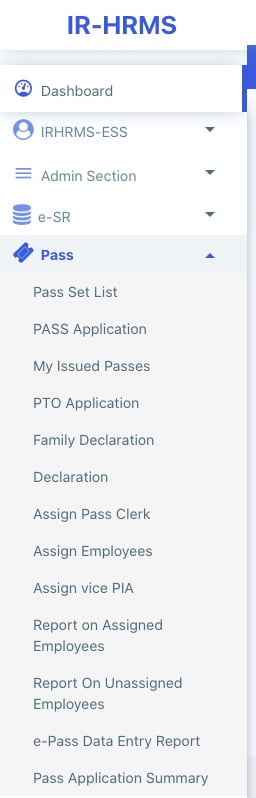
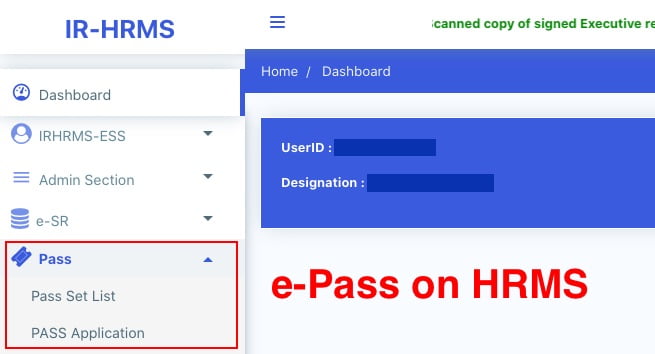
g) Click on the “Pass” tab on the left drop down menu.

h) Select “Pass Set List”. Availed manual passes and PTOs for the years 2020-21 will be displayed.

i) If the pass account details are correct, type OK in the “Remarks” tab and press “Confirm”.

j) If there is any error, type the nature of error in the remarks tab and press “Return to Clerk” tab.

k) Press “Yes” in the pop-up menu.

l) Next check the “Family Declaration” tab on the left drop down menu.

m) The screen containing the list of family members and the dependents will be displayed.

n) If all particulars regarding family and dependents of the employee are correct, tick the declaration and click ‘Submit’.

o) If there are any changes/updation, relevant documents e.g. Bonafide certificate etc.may be uploaded.

p) For uploading a document, click on the “Choose” tab displayed on the screen against the dependents and the upload the same. This will be sent to Dealing clerk/Pass clerk for modification.

q) On verification/approval by the Pass Issuing Authority, the employee will once again verify and submit.

r) On completion of the above steps, it will be construed that the family details and Pass/PTO details have been verified by the employee.

2.0 How to apply for a Digital e-Pass?

1. Click on the Pass Tab, then on “Pass Set List” tab of the drop down menu.

2. Select the ‘Type of Pass’ from drop down menu (privilege pass or PTO) and Click“Go”.

3. Year and entitlement of Passes will be displayed.

4. Click on the number displayed in the Available column for full set (PP) or half set Passes(PP/PTO), as required. You will be redirected to pass application page. If there are any previous existing applications (not submitted yet) for this year, they will appear in the list. They can be edited, clicking edit icon.

5. To create fresh application, Click on the “New Application” tab.

6.Enter STATION FROM and STATION TO. If you are not aware of the station code, mention name of the station in the “Station Description”.

7. Menu containing Family Details will be available on the screen, members may be clicked as and when needed to be included in the Pass.

8. Enter the break journey details(PP), if required.

9. If eligible for an Attendant and intend to take an attendant, then click the Tick box available in the screen for attendants.

10. Click “Submit”. On successful submission, the Pass application shall be forwarded to Pass Clerk. The applicant will receive following message on the registered mobile i.e. ‘Your Application No. xxxx has been forwarded to Pass Clerk.’

11. Open the “Pass Application”or “PTO Application” as applied to know the status of Application.

12. The list of Passes applied and their unique numbers with status will be displayed on approval of the same by Pass Issuing Authority.

13. Click on ‘My Issued Pass’ and click on “Generate OTP”as required.

14. An OTP will be generated.

15. Once the OTP is generated,A Unique Pass number will be received on the registered mobile.

16. Reservations for train travel can be made on online IRCTC portal as well as PRS counters at the Railway Stations using this unique Pass Number or Pass and Employee Identity Card.

3.0 How to cancel e-pass on HRMS?

1. Click on the “My Issued Pass Application” inside Pass tab.

2. List of Passes applied and generated will be displayed.

3. If the Pass has not been yet booked/reserved for journeys, the same can be cancelled.

4. Click on “Cancel the Pass”of the pass required to be cancelled.

5. An OTP is generated.

6. Once the OTP is entered, the Pass cancellation request is submitted.

E-Pass on HRMS application will save time, paper, money and lots of energy of Railway Employees and Railways itself.

In case of any issues please reach out to HRMS helpdesk
  • HRMS application related issue @ 7786940452 ,9971535534,7982542883
  • For OTP @ 7267910583,9953780947
  • For ePass related enquiry @ 9891643886,9069161539,9971168228 or
  • Write to us at irhrms@cris.org.in  
User Manuals for other modules of HRMS

Also read- Online E-Pass & PTO for Railway Employees under HRMS project

Source: HRMS Indian Railways

Railways reserve 20% vacancies for apprentices in level-1 recruitment

Indian Railways has reserved 20% vacancies for apprentices

As per Apprentice Act in 2016, Indian Railways has reserved 20% vacancies (i.e. 20,734 vacancies) for apprentices in 1,03,769 notified vacancies for level-1 recruitment currently under process.
Recently there have been news reports that the trained apprentices at Railway establishments are demanding regular appointment.

Apprentices are demanding this by asking for restoration of the earlier powers given to GMs which was discontinued in Mar 2017.

It may be noted that regular appointment without any open competition as being demanded by the some will be against the Constitutional provisions and GOI rules about regular recruitment. All eligible citizens of country are entitled to compete and apply for the regular jobs. Direct recruitment without any open competition is against the rules.

Provision of regular appointment for Apprentices

As per the amendment made in Apprentice Act in 2016, every employer has to make a policy of appointment of Act Apprentices trained in their establishment. Keeping this in view, Railways has kept 20% vacancies in Level 1 recruitment for such apprentices and give fair opportunity to all.

Position of engagement of Act Apprentices as per extant rule, Railways engages apprentices for providing training in their establishments.

As per Section 22 (i) of Act Apprentices Act, 1961 amended on 22nd Dec, 2014 provides that, ‘Every employer shall formulate its own policy for recruiting any apprentice who has completed the period of apprenticeship training in his establishment’.

In compliance with the above, instructions have been issued vide Railway Board’s letter No.E(NG)II/2016/RR-1/8 dated 21.06.2016, providing that 20% of the vacancies in case of direct recruitment to posts/categories in Level-1 shall be filled by giving preference to Course Completed Act Apprentices (CCAAs) trained in Railway establishments.  During 2018, RRBs have recruited 1288 apprentices in Level-1 posts. Further, 20% vacancies (i.e. 20,734 vacancies) have been kept reserved for apprentices in 1,03,769 notified vacancies for level-1 recruitment currently under process.

Indian Railways is going to start computer based tests for notified vacancies from 15th December 2020.

It may be noted that RRBs has issued three centralized employment notifications (CEN).

  • CEN 01/2019 (NTPC categories),
  • CEN 03/2019 (Isolated and ministerial categories) and
  • RRC-01/2019 (Level-1 categories)

These notifications have been issued for a total of about 1.4 lakh vacancies for various categories of staff by Railway Recruitment Boards (RRBs). Against these employment notifications, more than 2.40 crore candidates have applied.

Ministry of Railways have made requisite preparations for smooth conduct of Computer Based Test (CBT) which is scheduled from 15th Dec. 2020 onwards as notified earlier. The details of schedule of the CBTs will be uploaded on websites of RRBs in due course separately for these employment notifications.

Section 22 in THE APPRENTICES ACT, 1961

22. Offer and acceptance of employment. –

  1. It shall not be obligatory on the part of the employer to offer any employment to any apprentice who has completed the period of his apprenticeship training in his establishment, nor shall it be obligatory on the part of the apprentice to accept an employment under the employer.
  2. Notwithstanding anything in sub-section (1), where there is a condition in a contract of apprenticeship that the apprentice shall, after the successful completion of the apprenticeship training, serve the employer, the employer shall, on such completion, be bound to offer suitable employment to the apprentice, and the apprentice shall be bound to serve the employer in that capacity for such period and on such remuneration as may be specified in the contract: Provided that where such period or remuneration is not, in the opinion of the Apprenticeship Adviser, reasonable, he may revise such period or remuneration so as to make it reasonable, and the period or remuneration so revised shall be deemed to be the period or remuneration agreed to between the apprentice and the employer.

Source: PIB

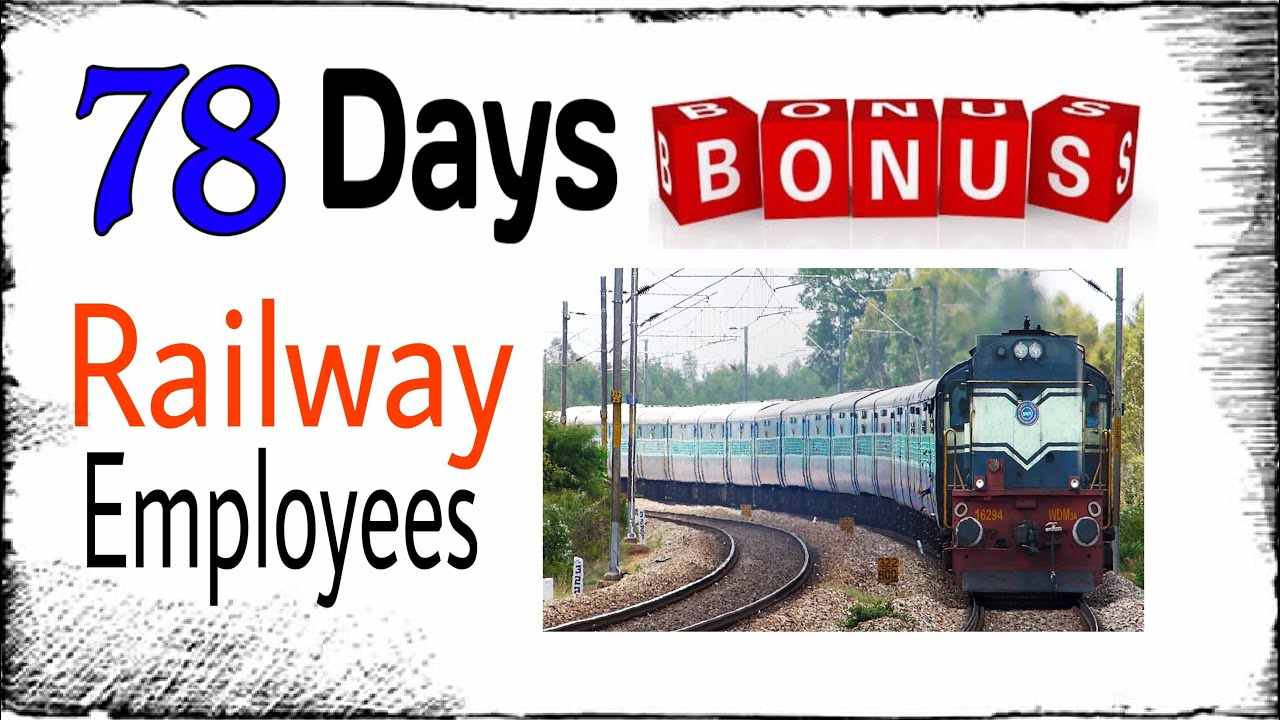
78 days’ Productivity Linked Bonus (PLB) to railway employees for 2019-20

78 days’ salary Bonus to 11.58 lakh non-gazetted Railway employees

The Union Cabinet in its meeting held on 21.10.2020 accepted the proposal of the Ministry of Railways for payment of Productivity Linked Bonus (PLB) equivalent to 78 days’ wages for the financial year 2019-2020 for all eligible non-gazetted Railway employees (excluding RPF/RPSF personnel). The financial implication of payment of 78 days’ PLB to railway employees has been estimated to be Rs. 2081.68 crores. 

  • Productivity Linked Bonus (PLB) equivalent to 78 days’ wages for the financial year 2019-2020 for all eligible non-gazetted Railway employees
  • The maximum amount payable per eligible railway employee is Rs.17,951 for 78 days.
  • About 11.58 lakh non-gazetted Railway employees are likely to benefit from the decision
  • Payment of 78 days’ PLB to railway employees has been estimated to be Rs. 2081.68 crores

About 11.58 lakh non-gazetted Railway employees have been granted bonus equivalent to 78 days wages for FY 2019-20 .

The wage calculation ceiling prescribed for payment of PLB to the eligible non-gazetted railway employees is Rs.7000/- p.m.  The maximum amount payable per eligible railway employee is Rs.17,951 for 78 days. About 11.58 lakh non-gazetted Railway employees are likely to benefit from the decision.

The Productivity Linked Bonus on Railway covers all non-gazetted railway employees (excluding RPF/RPSF personnel) who are spread over the entire country. Payment of PLB to eligible railway employees is made each year before the Dusshera/ Puja holidays.  The decision of the Cabinet shall be implemented before the holidays for this year as well. 

For the year 2019-20 PLB equivalent to 78 days’ wages will be paid which is expected to motivate the employees for working towards improving the performance of the Railways.

It may be noted that though this payment is being made for last year’s performance i.e. 2019-20 , even this year during COVID period,  a lot of hard work has been put in by Railways employees in movement of Shramik specials, for movement of essential commodities including Food grains, Fertilizers, Coal etc and completion of more than 200 vital maintenance projects  during lock down period  which would boost safety and all round  efficiency in railway operations.

Even on the freight side there has been major improvement post COVID lock down period. Freight speeds have almost doubled now as compared to last year. Freight loading has also increased by 14% for period of October 2020 as compared to similar period last year.

The payment of the PLB for 2019-20 is expected to motivate the employees for working towards improving the performance of the Railways further. The acknowledgement of their work will enhance the sense of inclusiveness and belongingness in Railway families. It is expected to enhance the productivity levels further.

It is also expected to help in consumer spending and boosting demand during the festive times.

Source: PIB

Also Read about

Final seniority list of railway officers Group ‘B’ issued in 2020

Group ‘B’ Final seniority list as on 01.04.2018 & 01.01.2019

Railway Board, vide letter No. E(GP)2013/1/31 dated 23.12.2019, asked Zonal Railways/PUs’ for seniority lists of Group ‘B’ officers of organised services as on 01.04.2018 & 01.01.2019 for promotion to Group ‘A’. But, required seniority list of railway officers have not yet been furnished from most of the Railways so far.

Page updated on 08.10.2020

As on date, Final seniority list of railway officers has been issued only for Traffic, Accounts, Personnel and S&T departments.

Provisional integrated seniority lists has been circulated for Electrical, and Stores departments.

Eligibility condition for promotion from Group ‘C’ to Group ‘B’ posts in Indian Railways

Based on these seniority lists Group ‘B’ officers are promoted to Group ‘A’ services. Group ‘A’ officers are directly recruited by the Union Public Service Commission (UPSC), and Group ‘B’ officer are promotee officers from Group ‘C’ staff.

S&T Department: Final seniority list of Group ‘B’ officers of Indian Railway

The provisional integrated seniority lists of Group ‘B’ officers of Signal & Telecom department of Indian Railways as on 01.04.2018 and 01.01.2019 were issued by Railway Board on date 11.08.2020. In response thereto, several representations were received which were examined. Also certain discrepancies have been pointed by some of the Railways. Accordingly, necessary corrections have been carried out.

The final seniority list as on 01.04.2018 (Annexure-I) and 01.01 2019 (Annexure-II) are enclosed for immediate circulation.

Traffic Department: Final seniority list of Group ‘B’ officers of Indian Railway

The provisional integrated seniority lists of Group ‘B’ officers of Traffic Department of Indian Railways as on 01.04.2018 and 01.01.2019 were issued by Railway Board on date 23.07.2020. In response thereto, several representations were received which were examined. Also certain discrepancies have been pointed by some of the Railways. Accordingly, necessary corrections have been carried out.

The final seniority list as on 01.04.2018 (Annexure-I) and 01.01 2019 (Annexure-II) are enclosed for immediate circulation.

Accounts Department: Final seniority list of Group ‘B’ officers of Indian Railway

The provisional integrated seniority lists of Group ‘B’ officers of Accounts Department of Indian Railways as on 01.04.2018 and 01.01.2019 were issued by Railway Board on date 22.06.2020. In response thereto, several representations were received which were examined. Also certain discrepancies have been pointed by some of the Railways. Accordingly, necessary corrections have been carried out.

The final seniority list as on 01.04.2018 (Annexure-I) and 1.01.2019 (Annexure-II) are enclosed for immediate circulation.

Personnel Department: Final seniority list of Group ‘B’ officers of Indian Railway

The provisional integrated seniority lists of Group ‘B’ officers of Accounts Department of Indian Railways as on 01.04.2018 and 01.01.2019 were issued by Railway Board on date 04.06.2020. In response thereto, several representations were received which were examined. Also certain discrepancies have been pointed by some of the Railways. Accordingly, necessary corrections have been carried out.

The final seniority list as on 01.04.2018 (Annexure-I) and 01.01.2019 (Annexure-II) are enclosed for immediate circulation.

Electrical Department: Provisional seniority list of Group ‘B’ officers of Indian Railway

On the basis of Group ‘B’ seniority lists of Electrical Engineering Department as on 1.4.2018 and 1.1.2019 furnished by different Railways /PUs, provisional integrated Group ‘B’ seniority Lists of Electrical Engineering Department of Indian Railways on All India basis as on 1.4.2018 and 1.1.2019 have been prepared and are enclosed at Annexure-l and Annexure-II.

Stores Department: Provisional seniority list of Group ‘B’ officers of Indian Railway

On the basis of Group ‘B’ seniority lists of Stores Department as on 1.4.2018 and 1.1.2019 furnished by different Railways /PUs, provisional integrated Group ‘B’ seniority Lists of Electrical Engineering Department of Indian Railways on All India basis as on 1.4.2018 and 1.1.2019 have been prepared and are enclosed at Annexure-l and Annexure-II.

Pending Seniority lists…

As on date 30.09.2020, seniority lists for Mechanical and Engineering departments has not been issued for 01.04.2018 & 01.01.2019. These seniority lists are still have to be sent by Zonal railways to Railway Board.
Eligibility for promotion from Group ‘C’ to Group ‘B’ posts in Railways

The eligibility criteria for appearing in the Selections/LDCEs for promotion to Group ‘B’ posts in the Departments having organised services has been laid down in terms of Board’s letters no. E(GP) 99/2/22 dated 29.03.2010 and 06.05.2014. Consequent upon implementation of the pay structures recommended by the VII Pay Commission, the said eligibility conditions have since been reviewed by the Railway Board and it has been decided to make following changes therein:

i) For Group ‘B’ selections (70% quota), Group ‘C’ employees working in Level 6 and above in Pay Matrix with 3 years of non-fortuitous service in Level 6 and above in Pay Matrix (including non-fortuitous service rendered in the corresponding pre-revised grade pay) will be eligible.

    • Group ‘C’ employee working in Level 6 and above, and
    • 3 years of non-fortuitous service in Level 6 and above

ii) For Group ‘B’ selections (30% LDCE quota), Group ‘C’ employees working in Level 6 and above in Pay Matrix with 5 years of non-fortuitous service in Level 6 and above in Pay Matrix (including non-fortuitous service rendered in the corresponding pre-revised grade pay) will be eligible.

    • Group ‘C’ employee working in Level 6 and above, and
    • 5 years of non-fortuitous service in Level 6 and above

(iii) However, for Selections/LDCEs for promotion to Group ‘B’ posts in Accounts department, Group ‘C’ employees fulfilling the above mentioned conditions should also have qualified the Appendix-3 IREM Examination.

    • For Accounts Department employee should also have qualified Appendix-3 IREM Examination additionally.

iv) In the integrated seniority of Group ‘C’ employees eligible for Group ‘B’ selections (70% quota) in all departments having organised services except Accounts department, employees in Level 7 of the Pay Matrix will be placed above those in Level 6 of the Pay Matrix. In either category, the relative seniority of employees coming from different streams will be determined with reference to length of non-fortuitous service in Level 7 or Level 6 in the Pay Matrix, as the case may be.

v) In the integrated seniority of Group ‘C’ employees eligible for Group ‘B’ selections (70% quota) in Accounts Department, employees in Level 8 in Pay Matrix will be placed above those in Level 6 in Pay Matrix. In either category, the relative seniority of employees coming from different streams will be determined with reference to length of non-fortuitous service in Level 8 or Level 6 in Pay Matrix, as the case may be.

Economy measures to curb government expenditures

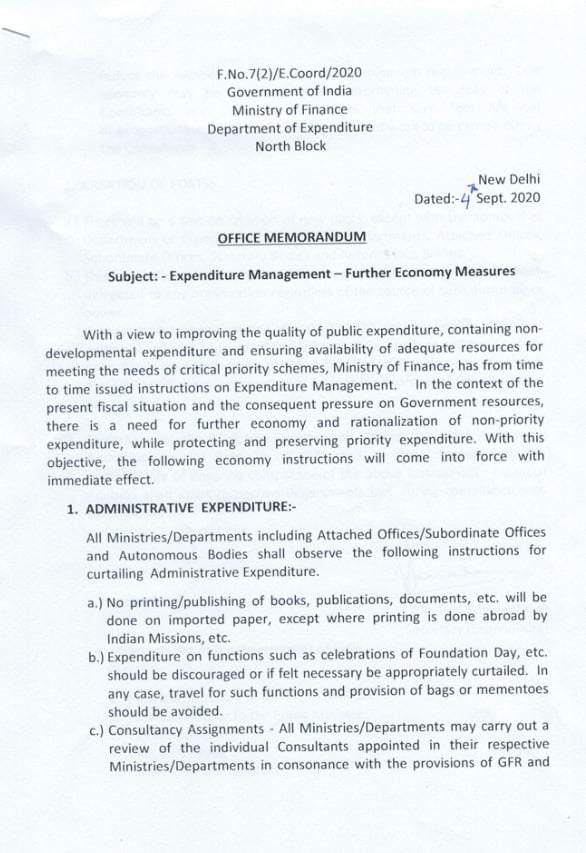
Expenditure Management — Further Economy Measures

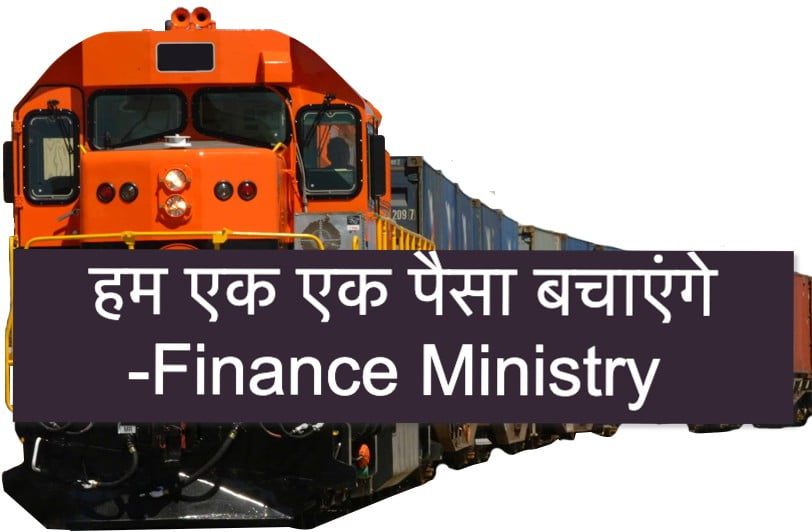
In the context of the present fiscal situation and the consequent pressure on Government resources, there is a need for further economy and rationalization of non-priority expenditure, while protecting and preserving priority expenditure.

With a view to improving the quality of public expenditure, containing non-developmental expenditure and ensuring availability of adequate resources for meeting the needs of critical priority schemes, Ministry of Finance, has from time to time issued instructions on Expenditure Management.

With this objective, the following economy instructions will come into force with immediate effect.

  • Ban on creation of new posts
  • Ban on celebrations of Foundation Day & official functions
  • Ban on printing of Books, Calendars, Document
  • Ban on travel for function, mementoes
  • Reduce the number of Consultants

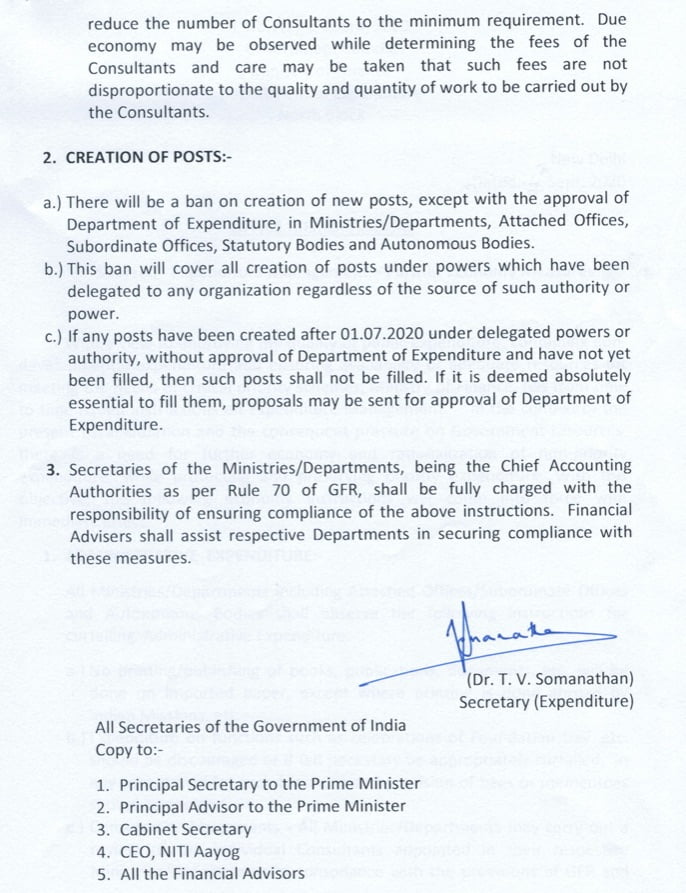
Download the Order for Economy measures

1. CURTAIL ADMINISTRATIVE EXPENDITURE:Costing Cutting

All Ministries/Departments including Attached Offices/Subordinate Offices and Autonomous Bodies shall observe the following instructions for curtailing Administrative Expenditure.

  • No printing/publishing of books, publications, documents, etc. will be done on imported paper, except where printing is done abroad by Indian Missions, etc.
    • Expenditure on functions such as celebrations of Foundation Day, etc. should be discouraged or if felt necessary be appropriately curtailed. In any case, travel for such functions and provision of bags or mementoes should be avoided.
    • Consultancy Assignments – All Ministries/Departments may carry out a review of the individual Consultants appointed in their respective Ministries/Departments in consonance with the provisions of GFR and reduce the number of Consultants to the minimum requirement. Due economy may be observed while determining the fees of the Consultants and care may be taken that such fees are not disproportionate to the quality and quantity of work to be carried out by the Consultants.
2. BAN CREATION OF POSTS
  • There will be a ban on creation of new posts, except with the approval of Department of Expenditure, in Ministries/Departments, Attached Offices, Subordinate Offices, Statutory Bodies and Autonomous Bodies.
  • This ban will cover all creation of posts under powers which have been delegated to any organization regardless of the source of such authority or power.
  • If any posts have been created after 01.07.2020 under delegated powers or authority, without approval of Department of Expenditure and have not yet been filled, then such posts shall not be filled. If it is deemed absolutely essential to fill them, proposals may be sent for approval of Department of Expenditure.


Read More about…

Online E-Pass & PTO for Railway Employees under HRMS project

Employees will be able to apply for pass online from anywhere and get the E-Pass generated online

Chairman Railway Board has launched E-pass module of Human Resource Management System (HRMS) developed by CRIS through video conferencing which was also attended by FC/Railways, all Board Members, CMD/IRCTC, MD/CRIS, all GMs, PCPOS, PCCMS, PFAs and DRMs.

Human Resource Management System (HRMS) for Indian Railway’ Employees

This Human Resource Management System (HRMS) will allow Railway employees to view their details related to their Increments, Promotions, Awards, Transfers, Postings, Leave, Training, and composition of Family as per records and Nominations for retirement benefits. This information is not readily available to employee at present. It brings transparency to administration.

DG/HR briefed about the various aspects of the e-Pass module and its phased implementation strategy.

Process for issuance of pass have been largely manual in IR. Also there was no facility for booking of ticket online on Pass for Railway employee.

Download User Manual For Employee, Pass Clerk & PIA

The E-Pass module has been developed by CRIS under HRMS project and will be rolled out over Indian Railways in phased manner. With this facility Railway employee is neither supposed to come to office for applying for Pass nor has to wait for pass being issued. Employee will be able to apply for pass online from anywhere and get the E-Pass generated  online. Complete process of application and generation of Pass is mobile friendly. .
Ticket booking on pass may also be done online on IRCTC site apart from earlier facility of counter booking from PRS/UTS counter.

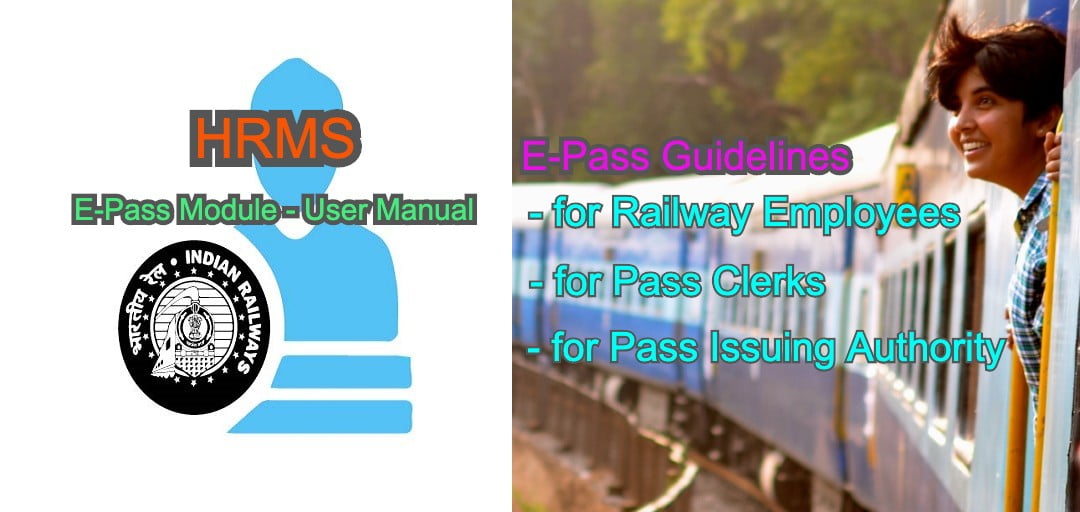
HRMS E-Pass Module- User Manual for Railway Employee, Clerk, PIA

Click below on the image for detailed guidelines for issue of e-Pass, Cancellation of e-Pass etc…

E-PASS module Guidelines for Railway Employee, Clerk, PIA

This facility will help Railway employee in using their pass hassle free and simultaneously make working of all officials involve in issuance of Pass smooth.

HRMS project is a comprehensive plan for digitization of complete HR process of Indian Railway. Total 21 modules has been planned in HRMS. Basic data entry of around 97% railway employees has been completed in Employee master and E-Service record modules of HRMS which had been launched last year.


[poll id=”3″]

CRIS is also going to launch Office order module and settlement modules of HRMS very shortly .

e-Pass for Railways | How to get E-Pass or PTO | How to register for Railway Epass
Online E-Pass for Railway Employees
In case of any issues please reach out to HRMS helpdesk
  • HRMS application related issue @ 7786940452 ,9971535534,7982542883
  • For OTP @ 7267910583,9953780947
  • For ePass related enquiry @ 9891643886,9069161539,9971168228 or
  • Write to us at irhrms@cris.org.in  
User Manuals for other modules of HRMS

Govt. employees will not get a hike in Dearness Allowance till July 2021

As per government notification “It has been decided that the additional instalment of Dearness Allowance payable to Central Government employees and Dearness Relief to Central Government pensioners due from 1st January 2020 shall not be paid. The additional instalment of Dearness allowance and Dearness relief due from 1st July 2020 and 1st January 2021 shall not be paid. However, Dearness Allowance and Dearness Relief at current rates will continue to be paid.”

No DA hike and No DA arrear for 1 year, 6 months.

No arrears for the period from 1st of January 2020 to 30th of June 2021 shall be paid.

The Country is in Lock Down since March’24 and future road map is also not clear, at this critical juncture Government is looking for curtailing the expenditure by various means. This is the first step, lots more to come. Employees of Government sector and private should be ready to face cut in various perks.

Government pensioners will also not get hike in their DA till July 2021, they will get only current rate of Dearness Allowances (DA).

These orders of freezing of Dearness Allowances to Central Government employees and Dearness Relief to Central Government pensioners shall be applicable from January 2020 to June 2021, without any arrear.

HRMS Tutorials in Hindi

HRMS application is single window communication system between Railway employees and Administration. Here are the tutorials for various modules of HRMS.

ePASS Ticketing (Hindi) –
ePass Management for Employees, PC & PIA(Hindi) –
ePass Role Management for Pass Admin (Hindi) –
Miscellaneous & Leave Office Order (Hindi) –
Transfer posting & Promotion Posting Office Order (Hindi) –
New Joinee & Exit Order (Hindi) –
APAR Module (Hindi) –
Settlement Module (Hindi) –
PF & Advance module (Hindi) –

Also Read more about HRMS tutorials…

Access the HRMS website or Mobile app with below link 
? IR-HRMS Helpdesk Numbers

If you face issues that can’t be resolved using manuals or videos, reach out to the official helpdesk.

? Email Support:

☎️ Phone Support (CRIS HQ):

In case of any issues please reach out to HRMS helpdesk:-

Please Note :

There are changes in HRMS Helpdesk Mobile no. Zone wise Helpdesk Mobile No is as follows –

  • 1) Mobile no. 9718972731 for SER + ECoR + NFR + RCT
  • 2) Mobile no. 8287998772 for SECR + CR + RDSO + RWF
  • 3) Mobile no. 7838961987 for SR + CORE + CTI + NR
  • 4) Mobile no. 9971535534 for NCR + NER + ER + NFRC
  • 5) Mobile no. 7011532241 for NWR + RWP + SWR + RCF
  • 6) Mobile no. 8375846067 for DMW + SCR + CLW + MCF
  • 7) Mobile no. 7982542883 for METRO + COFMOW + WR + ECR
  • 8) Mobile no. 9971168228 for RB + ICF + WCR + BLW

Railway Board to ‘right size’ by transferring 25% officials to zones

There are 200 officials in the Railway Board and Now, Board will transfer 50 officers to the zonal railways to reduce the size and improve the efficiency.

Too many officers are adversely affecting the efficiency

This time Railway Board is seriously rethinking to reduce its size to 150 officials. 25% officers of Director and above levels (50) will be transferred to various zonal railways.

There are too many officers in Board. Thus, to increase the efficiency & right sizing the board, this is much needed step.

This was also the part of Minister Piyush Goyal’s 100-day agenda and a top priority for present Chairman of Railway Board.

Interestingly, the plan was first mooted by the BJP government in 2000 in the leadership of the Atal Bihari Vajpayee, but could not got implemented.

The Bibek Debroy Committee on Indian Railways in 2015

In the past also, the Bibek Debroy Committee on Indian Railways recommended the restructuring of the Board. Overstaffed Railway is adversely affecting the efficiency of the organisation.

Summary of the Bibek Debroy Committee on IR

  • The Committee was constituted on September 22, 2014 to prepare a blueprint for reforming Indian Railways.
  • The Committee submitted its final report in June 2015.
  • Failure of private participation.
  • Need for an independent regulator
  • Financing of Railways is a challenge
  • Restructuring of zones
  • Focus on core activities
  • Accounting reforms

Report Summary

There are many Directors & Members post at the apex level of Railway because board is having many Directorates.

DoPT cannot issue binding circulars upon the Railways. Railways can frame own Rules.

The Department of Personnel and Training (DOPT) is the Nodal Agency to form the service rules for all the Group-‘A’ services of all the Government Ministries and Department. However, Railway also has the Indian Railways Establishment Manual (IREM).

In a legal legal battle between promotees and direct recruits, the Supreme Court has held that the Railways is not bound by the memorandum issued by the Department of Personnel and Training (DoPT) and are empowered to frame its own rules to lay down the service conditions of its employees.

“We also hold that the IREM has statutory force and has been issued in exercise of powers vested under the proviso to Article 309 of the Constitution.”

 Whether the Railways is bound by the rules framed by the DoPT?

Whether the Railways is bound by the rules framed by the DoPT or it can frame its own rules and whether the IREM has statutory force? The question has been clarified by a three-judge bench of Justice Madan B. Lokur, Justice S. Abdul Nazeer and Justice Deepak Gupta of Supreme Court.

In Prabhat Ranjan Singh vs. R.K. Kushwaha case, SC held that the Indian Railways Establishment Manual (IREM) has statutory force and has been issued in exercise of powers vested under the proviso to Article 309 of the Constitution.

 DoPT cannot issue binding circulars upon the Railways

Referring to Allocation of Business Rules, 1961, the bench said the Railways is specifically excluded from the ambit of the scope of business allocated to the DoPT, whether it be for classification of posts, recruitment of ministerial staff, appointment of non-Indians to civil posts, fixing of service conditions, including conduct rules, general policy regarding retrenchment and revision of temporary service of the Railways etc., and as such the DoPT cannot issue binding circulars upon the Railways.

“We may make it clear that if the DoPT issues a circular and the Railways specifically accepts the circular or makes it applicable, then such a circular may apply but if the circular is not made specifically applicable then it has no force so far as the Railways and its employees are concerned,” the bench said.

The Supreme Court also said Allocation of Business Rules, 1961, while allocating business to the Ministry of Railways, power has been given to it to deal with all matters, including those relating to revenue and expenditure, and, therefore, the Ministry of Railways has the power to lay down conditions of service for its employees.

Taking note of various communications with regard to the IREM, the bench observed that all of them make a mention that they have been issued in exercise of powers conferred by proviso to Article 309 of the Constitution. “This leaves no manner of doubt that the rules under IREM Vol.1 are also statutory rules.”

 Inter-se seniority of Direct and Promotee officers

With this judgement of Supreme court, the inter-se seniority of Direct and Promotee officers of will be as per RBE-33/18 order. to know about the seniority list for all the department.

 Read full judgement