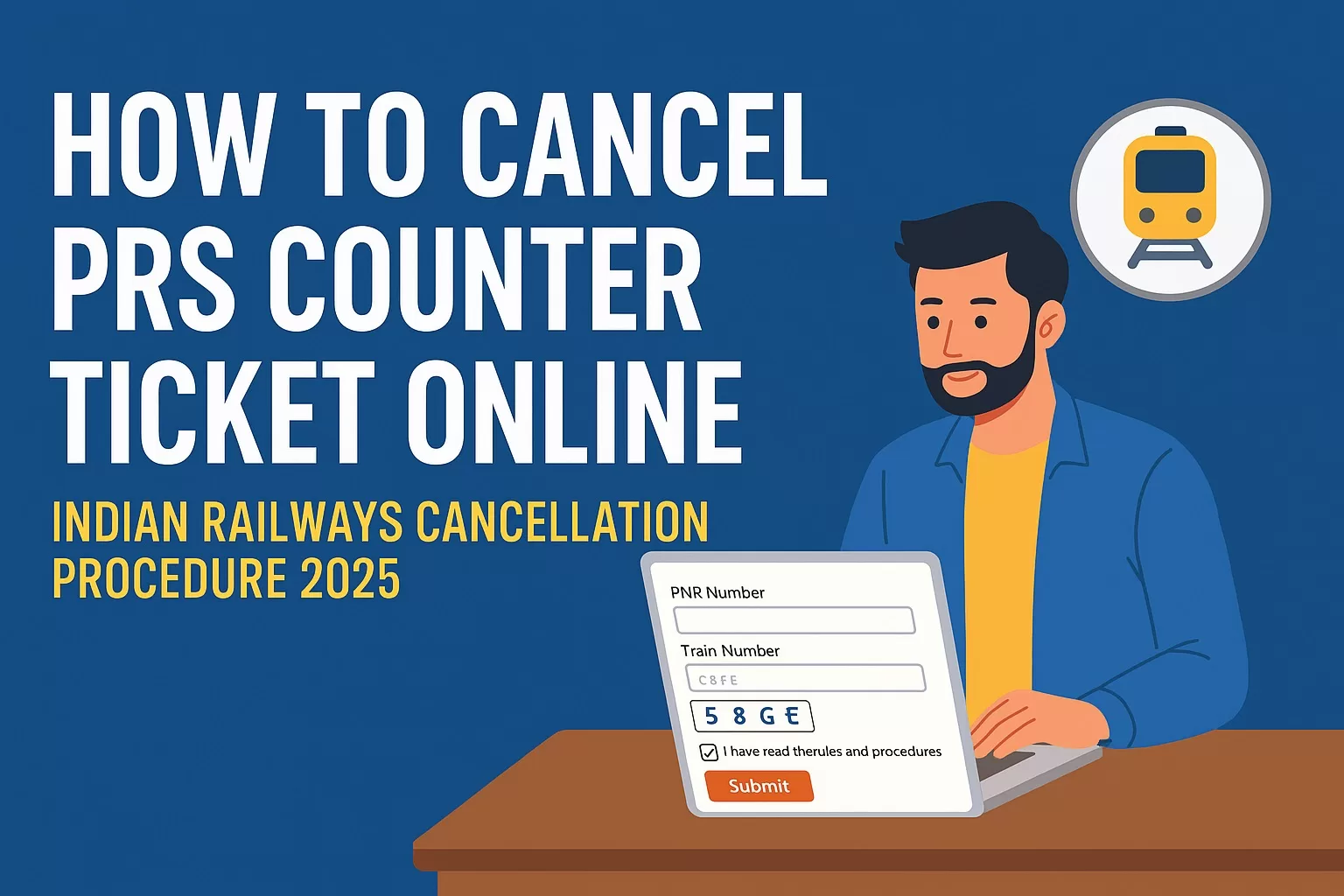
Counter Ticket Cancellation Online in 1 minute, How?

Earlier, if you booked your train ticket from a Passenger Reservation System (PRS) counter, the only way to cancel it was:

  • By physically visiting the station, and
  • Surrendering the original ticket at the same or another PRS location
    This posed serious challenges:
  • ❌ Not possible for passengers out of town
  • ❌ Difficult for working professionals
  • ❌ Risk of missing the cancellation deadline and losing the refund.

But now, Indian Railways has introduced an online counter ticket cancellation facility via the IRCTC website, eliminating the need to visit a railway station at that moment.

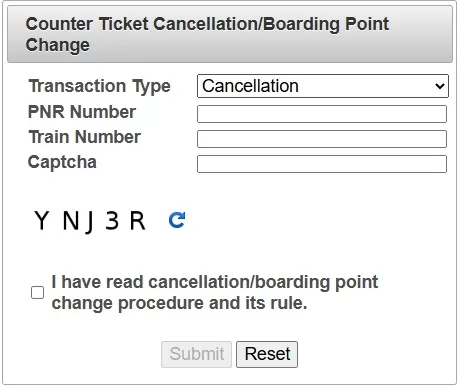
Here is a simplified step-by-step guide for the Counter Ticket Cancellation online through IRCTC website in just a minute time.

Counter Ticket Cancellation Online through IRCTC website
  1. Visit the Official page of IRCTC Website for cancellation.
  2. Enter the following details:
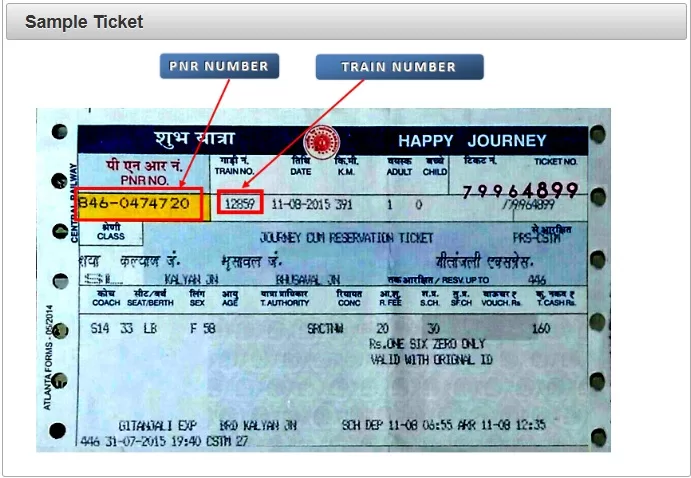
    • PNR Number
    • Train Number
    • Captcha Code
  1. Read the Rules and Procedures and check the confirmation box.
  2. Click ‘Submit’.

? OTP Verification

  • An OTP will be sent to the mobile number given at the time of booking.
  • Enter the OTP and click ‘Submit’.
  • After successful validation, PNR details will be displayed.

? Ticket Cancellation

  • Verify the ticket details.
  • Click on ‘Cancel Ticket’ for full cancellation.
  • The refund amount will be displayed.
  • You will receive an SMS like: “Your PNR xxxxxxxxxx has been cancelled. Collect refund amt ₹xxxxx from journey commencing station or nearby satellite PRS locations. Ref. Terms & conditions”

? Refund Collection Guidelines

  • Carry the original ticket to claim refund at PRS counters.
  • Refund can be collected from any PRS counter or designated satellite PRS locations.

Time Limits for Ticket Cancellation

Confirmed TicketsUp to 4 hours before departure
RAC/Waitlisted TicketsUp to 30 minutes before departure

Refund Timing After Departure

  • For Trains Departing between 18:01 hrs – 06:00 hrs:
    Refund allowed during first two hours of PRS counter opening next day.
  • For Trains Departing between 06:01 hrs – 18:00 hrs:
    Refund allowed up to 4 hours after departure during PRS working hours.

⚠️ Important Notes

  • Refund beyond these time limits can be collected only at journey commencing station or its nearby designated PRS locations.
  • Always verify station convenience before proceeding with cancellation.

Also Read

Tatkal Booking Rules and Timings: The 2025 Guide to Fast Train Reservations

Need to book a last-minute train ticket? Welcome to the world of Tatkal bookings — Indian Railways’ emergency ticketing system. Whether you’re a frequent traveler or caught in a spontaneous travel plan, understanding Tatkal rules and timings can help you book tickets faster and smarter in 2025.

In this guide, we’ll walk you through everything you need to know about Tatkal ticket bookings on IRCTC — from timings and charges to smart tips and changes made in 2025.

? What is the Tatkal Scheme?

Tatkal (meaning “immediate”) is a premium ticketing system launched by Indian Railways to allow passengers to book tickets at short notice. A limited number of seats are reserved in almost all express trains under this scheme.

⏰ Tatkal Booking Timings in 2025

Indian Railways maintains separate booking windows for different travel classes:

  • AC Classes (1A, 2A, 3A, CC, EC):
    ? Opens at 10:00 AM, one day before the train’s departure from the origin station.
  • Non-AC Classes (SL, 2S):
    ? Opens at 11:00 AM, one day before departure.

Note: The booking date is calculated from the origin station, not your boarding station.

? Example of Tatkal Booking Date

If a train leaves from its origin at 11:00 PM on 15th June, then Tatkal booking opens at:

  • 10:00 AM on 14th June for AC classes
  • 11:00 AM on 14th June for Non-AC classes

? Tatkal Charges (Fare Structure 2025)

Tatkal tickets are priced higher than normal tickets due to premium charges. Here’s a breakdown:

AC Classes:

  • 2A: ₹400 extra
  • 3A: ₹300 extra
  • CC (Chair Car): ₹300 extra
  • EC (Executive Class): ₹400-500 extra

Non-AC Classes:

  • Sleeper (SL): ₹100-150 extra
  • Second Sitting (2S): ₹10-20 extra

Charges may vary slightly based on distance and route.

✅ Tatkal Booking Rules in 2025

Here are the latest rules updated for 2025:

  1. One ID per booking:
    The primary passenger must carry the same ID proof used while booking.
  2. No waitlisting:
    Tatkal tickets are issued only if seats are available. No waitlisted Tatkal tickets are allowed.
  3. Partial cancellation allowed:
    In case of group bookings, some passengers can cancel without affecting others.
  4. Refund on cancellation:
    • Confirmed Tatkal ticket: No refund on cancellation by the passenger.
    • Waitlisted Tatkal ticket (if booked): Standard cancellation rules apply.
    • Train cancelled by Railways: Full refund issued.
  5. Only one Tatkal ticket per user ID per train:
    Limits bulk or automated bookings to ensure fairness.
  6. No agent booking during first 30 minutes:
    IRCTC restricts travel agents from booking Tatkal tickets between 10:00–10:30 AM for AC and 11:00–11:30 AM for Non-AC.

? Pro Tips to Book Tatkal Tickets Faster

  1. Login early: Be ready 5–10 minutes before the booking opens.
  2. Use IRCTC Fast Booking: Save passenger and payment info in advance.
  3. Enable Auto-fill extensions: Use tools like Magic Autofill or browser form savers (carefully).
  4. Prefer UPI or IRCTC Wallet for payment: They’re faster and reduce transaction failures.
  5. Use multiple devices: For high-demand trains, keeping backup logins helps.
  6. Check train from source: Sometimes, selecting the source station improves ticket availability.

? Use the IRCTC SwaRail App

IRCTC’s new SwaRail App supports fast Tatkal bookings with integrated payment options and PNR alerts.

Bonus: The app uses AI to suggest alternative routes and trains in case your first choice is unavailable.

? Documents Required for Tatkal Booking

Keep one of the following ID proofs ready while booking and traveling:

  • Aadhaar Card
  • Voter ID
  • PAN Card
  • Driving License
  • Passport
  • Student ID (for students)

ID details must match exactly, or you may face penalties.

? Common Mistakes to Avoid

  • Booking Tatkal ticket for wrong date/time (from source station!)
  • Using slow or failing payment methods
  • Entering incorrect passenger details
  • Refreshing the page mid-booking (you’ll get logged out)

Tatkal ticket booking doesn’t have to be stressful — if you know the tatkal rules & timings and prepare in advance. In 2025, with real-time apps like SwaRail, faster payments, and smarter booking logic, passengers have a better shot at snagging those last-minute seats.

Just remember:
? Be fast, stay calm, double-check your details, and use verified platforms like IRCTC only.

Safe travels, and may the Tatkal odds be ever in your favor! ?

How to Book Train Tickets Without Hassle: 7 IRCTC Tips for 2025

How to Book Train Tickets Without Hassle: 7 IRCTC Tips for 2025

Booking train tickets in India can sometimes feel like a race against time—especially during peak travel seasons or when snagging those elusive Tatkal tickets. But don’t worry! With a few smart strategies and the right tools, you can breeze through the booking process like a pro in 2025. IRCTC ticket booking tips will surely help you in booking your train tickets in 2025.

Here are 7 must-know IRCTC tips that will help you book your train tickets without breaking a sweat.


IRCTC ticket booking tips 2025: Step-by-Step guide

1. Register and Verify Your IRCTC Account Early

If you haven’t signed up on IRCTC’s official website yet, now’s the time! Make sure you complete your KYC verification early — this unlocks faster payment options and smoother booking flows.

Why bother? Verified accounts help reduce payment failures and save time when seats are selling out fast. Plus, IRCTC prioritizes verified users for some services.


2. Download and Use the Official SwaRail App

In 2025, IRCTC rolled out the brand-new SwaRail app — your all-in-one railway assistant. This app is a game-changer: it lets you book tickets, track your PNR status, check coach positions, and even lodge complaints — all from a single platform.

The AI-powered features give personalized train and seat recommendations, so you can find the best options without endless scrolling.

Pro tip: Keep the app updated regularly for the latest features and bug fixes!


3. Choose Fast and Reliable Payment Methods

Nothing’s worse than losing your seat because your payment got stuck! Link your account with fast payment options like UPI, net banking, or IRCTC’s own e-wallet for quicker transactions.

Saving your payment details securely on the app or website can save valuable seconds during checkout—perfect for Tatkal bookings!


4. Set Alarms for Tatkal Booking Time

Tatkal tickets open sharp at 10 AM for AC classes and 11 AM for non-AC classes, and millions of users flood the site the moment bookings open.

Make sure to set alarms or reminders, log in a few minutes early, and keep all your passenger info handy. If you want to get serious, practice filling the form beforehand to avoid errors that cost you precious seconds.

You can learn more about Tatkal booking rules and timings here.


5. Use Auto-Fill Browser Extensions — But With Caution

Auto-fill extensions can speed up form filling, but don’t rely on them blindly. Double-check all passenger details before submission to avoid mistakes that might lead to ticket cancellations.

Never use auto-fill for OTPs or Captchas — these must be entered manually.


6. Stay Flexible: Check Alternate Trains and Routes

If your favorite train is full, don’t panic! Use IRCTC’s “Book from Calendar” feature to check availability up to 120 days ahead.

Also, explore alternate trains or nearby stations that might get you to your destination almost as fast. Sometimes a little flexibility goes a long way — and you might discover better travel options!


7. Review Everything Before You Hit ‘Pay’

Almost done? Pause for a moment and double-check:

  • Train number and date
  • Passenger names and ages
  • Class of travel
  • Payment amount

Mistakes at this stage can mean cancellations or refund headaches later. Once confirmed, save your e-ticket and note your PNR number — it’s your travel lifeline.


Bonus Tip: Use Multiple Devices and Browsers

For high-demand bookings like Tatkal, some travelers keep multiple devices or browsers open to increase their chances. Just make sure not to spam the system — IRCTC may block suspicious activity.


Wrapping Up – IRCTC ticket booking tips 2025

Booking train tickets in 2025 has never been easier thanks to IRCTC’s digital upgrades. Whether you’re a frequent traveler or planning your first long-distance journey, these tips will save you time, stress, and maybe even money.

Start by setting up your verified IRCTC account, get familiar with the SwaRail app, and plan ahead. With a bit of preparation, you’ll be zooming down those railway tracks in no time.

Happy and hassle-free travels!

Also Read

Online train ticket booking on Railway e-PASS: IRCTC

Here’s a user-friendly User Guide for E-PASS Booking on IRCTC:

User Guide: for online train ticket booking on Railway e-PASS on IRCTC

This guide will walk you through the process of online booking railway tickets using an e-PASS on the IRCTC platform (website or mobile app).

Step-by-Step Instructions

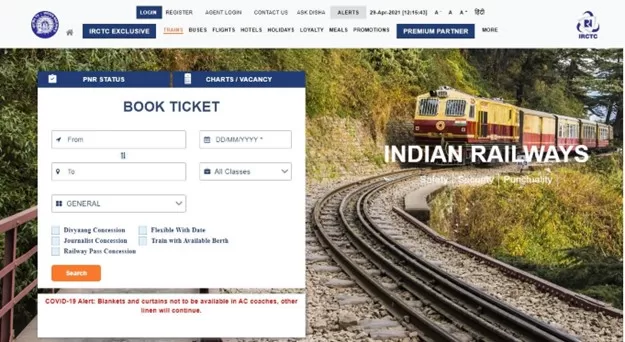
1. Access the IRCTC Portal

  • Go to the IRCTC website: www.irctc.co.in
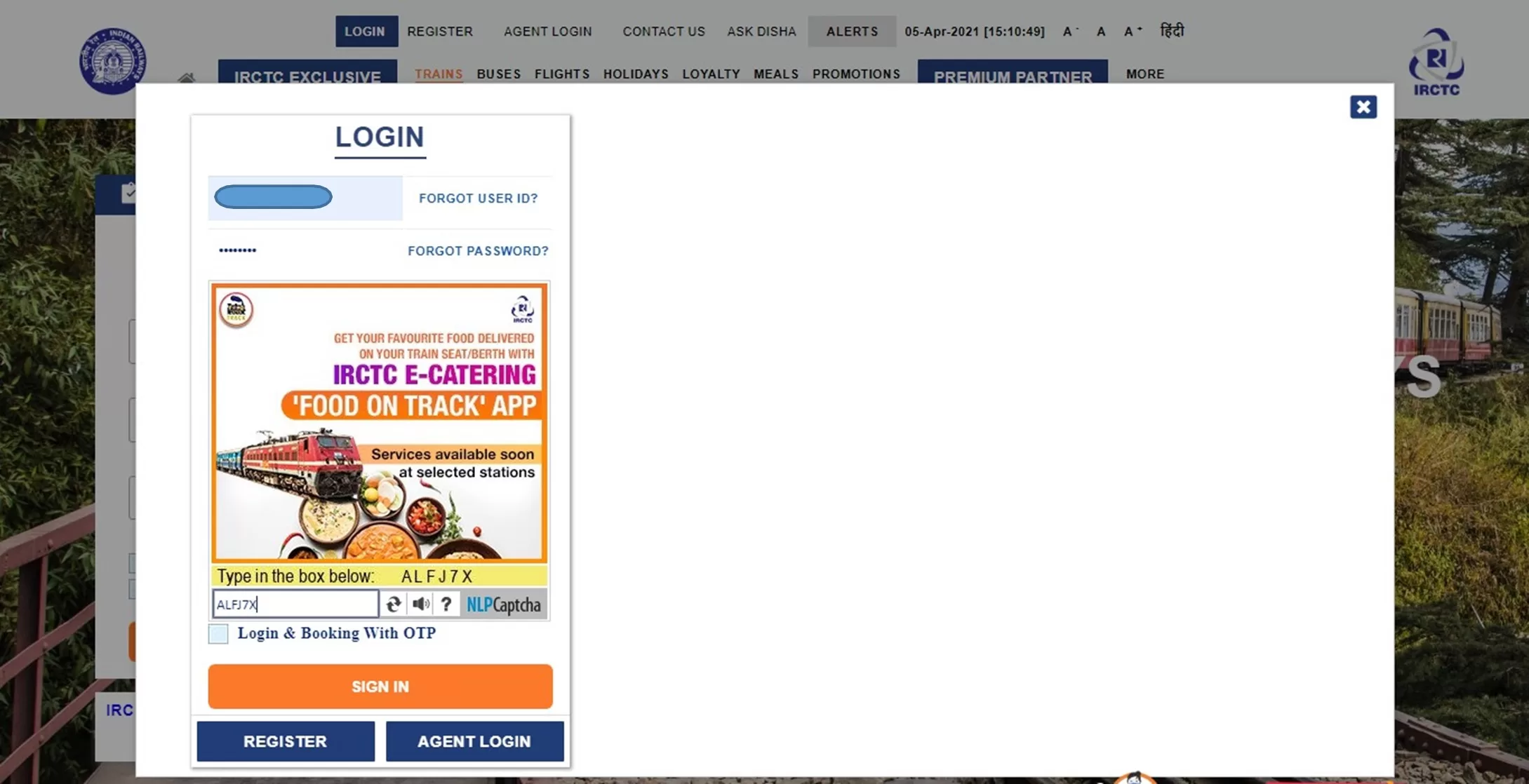
  • Click on the “LOGIN” button at the top.
  • Enter your registered User ID and Password to sign in.

2. Begin Booking Your Journey

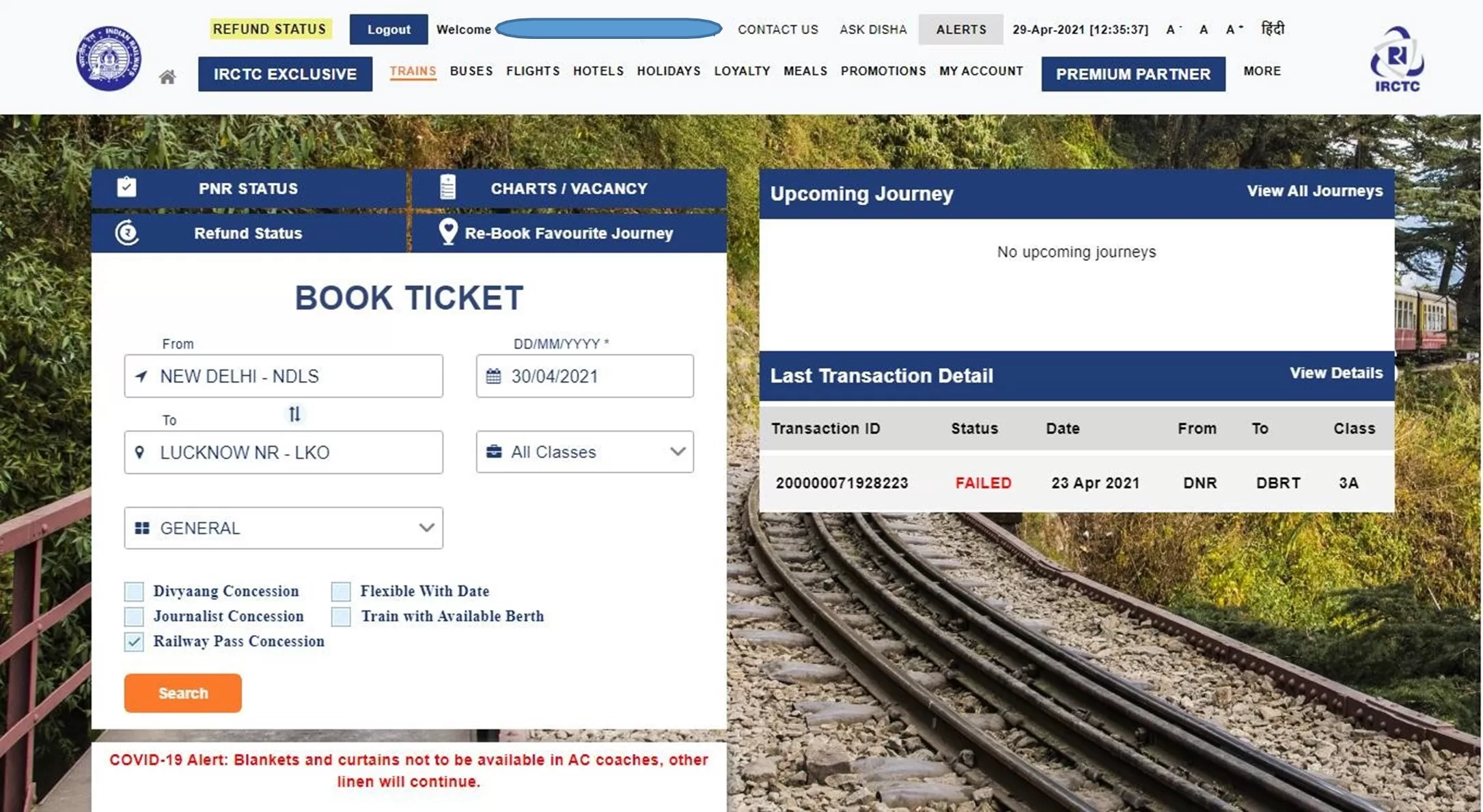
  • On the Book Ticket page, fill in:
    • From Station
    • To Station
    • Date of Journey
    • Quota
    • Class of Travel
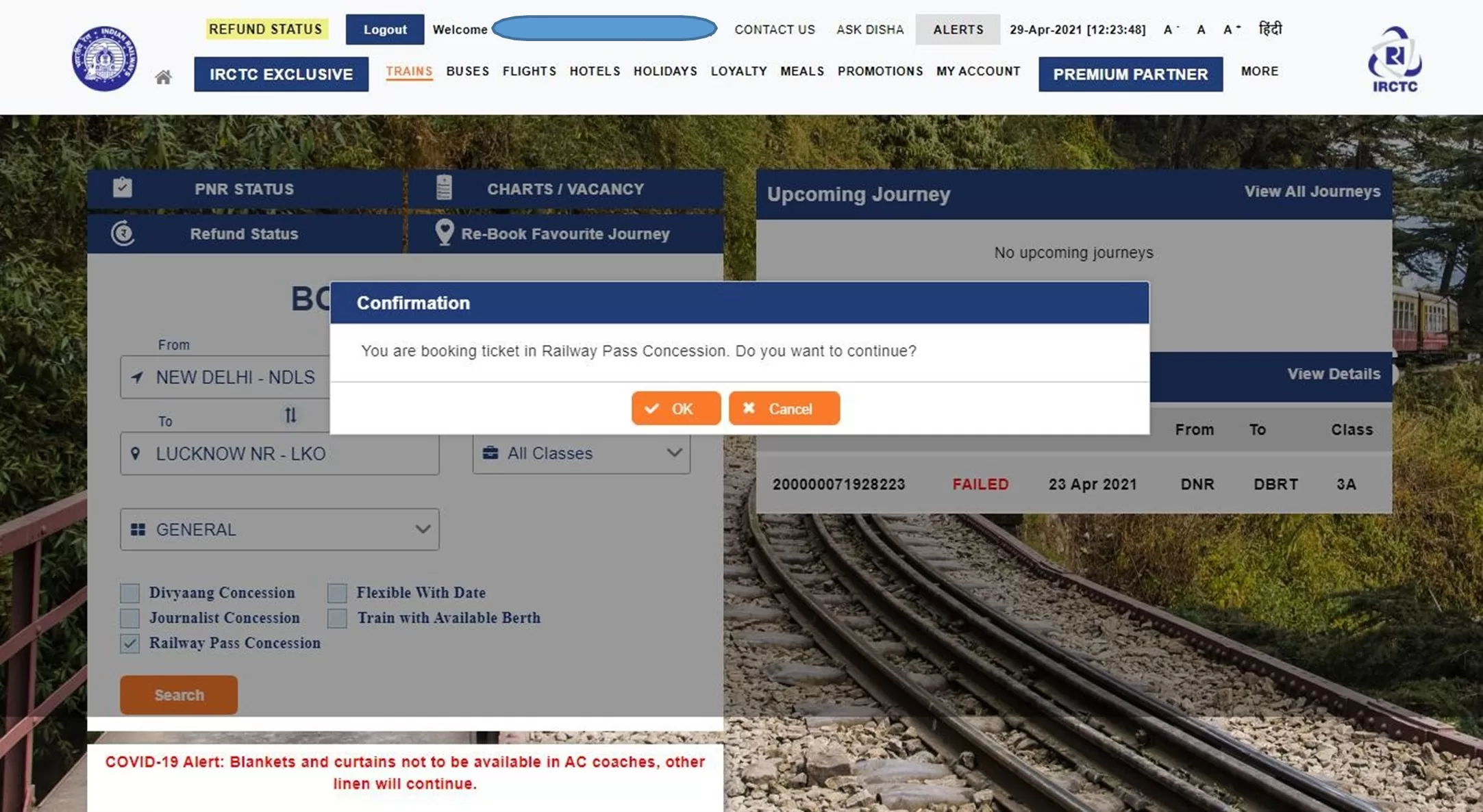
  • Check the “Railway Pass Concession” checkbox.

3. Confirm Concession Booking

  • A message will appear:
    “You are booking ticket in Railway Pass Concession. Do you want to continue?”
  • Click “OK” to proceed.

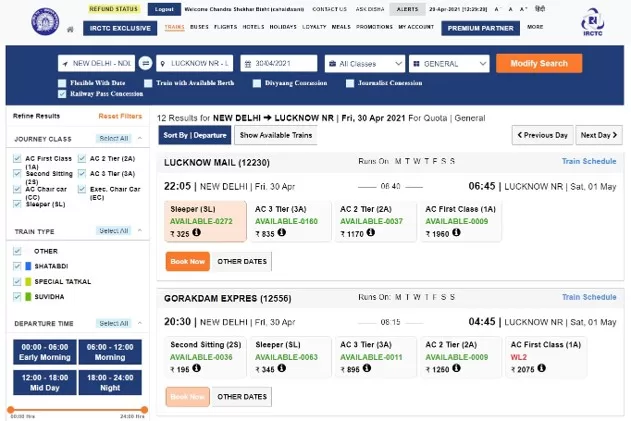
4. Search Trains

  • Optionally, check “Flexible with Date” if your journey date is not fixed.
  • Click “Search” to view train options.
  • On the next screen, you’ll see a list of available trains with class-wise seat availability.
  • Select the desired class and click “Book Now”.

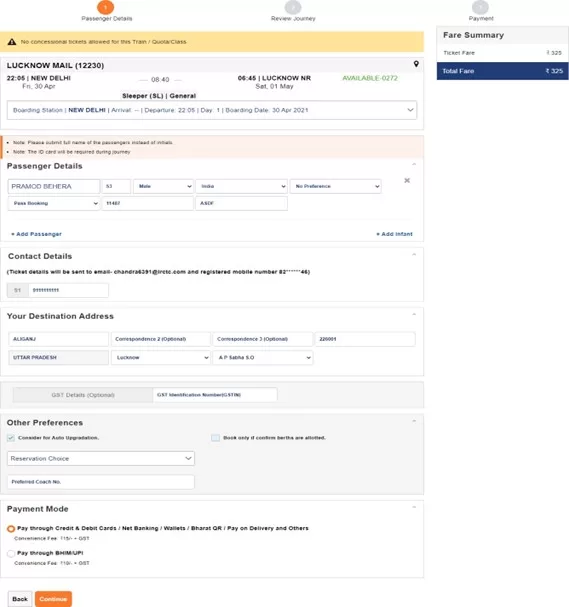
5. Enter Passenger Details

  • On the Passenger Reservation Page:
    • At least one passenger must be a Pass holder.
    • Enter:
      • Passenger Name
      • Age
      • Gender
      • For Pass holders:
        Select “Pass Booking” and enter:
        • Pass Number
        • Pass PIN Code
      • For non-pass holders, choose “General Booking”.
  • Add additional passengers using the “Add Passenger” option.
  • Enter Destination Address.
  • Modify Boarding Station if needed using the dropdown menu.
  • Provide Mobile Number and select Payment Mode.
  • Click “Continue” to proceed.

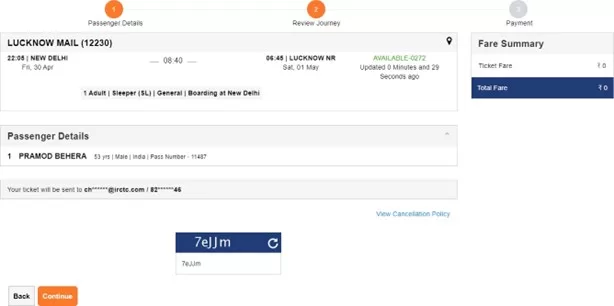
6. Review Booking

  • On the Booking Review Page, you will see:
    • Ticket details
    • Total fare
    • Berth availability
    • Pass information
  • Use the “Back” button if changes are needed.
  • Note:
    • No IRCTC convenience fee for tickets with only Pass/PTO passengers.
    • Fee applies for mixed bookings:
      • ₹15 + GST for SL and 2S
      • ₹30 + GST for other classes
    • Travel insurance is not available for pass bookings.
  • Enter the captcha and click “Continue”.

7. Payment and Confirmation

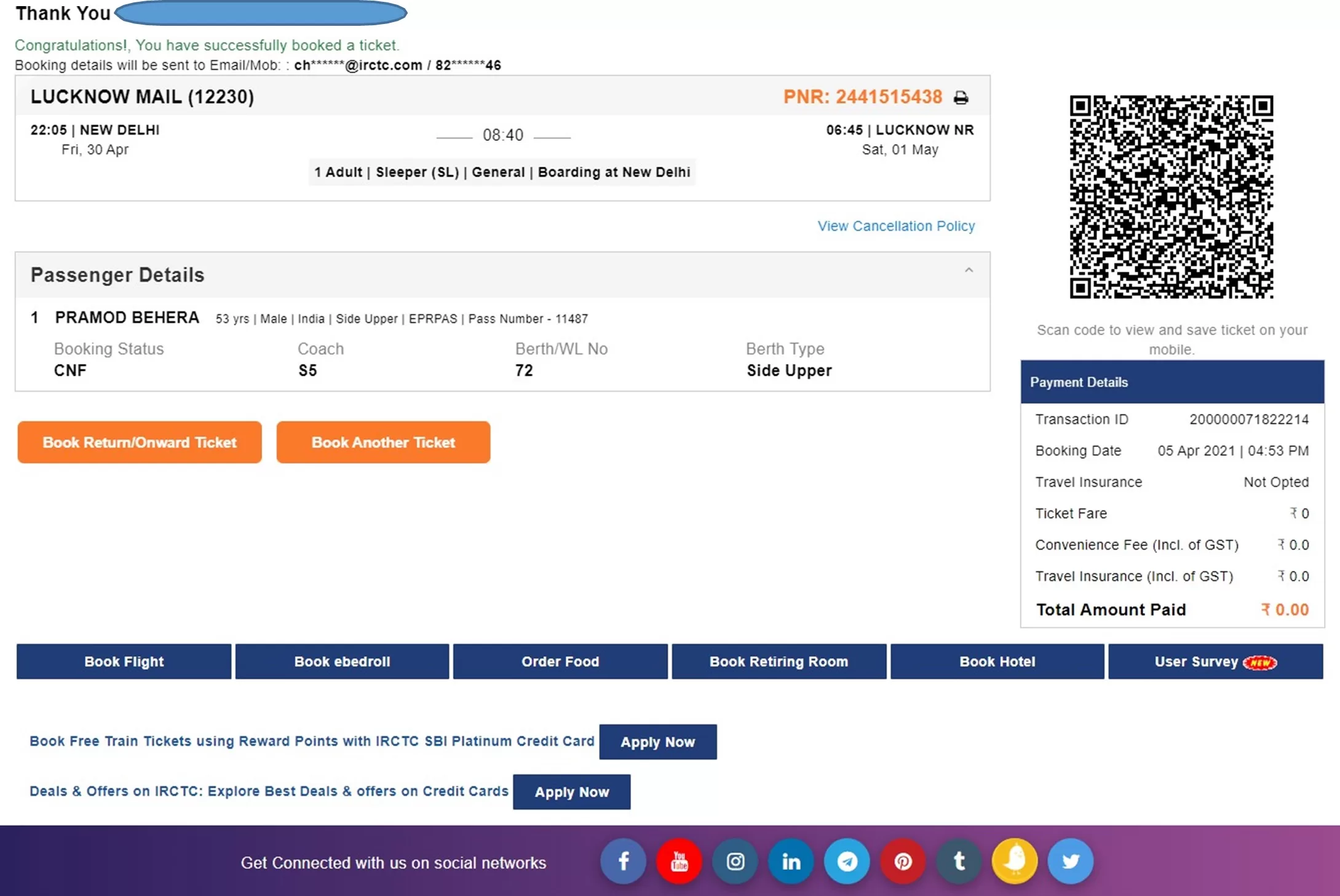
  • If the fare > ₹0:
    • Proceed to payment.
    • On success, PNR Number is generated.
  • If fare = ₹0:
    • Click “Continue”.
    • Booking is confirmed and PNR is generated.

8. Post-Booking

  • You will receive:
    • SMS (VRM) on your registered mobile number.
    • Booking Confirmation Email.
  • You can:
    • Print Electronic Reservation Slip (ERS) by clicking on the “Print Ticket” button next to PNR.
    • Use “Book Return/Onward Ticket” to reuse current passenger details.
    • Click “Book Another Ticket” for a fresh booking.

User guide in detail: Online train ticket on Railway e-pass
  • Login to the IRCTC website by clicking on “LOGIN” option provided at the top and enter your registered User ID and Password.
  • On Book Ticket Page, enter your desired “From station”, “To station”, “Date of Journey”, “Quota” and “Class” of travel.
  • Select the “Railway Pass Concession” checkbox.

A confirmation message will be displayed – “You are booking ticket in Railway Pass Concession. Do you want to continue?” Press “OK” to continue.

  • In case, you do not have any fixed date of journey, select “Flexible with Date” option.

To find train list, click on “Search” button.

  • The “List of Trains” will be displayed in next page with class wise availability and fare.
  • To select the train from the train list, select desired class of travel and click on “Book Now” button.
  • Passenger Reservation Page” will be displayed in the next page.
  • For booking a Pass Booking ticket, at least one of the travelling passenger must be pass holder.
  • Enter “Passenger Name”, “Age”, “Gender” and select concession option as “Pass Booking” for pass holder and provide “Pass Number” and “Pass PIN Code” as per the details available in pass issued.
  • Additional passenger can be added here by clicking on “Add Passenger” option.
  • Concession option for general passenger to be selected as “General Booking”.
  • Destination passenger address will be required to be provided under “Your Destination Address”.
  • Boarding Station for the journey can be changed by clicking the down arrow button on “Boarding Station” option provided on the Passenger Reservation Page by selecting the desired boarding station name from the drop down list.
  • After providing Passenger’s Mobile Number and selecting Payment Mode, click on “Continue” button to proceed next and to make any change in journey details “Back” button may be used.
  • Once the passenger details entered get verified with the details in pass issued, next page will be displayed as “Booking Review Page”.
  • The ticket details, Total fare, Availability of berths and Pass details will be displayed on the screen.
  • To make change in journey details, “Back” button may be used.
  • IRCTC convenience fee will not be levied on tickets booked for only Pass/PTO passengers.
  • IRCTC Convenience Fee (Rs. 15+GST for SL and 2S and Rs. 30+GST for all other classes) will be charged on tickets accompanying General passengers with PASS/PTO holders.
  • Travel insurance premium will not be charged for the time being on PASS booking tickets.
  • After checking all details, enter the captcha and click on “Continue” button.
  • If total fare to be paid is greater than zero, then payment option page will be displayed to make payment and “PNR number” will be generated after successful payment and successful response from PRS system.
  • If total fare to be paid is displayed as zero, then on clicking continue button Booking Confirmation Page will be displayed after successful response from the PRS system “PNR number” will be displayed.
  • “Virtual reservation message” (VRM) in the form of “SMS” will be sent on Registered Mobile Number.
  • Booking confirmation mail” will be sent on Registered Email ID.
  • Electronic Reservation Slip (ERS) can be printed by clicking on “Print Ticket” image button provided at next of PNR Number.
  • To book ticket for Return/Onward Journey, “Book Return/Onward Ticket” button may be used. Using this option will retain the details of Passengers as provided in the current ticket.
  • To book another ticket, “Book Another Ticket” button may be used.
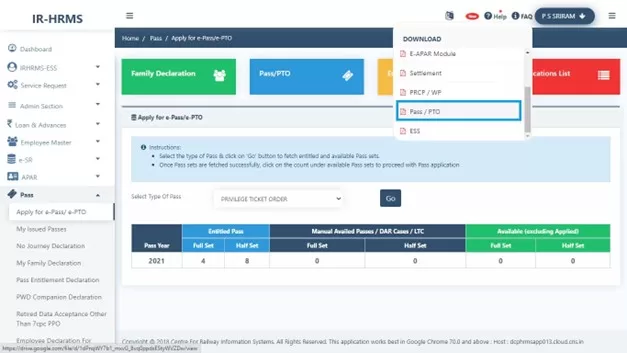
  • Pass booking related FAQs are provided in HRMS Dashboard. Please refer below screen.

I hope this guide for online train ticket booking on Railway e-PASS is helpful to you. For such content also read below links…

Also Read

Top 10 Updates in Indian Railways You Should Know in 2025

Indian Railways latest news (Top 10 updates in 2025)

Indian Railways, one of the world’s largest rail networks, continues its journey of transformation in 2025. From high-speed trains to digital innovations and station modernization, the national transporter is evolving rapidly to serve both passengers and the economy better.

Here are the top 10 Indian Railways update you should know in 2025:


1. ? Launch of 9,000 HP Electric Locomotive

In April 2025, Indian Railways unveiled its first 9,000 HP electric locomotive, built at the Dahod workshop in Gujarat. This high-horsepower engine is expected to revolutionize freight movement by increasing hauling capacity and reducing transit times.

Why it matters: More powerful locomotives will improve logistics efficiency and support “Make in India” goals.


2. ? IRCTC SwaRail App Goes Live

The SwaRail mobile app, launched by IRCTC, allows users to book tickets, check PNR status, file complaints, and view train running status—all in one place.

  • Download for Android mobile: Link

Why it matters: The app simplifies train travel for millions and reduces dependence on third-party platforms.


3. ?️ 103 Stations Redeveloped Under Amrit Bharat Scheme

Over 100 railway stations were inaugurated this year after massive revamps under the Amrit Bharat Station Scheme. Enhancements include LED lighting, waiting lounges, footbridges, elevators, and retail spaces.

Why it matters: Passengers now experience airports-like facilities at major stations.


4. ? Vande Bharat Network Expansion

The number of Vande Bharat Express trains has expanded significantly in 2025, with new routes covering smaller towns and border regions like Jammu, Siliguri, and Tirupati.

Why it matters: Faster and more comfortable travel is now accessible to more people, boosting regional connectivity.


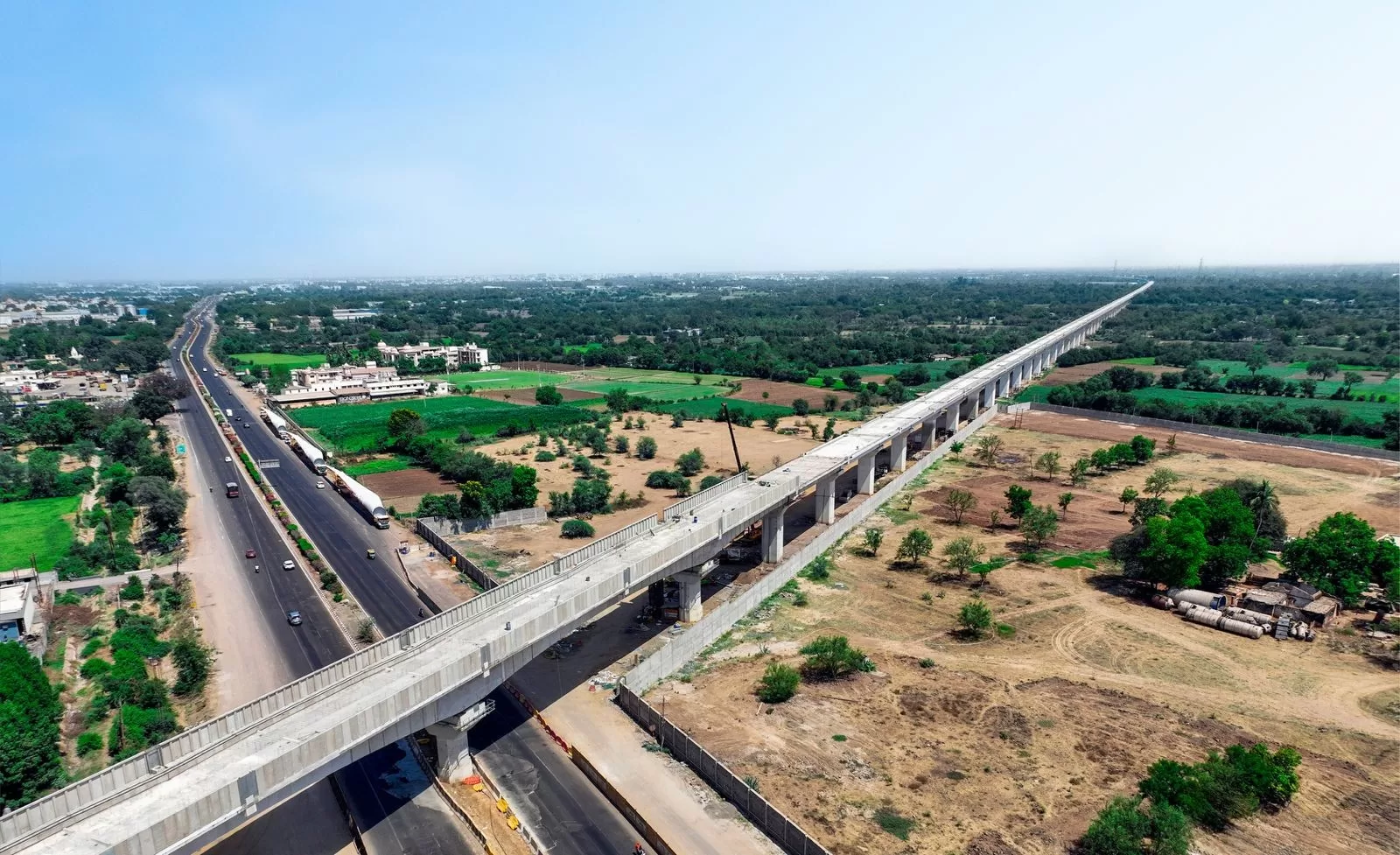
5. ?️ 300 km of Bullet Train Viaduct Completed

The Mumbai–Ahmedabad Bullet Train Project has achieved a major milestone with over 300 km of viaducts completed. Construction is on track for the first phase to be operational by 2026.

Why it matters: India is closer than ever to high-speed rail travel, matching global standards.


6. ? Railway Budget 2025 Prioritizes Modernization

The Union Budget 2025 allocated ₹2.7 lakh crore to Indian Railways. Funds are being directed toward electrification, safety systems like Kavach, and AI-based train scheduling.

Why it matters: A modern, digitized railway system is on the horizon.


7. ?‍✈️ Toilets for Loco Pilots in 150 Locomotives

Southern Railway is retrofitting 150 locomotives with in-cab toilets for loco pilots, especially benefiting female staff. This step follows years of demand from frontline employees.

Why it matters: Enhancing crew comfort means safer and more humane working conditions.


8. ? Digital Parcel Booking & Cargo Platform Launched

Indian Railways introduced a digital platform for parcel and cargo booking, enabling MSMEs and traders to track and schedule freight seamlessly online.

Why it matters: It supports e-commerce growth and makes Railways a stronger logistics partner.


9. ? Railway Wi-Fi Now at Over 9,000 Stations

Free public Wi-Fi is now available at more than 9,100 railway stations across India, including rural and semi-urban areas.

Why it matters: Digital inclusion and connectivity are improving for all travelers.


10. ? New Rail Lines for Strategic and Rural Regions

Work has begun on key projects like the Gunupur-Theruvali line in Odisha and other strategic routes in border areas.

Why it matters: These projects boost both national security and rural development.


From cutting-edge technology to infrastructure overhauls, Indian Railways is undergoing a once-in-a-generation transformation. Whether you’re a frequent traveler, rail enthusiast, or policy follower, these developments mark a new chapter in how India moves—efficiently, safely, and sustainably. These are 10 important updates from Indian Railways latest news.

Stay tuned to RailMinistry.com for more updates, in-depth stories, and real-time Indian railways latest news from across India.

Also Read

Latest Railway Board Circulars 2025

Railway Board Circulars 2025 (RBE No. & Year)
RBE No & YearDateLetter NoDescription
01/202502/01/2025E(NG)II/2024/RR-1/41Minimum Educational Qualification for recruitment from open Market in Level-1 of the pay matrix of 7th CPC.
02/202506/01/20252024/E(Trg.)/41/15Periodicity of Refresher Course of Chief Loco Inspector (CLls).
03/202515/01/20252024/E(Trg)/41/22Revised Module for Refresher Course for JEs/ SSEs of Diesel organization.
04/202516/01/2025PC-VII/2019/RSRP/3(Pt.I)Upgradation of Pay Structure of certain cadres under RBE 155/2022 dated 17.11.2022.
05/202527/01/20252024/E(Trg.)/43/4Revision in Training Period of Technician Category.
07/202527/01/2025F(E)I/2024/AL-28/34Payment of difference/arrears of TA/DA arising out of enhancement of rate by 25% upon revision of DA to 50% w.e.f. 01.01.2024- clarification-reg.
08/202530/01/2025E(GP)2006/2/17Holding of Selections for promotions to Group – B posts of Public Relation Officer on the Railways – Authorities for setting up of Question Papers.
09/202530/01/20252024/F(E)III-PN1/8Clarification on deletion of name of daughter from the family details of a Railway pensioner.
10/202503/02/2025E(GP)2024/2/28 (E.No.3466256)Promotions from Group – C to Group – B posts through 70% Selection – Centralized CBT.
11/202504/02/2025E(P&A)I-2012/PS-5/PE-3(pt)Amendments in the minimum qualifications for the post of Primary Teachers in Railway Schools.
12/202506/02/20252024/E(W)/13/8Clarification regarding the facility of substitution for Staff Benefit Fund Committee (SBFC) Meetings/Camps. (ACS No.148)
13/202506/02/20252024/F(E)III/NPS1/6Contribution by the Railway employee to the National Pension System in respect to railway employees covered under NPS.
14/202506/02/20252024/F(E)III/NPS1/9Contribution by the Government to the National Pension System in respect to railway employees covered under NPS.
15/202513/02/20252025/F(E)III/NPS1/1Effect of compulsory retirement or dismissal or removal from railway service on the accumulated pension corpus under NPS in respect of railway servant covered under the National Pension System-reg.
16/202519/02/20252025/E(Trg.)/41/1Revised Training Modules of Non-Gazetted Staff of Traffic Department.
17/202506/03/20252024-E(SCT)I/49/20Operation of Revised Post Based Rosters in Direct Recruitment for Scheduled Castes (SCs), Scheduled Tribes (STs) Other Backward Classes (OBCs) and Economically Weaker Sections (EWS), on introduction of 10 % reservation for
EWSs in Jobs.
18/202507/03/2025PC-V/2016/A/Med/1(FMA)(E)Grant of Fixed Medical Allowance to Railway pensioners/family pensioners – change in option.
19/202520/03/2025E(W)/2021/UN-1/2Corrigendum- Change in the colour of Uniform of C&W Staff.
20/202510/03/2025PC-III/2024/4/3(Re-designation)Revision of Designations of Staff of Accounts Department.
21/202511/03/2025PC-V/2020/M/1(NFIR)(E)Regulation of MACPS in case of promotion taking place in the pre-revised pay structure between 01.01.2006 and the date of notification of CCS(RP) Rules, 2008 and the subsequent merger of the pre-revised pay scales of the
promotional and the feeder posts in a common Grade.
22/202518/03/20252025/F(E)III/UPS/1Introduction of Unified Pension Scheme as an option under the National Pension System.
23/202526/03/20252024/F(E)III/NPS1/5Refund of employees share with returns thereon on availing benefits under Railway Service (Pension) Rules, 1993 or Railway Services (Extraordinary Pension) Rules, 1993 in the event of death of a railway servant covered under National Pension System or his discharge on the ground of disablement or invalidation.
24/202527/03/2025E(GP)2007/2/5Promotion to Gr. B post of Assistant Library & Information Officer.
25/202528/03/2025E)III/2025/UPS/1Pension Fund Regulatory and Development Authority (Operationalization of Unified Pension Scheme under National Pension System) Regulations, 2025 -regarding.
26/202501/04/2025F(E)III/2025/PN1/2Condition for grant of additional pension to the retired Railway Employees covered under Railway Services (Pension) Rule, 1993-reg.
27/202503/04/2025E(G) 2016 RN 2-1Retention of Railway accommodation at previous place of posting by Railway officers /staff on their deputation to NHSRCL – reg.
29/202503/04/2025PC-III/2000/GIS/2Central Government Employees Group Insurance Scheme, 1980 – Tables of Benefits for the Savings Fund for the period from 1.01.2025 to 31.03.2025..
30/202508/04/2025E(G) 2025 RN 2-3Retention of Railway quarters on transfer to Jammu Division of Northern Railway – reg.
31/202509/04/2025PC-VII/2016/I/7/2/1Grant of Dearness Allowance to Central Government employees – Revised Rates
effective from 01.01.2025.
32/202516/04/2025E(NG)I/2025/TR/8Threshold value for processing Inter Railway request transfer application.
33/202523/04/2025E(NG)i-2018/CFP/5Amendment to Note (4) below Para 189(i) of IREM, Vol-I (ACS No.290).
34/202529/04/2025E(NG)II/2006/PO/NR/10(Pt)Extension of Special Concessions/incentives to Central Government employees working in Kashmir Valley in attached/subordinate offices or PSUs falling under the control of Central Government for a further period of three years
with effect from 01.08.2024.
36/202529/04/2025F(E)I/2025/AL-28/4Modification of Instructions regarding Air Travel Entitlements of Railway officers on Tour/ Duty and Delegation of Powers w.r.t. Sanctioning of Air Travel.
39/202502/05/2025E(G) 2024 RN 2-3Permission for retention of Railway accommodation at the previous place of posting – reg.
41/202506/05/20252023/E(LL)/OTA/3Payment of OTA to Supervisory categories /Grades (performing non-supervisory role) of staff of all concerned Departments over the Railways

Also Read

Air Travel Entitlements of Railway officers on Tour/Duty

Air Travel Entitlements of Railway officers on Tour and Duty

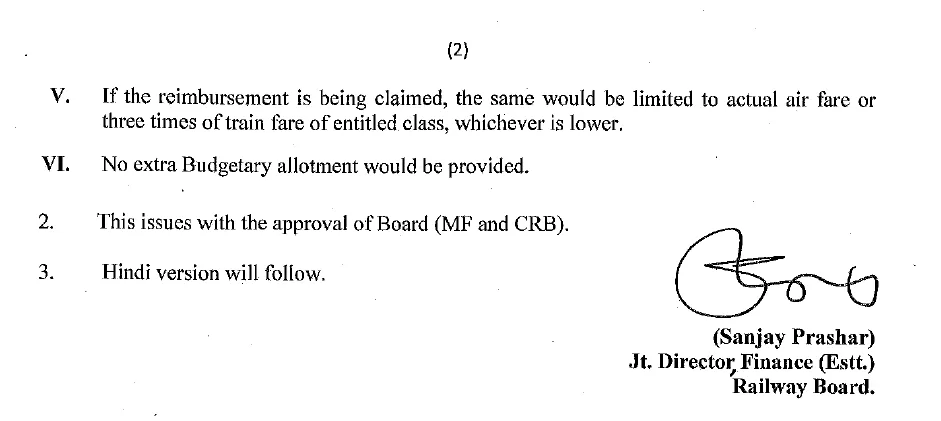
Railway Board has issued latest Instructions regarding Air Travel Entitlements of Railway officers on Tour/Duty and Delegation of Powers w.r.t. Sanctioning of Air Travel vide Letter No. F(E)I/2025/AL-28/4, Dated 29.04.2025.

RBE No. : 36/2025, Dated 29.04.2025

Earlier References in this regard: Railway Board’s letters No. F(E)I/2017/AL-28/41, dated 24.04.2018, 08.05.2018 & 10.05.2018 and Board’s letter No. F(E)I/2021/AL-28/47, dated 13.08.2021.

Instructions regarding air travel entitlements of Railway officers on tour/duty and delegation of powers w.r.t. sanctioning of air travel have been issued from time to time. It has now been decided in modification to all the earlier instructions on the subject that the revised instructions regarding air travel on tour/duty will be as following:

I. PHOD/CHOD in Zonal Railways/PUS, CAO/C in Construction Organizations, DGs in CTIs and DRM in Divisional offices may, for officers under their control, sanction travel by air on duty:

(i) Without Finance concurrence for officers in Pay Matrix Level-14 & above.

(ii) With Finance concurrence for officers in Pay Matrix Level-13 & below.

II. In Railway Board, power to sanction air travel on duty by officers shall remain with AMs/PEDs. However, prior Finance concurrence shall be mandatory for air travel on duty by officers below the Director level.

III. Air travel entitlement for officers of Level-13 and below would be in Economy Class and for officers in Level-14 and above would be as per MoF/DoE’s instructions issued vide O.M. No. 19030/1/2017/-E.IV, dated 13.07.2017, i.e., in Business / Club Class.

IV. The officer will have to submit a self-certification in his/her Tour Programme and also with TA/DA claim that no Group C staff is being booked/has travelled on duty with the officer.

V. If the reimbursement is being claimed, the same would be limited to actual air fare or three times of train fare of entitled class, whichever is lower.

VI. No extra Budgetary allotment would be provided.

This issues with the approval of Board (MF and CRB).


What is new in these instructions on Air Travel Entitlements of Railway officers
  • Level-14 officers (SAG) and above can travel in Business / Club classes.
  • There will not be any requirement of sanction from General Managers (GM) for Air travel.
  • Reimbursement is limited to actual air fare or three times of train fare of entitled class, whichever is lower. This condition of maximum reimbursement can be discussed considering the fare of flights for business class.

Also Read…

The Future of Railways: A Global Push Toward AI-Driven Automation

Railway transportation is undergoing a transformation powered by artificial intelligence and automation. From autonomous trains running on heavy-haul freight lines to AI-based traffic management systems optimizing scheduling and energy consumption, the rail industry worldwide is embracing a future of safer, more efficient, and environmentally friendly operations. This article explores the key players, technologies, and initiatives driving this revolution.


Autonomous Trains: From Mining Rails to High-Speed Networks

Freight and Heavy-Haul Operations

One of the most striking examples of railway automation is Rio Tinto’s AutoHaul project in Western Australia. Launched to operate driverless iron ore trains, AutoHaul covers over 1,900 kilometers of track, marking the world’s first fully autonomous heavy-haul rail network. The trains, which operate without onboard crews and are supervised remotely, have already logged millions of kilometers, showcasing how AI-driven control systems can boost safety and productivity in challenging environments. Collaborations with technology providers like Hitachi Rail have been pivotal in implementing advanced signalling and obstacle detection systems that ensure continuous, efficient operation .

Passenger Rail and Mainline Innovations

In the passenger rail sector, innovation is equally rapid. In Hamburg, Deutsche Bahn and Siemens Mobility demonstrated the world’s first automated, driverless train on a traditional rail network. These trials, part of Germany’s “Digital Rail for Germany” initiative, have introduced Automatic Train Operation (ATO) on S-Bahn commuter services. Although human staff remain onboard as a safeguard, the AI system autonomously handles station stops, speed adjustments, and energy management, promising improvements in capacity and punctuality.

Meanwhile, France’s SNCF, in consortium with industry leaders such as Alstom, Thales, and Bosch, is testing autonomous regional train prototypes. Their efforts, supported by government-backed research, aim to achieve full autonomy in the coming years. In China, the launch of a driverless high-speed bullet train during the Beijing Winter Olympics marked another milestone. This Fuxing high-speed train, operating at 350 km/h, leverages AI, 5G connectivity, and a suite of sensors to automatically manage departures, cruising, and stops—underscoring China’s aggressive pursuit of smart railway technologies .

Startup Innovations in Autonomous Rail

Startups are also making significant strides in autonomous rail technology. Companies like Railspire are retrofitting existing locomotives with AI autopilot systems for railyard operations. These solutions, designed for confined environments like switching yards, blend human oversight with AI precision, enhancing safety and operational efficiency in areas traditionally prone to errors.

AI-Powered Traffic Management and Real-Time Control

Efficient railway operations depend not only on the individual performance of trains but also on the seamless coordination of entire networks. Advanced AI systems are being deployed to manage real-time train movements and schedule adjustments.

Dispatching and Scheduling with AI

Companies such as Wabtec have developed tools like the Movement Planner, an AI-based dispatch system that automatically calculates optimal routes and meet-pass plans for trains. This technology is particularly impactful for freight railroads, where dynamic scheduling and conflict resolution can significantly reduce delays and improve network throughput. By analyzing data on train locations, speeds, and network constraints, AI systems can suggest real-time schedule tweaks that streamline operations .

Disruption Management and Route Reoptimization

Rail operators are increasingly relying on AI to manage disruptions. Hitachi Rail’s hybrid railway traffic management system is designed to quickly reschedule trains during delays or incidents. This system draws on machine learning to mimic the decision-making of experienced controllers, providing swift, data-driven solutions that restore normal operations faster than conventional methods. Similarly, Deutsche Bahn has tested AI tools that flag potential conflicts before they escalate, ensuring proactive adjustments that minimize the impact of delays .

Enhancing Safety Through Vision and Sensing

Safety remains paramount in railway operations. AI-powered vision systems, such as those developed by Rail Vision in Israel, use deep learning and sensor fusion (cameras, LiDAR, and radar) to detect obstacles on tracks up to 2 km ahead. These systems not only alert train operators but can also trigger emergency braking in fully automated setups. Such technologies are crucial for both autonomous trains and traditional operations, ensuring that advanced automation does not compromise safety .

Energy Optimization: Smarter, Greener Rail Operations

In addition to operational efficiency and safety, AI is playing a key role in reducing energy consumption and emissions across the rail network.

Intelligent Cruise Control and Energy Savings

Wabtec’s Trip Optimizer is a prime example of how AI can enhance energy efficiency. By analyzing variables such as track gradients, curves, speed limits, and train weight, Trip Optimizer computes the most energy-efficient driving profiles. Acting like an autopilot, it modulates throttle and braking to conserve fuel, which has resulted in substantial cost savings and a significant reduction in CO₂ emissions. Similar energy management systems in electric train operations leverage regenerative braking and optimized acceleration patterns to further decrease energy usage .

AI in Passenger Rail Efficiency

For passenger rail services, AI not only improves punctuality but also contributes to greener operations. Automated driving profiles in S-Bahn trains, for instance, reduce energy waste by ensuring that acceleration and braking are performed optimally. This results in both lower operational costs and a reduced environmental footprint—a critical advantage as urban transit systems strive for sustainability .

Global Initiatives and Future Outlook

The transformation of railway operations is supported by extensive government and industry initiatives worldwide:

  • Germany’s Digital Rail for Germany funds pilot projects like the Hamburg S-Bahn autonomous train, paving the way for nationwide implementation of AI-driven technologies.
  • France’s Autonomous Train Consortium brings together major industry players and research institutes to fast-track the development of driverless regional trains.
  • China’s Smart Rail Strategy has led to the launch of the world’s first autonomous high-speed train, backed by significant state investment.
  • European Union Programs such as Shift2Rail (and its successor, Europe’s Rail) promote cross-border collaboration in developing innovative railway solutions, from autonomous freight operations to intelligent energy management.

These initiatives, combined with rapid advances from startups and established companies alike, point to a near-future where AI and automation are integral to every facet of railway transportation.

Conclusion

AI-driven railway automation is not just a futuristic concept—it is actively reshaping the industry around the globe. With projects ranging from Rio Tinto’s autonomous mining trains and Germany’s driverless S-Bahn services to China’s high-speed bullet trains and innovative startup solutions, the rail sector is on the cusp of a major transformation. By integrating advanced AI for traffic management, safety, and energy efficiency, the industry is poised to deliver unprecedented improvements in reliability, performance, and sustainability. As global initiatives and collaborative research continue to drive these technologies forward, the next decade promises to usher in a new era of smart, autonomous railways.

Author of the Article
Aryaman Chaudhary 
Founder Trackster

Also Read…

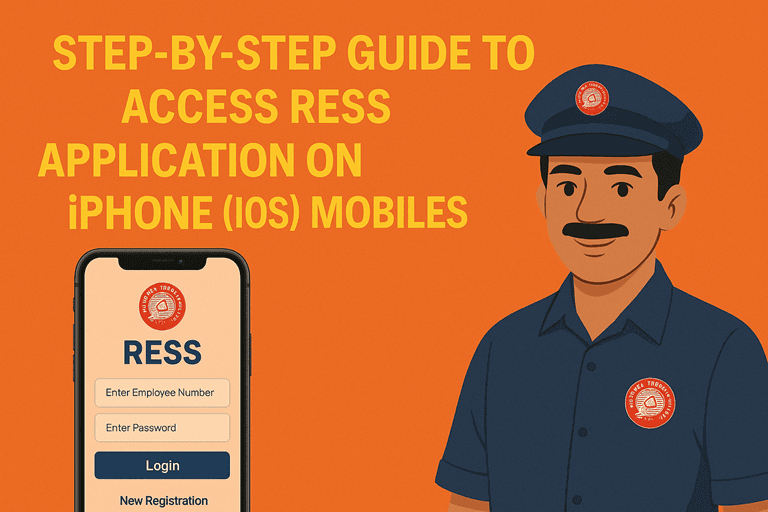
RESS on iPhone (iOS) for Railway Employees salary slip

​Hey! If you’re trying to access RESS (which typically refers to the Railway Employee Self Service portal used by Indian Railways staff), here’s how you can do it on an iPhone (iOS):

Step-by-Step Guide to Access RESS on iPhone (iOS) users

RESS app is not listed on the Apple App Store for iOS devices.​ Though, the Railway Employee Self Service (RESS) application developed by the Centre for Railway Information Systems (CRIS) is available for Android devices on the Google Play Store.

However, iPhone users can also access RESS services through the mobile version. Here’s how:

How to use Railway Employee Self Service (RESS) application on iPhone mobiles?
  1. For iOS/iPhone user to click on the linkhttps://aims.indianrailways.gov.in/Public/Ress
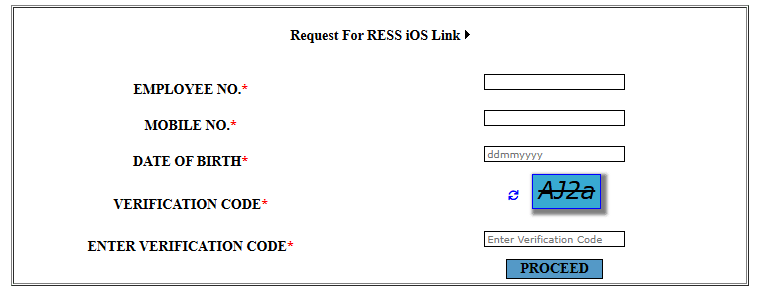
  2. A page will open as below:-
  1. Fill the employee details like

All the fields are mandatory. Please ensure that Mobile number is registered. OTP will be sent on to registered mobile number only. After filling all the details click to PROCEED.

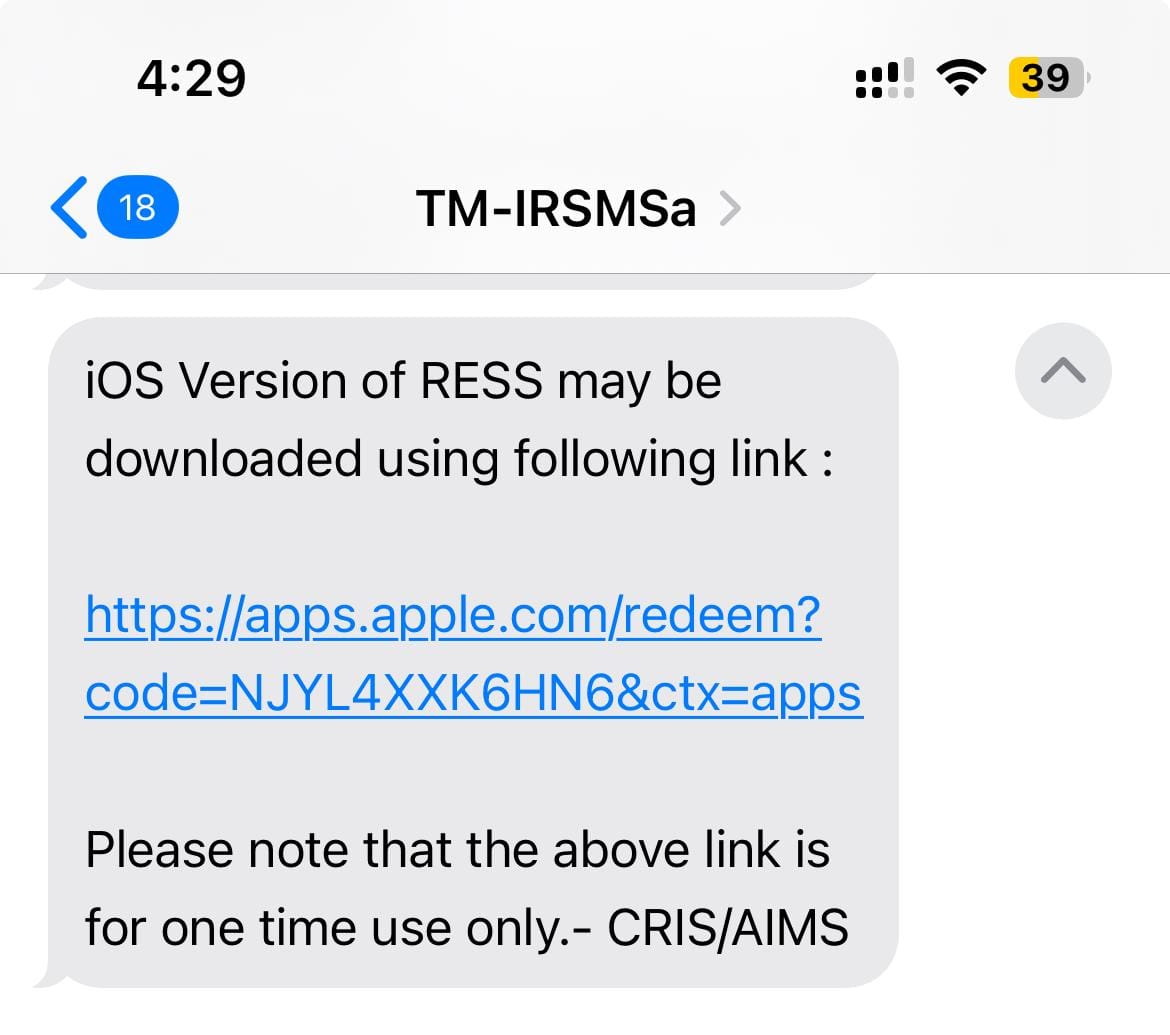
  1. SMS on registered mobile number will be sent with the link to download...
  1. On click of link received through SMS, iOS version app will be installed on your iPhone. Please note that the above link is for one time use only.

Enjoy the RESS app on your iPhone mobiles.

? Tips for Smooth Access

  • Make sure your mobile number is registered in the HRMS/AIMS database.
  • Employee details are readily available.

Also read…

NPS vs UPS: Which Retirement Plan Offers Better Benefits?

Retirement planning is a crucial financial decision. Choosing the right scheme can significantly impact your future security. With evolving policies in 2025, the battle of OPS vs. NPS vs UPS has become more intense. Each scheme comes with unique features. But which one truly offers the best benefits for you? Let’s dive deep into these three schemes to help you make an informed decision about your golden years.

Understanding NPS

In 2004, the National Pension System (NPS) replaced OPS for government employees. It was extended in 2009 to cover private-sector employees, self-employed individuals, and NRIs. Unlike OPS, NPS is a market-linked pension scheme where an individual’s retirement corpus depends on investment performance.

Employees contribute regularly, and upon retirement at 60, 40% of the accumulated corpus can be used for an annuity, and 60% can be withdrawn without the burden of taxation. There is no assured pension amount, as payouts depend on investment performance.

NPS Eligibility Criteria

  • Open to government and private-sector employees
  • Available for NRIs and self-employed individuals
  • Requires mandatory contributions during service

Pros of NPS

  • Higher returns due to market-linked investments
  • Partial lump sum withdrawal (60%) allowed at retirement
  • NPS deduction under Sections 80C, 80CCD (1B), and 80CCD (2)
  • Flexibility to choose fund managers and investment options

Cons of NPS

  • Pension is not guaranteed, as it depends on market performance
  • 40% of the corpus must be annuitised, reducing immediate liquidity
Understanding UPS

As you already know, the NPS and OPS full-form now, it’s time to learn what UPS stands for. Introduced in 2024, the Unified Pension Scheme (UPS) aims to provide a guaranteed pension similar to OPS but with a contribution model like NPS. It is currently available to all central government employees and may extend to state government employees.

Employees covered under NPS can switch to UPS, ensuring broader pension coverage. The scheme guarantees a pension amount of 50% of the average basic salary over the last 12 months before retirement for those with at least 25 years of service. Additionally, employees with a minimum of 10 years of service are entitled to a minimum pension of ₹10,000 per month upon superannuation.

In case of the pensioner’s death, their family will receive 60% of the last pension drawn. Employees contribute 10% of their basic salary and DA, while the government contributes 18.5%—a higher share than NPS’s 14%.

UPS Eligibility Criteria

  • Available to all central government employees (may extend to state employees)
  • Employees covered under NPS can switch to UPS
  • Requires 10% employee contribution of basic pay + DA

Pros of UPS

  • Guaranteed pension amount based on last 12 months’ salary
  • Higher government contribution (18.5%) compared to NPS (14%)
  • Family pension provision ensures financial security for dependents
  • Inflation-linked adjustments protect purchasing power
  • Gratuity benefits included

Cons of UPS

  • No lump sum payout at retirement
  • Taxation details unclear at this stage
  • It may not provide financial flexibility compared to NPS
OPS vs NPS vs UPS: Decoding the Key Differences
FeatureOld Pension Scheme (OPS)National Pension System (NPS)Unified Pension Scheme (UPS)
TypeDefined Benefit Scheme (Guaranteed pension)Market-linked Investment SchemeHybrid Pension Scheme (Guaranteed pension with contribution model)
Applicable ToCentral government employees appointed before 22 Dec 2003Government and private-sector employees, NRIs, self-employed individualsCentral government employees (may extend to state employees)
Employee ContributionNone10% of basic salary + DA10% of basic salary + DA
Government ContributionFully funded by the government14% of basic salary + DA18.5% of basic salary + DA
Pension CalculationBased on the last drawn basic salaryDepends on investment performance and annuity plan50% of average basic pay over the last 12 months (for employees with 25+ years of service)
Lump Sum Payout at RetirementNo60% of corpus (tax-free), 40% annuitisedNo
Family PensionYes, full pension benefits for the spouseDepends on the annuity plan chosen60% of the last pension drawn given to family
Inflation Protection (DA Revisions)Twice a yearNo guaranteed DA revisionYes, inflation-linked adjustments
Tax BenefitsNo tax benefitsTax deductions under Sections 80C, 80CCD (1B), and 80CCD (2)Taxation details are yet to be clarified
Risk FactorNo risk, fixed pensionMarket-dependent returns, no guaranteed pensionNo market risk, assured pension
Gratuity BenefitsYesYesYes
Flexibility in InvestmentNot applicableChoice of fund managers and investment optionsNot applicable
SustainabilityHigh burden on the government, increasing pension liabilitiesSustainable, self-funded through investmentsBalanced approach with government support

NPS vs UPS: Which One is the Best for You?

Choosing the right pension scheme depends on various factors, including job stability, risk tolerance, and retirement expectations. Here’s a comparative analysis to help you decide:

1. If You Want Flexibility and Market-Linked Growth:

Best Option:NPS

  • Allows individuals to choose their investment options and fund managers.
  • Offers tax benefits under Sections 80C, 80CCD (1B), and 80CCD (2).
  • Suitable for private-sector employees, NRIs, and self-employed individuals.
  • However, returns are not guaranteed as they depend on market performance.

2. If You Want an Assured Pension with Government Support:

Best Option:UPS

  • Provides a guaranteed pension amount of 50% of the last 12 months’ average salary (for employees with 25+ years of service).
  • Ensures an assured family pension and minimum pension.
  • Government contribution is higher (18.5%) than in NPS.
  • Ideal for government employees looking for a balance between assured benefits and sustainable funding.
  • However, the details of the taxation and long-term sustainability remain under review.

Final Verdict

  • OPS is ideal for those eligible for it, as it offers guaranteed benefits without personal contributions.
  • NPS suits individuals who are comfortable with investment risks and want tax advantages.
  • UPS appears to be a middle ground, providing government-backed financial security while ensuring sustainability.

For government employees hired after 2004, UPS might be a better alternative to NPS due to its assured pension benefits. However, private-sector employees and self-employed individuals will still find NPS the only viable option. Ultimately, the best plan depends on your employment type, financial goals, and risk preference.

Conclusion

Selecting the right pension scheme—OPS, NPS, or UPS—depends on your financial goals, job security, employer status and risk appetite. OPS offers lifelong stability but is available only to a limited group. NPS provides flexibility and market-linked returns, making it suitable for private-sector employees and self-employed individuals. UPS, the latest scheme, strikes a balance by offering guaranteed pensions. As pension policies evolve, it’s essential to stay informed about updates and choose the plan that aligns best with your future security needs.

FAQs:

1. What is the difference between OPS and NPS?

OPS provides a guaranteed, lifelong pension based on the last salary drawn, with no employee contributions required. NPS is a market-linked scheme in which employees contribute a portion of their salary, and the pension amount depends on investment returns. OPS ensures financial security, while NPS offers flexibility but lacks guaranteed benefits.

2. Which is better, OPS, NPS, or UPS?

OPS is the best for financial security, as it guarantees a pension without requiring contributions. NPS is suitable for private-sector employees and those preferring investment-linked growth, though it lacks assured returns. UPS balances both, offering a fixed pension with mandatory contributions and making it a structured alternative to NPS.

3. What will happen to NPS after UPS?

UPS is expected to replace NPS for government employees, providing an assured pension model instead of market-dependent returns. Employees under NPS may be able to switch, but details on fund transfers and taxation are yet to be clarified. The transition will impact retirement planning, making it essential to stay updated on policy changes.

4. Is UPS better than OPS?

OPS is fully government-funded and offers a pension based on the last salary drawn, whereas UPS requires employee contributions and calculates pensions based on a 12-month average salary. While UPS aims to be sustainable for the government, OPS provides better financial security for retirees. OPS remains the preferred choice for those eligible due to its non-contributory nature and predictable benefits.

5. What is the new pension scheme for 2025?

The Unified Pension Scheme (UPS) is designed to replace NPS for government employees. It offers a defined pension structure and ensures a minimum pension of ₹10,000 per month, with government contributions set at 18.5%. Unlike NPS, UPS provides guaranteed benefits but may lack lump sum withdrawal options upon retirement.

6. How much pension is available from NPS?

The pension amount in NPS is not fixed, as it depends on the total accumulated corpus and annuity plan chosen at retirement. Upon retirement, 60% of the corpus can be withdrawn tax-free, while the remaining 40% must be invested in an annuity to receive a monthly pension. The exact pension amount varies based on market returns, annuity rates, and individual contributions.

7. Which pension scheme offers the most tax benefits?

NPS offers the most tax benefits, with deductions available under Section 80C (₹1.5 lakh), Section 80CCD(1B) (₹50,000), and Section 80CCD(2) for employer contributions. OPS does not provide tax-saving benefits during service but ensures a tax-free pension in retirement. UPS taxation details are still awaited, but it is expected to follow a structure similar to OPS.

8. Is UPS only for government employees?

In 2024, the Union Cabinet approved the Union Pension Scheme (UPS) to provide a minimum assured pension to central government employees. UPS has been introduced as an optional component within the National Pension System (NPS). It will be available to central government employees already enrolled in NPS and opting for the scheme.

Also Read.

UNOFFICIAL Information center for Indian Railways

Exit mobile version