Notice: Function WP_Scripts::localize was called incorrectly. The $l10n parameter must be an array. To pass arbitrary data to scripts, use the wp_add_inline_script() function instead. Please see Debugging in WordPress for more information. (This message was added in version 5.7.0.) in /home4/railmu7v/public_html/wp-includes/functions.php on line 6170
Notice: Function WP_Scripts::localize was called incorrectly. The $l10n parameter must be an array. To pass arbitrary data to scripts, use the wp_add_inline_script() function instead. Please see Debugging in WordPress for more information. (This message was added in version 5.7.0.) in /home4/railmu7v/public_html/wp-includes/functions.php on line 6170
Notice: Function WP_Scripts::localize was called incorrectly. The $l10n parameter must be an array. To pass arbitrary data to scripts, use the wp_add_inline_script() function instead. Please see Debugging in WordPress for more information. (This message was added in version 5.7.0.) in /home4/railmu7v/public_html/wp-includes/functions.php on line 6170
Notice: Function WP_Scripts::localize was called incorrectly. The $l10n parameter must be an array. To pass arbitrary data to scripts, use the wp_add_inline_script() function instead. Please see Debugging in WordPress for more information. (This message was added in version 5.7.0.) in /home4/railmu7v/public_html/wp-includes/functions.php on line 6170
Skip to content
Family pension under OPS on death of Railway Employee covered under UPS
Railway board vide RBE No.76/2025, dated 29.07.2025 issued revised guidelines regarding Options to avail benefits under old pension scheme on death of Government servant during service or his discharge from Government service on account of invalidation or disability for Central Government servants covered under Unified Pension Scheme.
When a Government servant dies while in service, the family is entitled to benefits as per the Old Pension Scheme, even if the employee was covered under UPS.
Revised rule under UPS issued by Ministry of Personnel, P.G. and Pensions on 18.07.2025.
Subject: Options to avail benefits under old pension scheme on death of Government servant during service or his discharge from Government service on account of invalidation or disability for Central Government servants covered under Unified Pension Scheme
The undersigned is directed to refer to the Ministry of Finance, Department of Financial Service’s Notification No. FS-1/3/2023-PR dated 24.01.2025 regarding introduction of the Unified Pension Scheme (UPS) as an option under NPS for the recruits to the Central Government civil service w.e.f. 01.04.2025 giving one time option to the Central Government employees covered under the National Pension System (NPS) for inclusion under the UPS.
The Department of Pension and Pensioner’ Welfare had notified the CCS (Implementation of National Pension System) Rules, 2021 to regulate service related matters of Central Government employees covered under NPS. Rule 10 of these rules provides for the option to be exercised by every Central Government employee covered under NPS for availing benefits under NPS or Old Pension Scheme (OPS) in the event of death of Government servant during service or his discharge on the ground of invalidation or disablement.
UPS has been notified as an option under the NPS. Therefore, it has been decided that the Central Government civil employees who opt for UPS under NPS shall also be eligible for option for availing benefits under UPS or the CCS (Pension) Rules, 2021 or the CSS (Extraordinary Pension) Rules, 2023 in the event of death of the Government servant during service or his discharge on the ground of invalidation or disablement.
Every Central Government servant covered who opts for Unified Pension Scheme under the National Pension System shall, at the time of joining Government service, exercise an option in Form 1 for availing benefits under the UPS or under the CCS (Pension) Rules, 2021 or the CCS (Extraordinary Pension) Rules, 2023 in the event of his/her death or boarding out on account of disablement or retirement on invalidation. Existing Government servants, who have opted for the Unified Pension Scheme under the National Pension System, shall also exercise such option as soon as possible after the notification of these clarifications.
The option shall be exercised to the Head of Office who will accept the same after verifying all the facts submitted therein and place it in the service book. A copy of the option shall be forwarded by the Head of Office to the Central Recordkeeping Agency through the Drawing and Disbursing Officer and the Pay and Accounts Officer for their record. The Pay and Accounts Officer shall also make suitable entry in the online system indicating the details regarding the option exercised by the Government servant.
Every Government servant shall, along with the option in Form 1, also submit details of family in Form 2 to the Head of Office. The Head of Office shall, on receipt of the Form 2, acknowledge receipt of the Form 2 and all further communications received from the Government servant in this behalf, countersign it indicating the date of receipt and get it pasted on the service book of the Government servant concerned. The Head of Office on receipt of communication from the Government servant regarding any change in the size of family shall also incorporate such a change in Form 2.
The option exercised may be revised at any number of times by the Government servant before his retirement by making a fresh option intimating his revised option to the Head of Office. On receipt of the revised option, the Head of Office and the Pay and Accounts Officer shall take further action as mentioned above.
A Government servant who is discharged on invalidation or disability shall be given an opportunity to submit a fresh option at the time of such discharge. Where such Government servant does not exercise a fresh option or is not in a position to exercise fresh option at the time of discharge, the option already exercised by the Government servant shall become operative. Where no option was exercised by the Government servant and the Government servant is not in a position to exercise an option at the time of discharge, his case will be regulated in accordance with para 11 below.
In the case of death of a Government servant while in service, the last option exercised by the deceased Government servant before his death shall be treated as final and the family shall have no right to revise the option.
Where a Government servant who did not exercise an option and dies before completion of service of fifteen years, his family will be granted family pension in accordance with the provisions of the CCS (Pension) Rules, 2021 or the CCS (Extraordinary Pension) Rules, 2023, as the case may be, as a default option.
Where a Government servant is discharged from Government service on account of invalidation or disability before completion of service of fifteen years without exercising an option, and is also not in a position to exercise an option at the time of discharge, he will be granted invalid pension or disability pension in accordance with the provisions of the CCS (Pension) Rules, 2021 or the CCS (Extraordinary Pension) Rules, 2023 as the case may be, as default option;
In all other cases, where no option was exercised by the Government servant, the claim of the Government servant on discharge from the service and that of the family on death of the Government servant, shall be regulated in accordance with the regulations to be framed in this regard.
In cases where the option exercised by the deceased Subscriber or the default option for benefit under the CCS (Pension) Rules or the CCS (Extraordinary Pension) Rules becomes infructuous on account of non-availability of an eligible member of the family for grant of family pension under the CCS (Pension) Rules, 2021 or the CCS (Extraordinary Pension) Rules, 2023 such option would be deemed to have become invalid and the benefits admissible under the Unified Pension Scheme shall be granted in accordance with the regulations to be framed in this regard.
A Government servant, who had exercised option or in whose case the default option is for availing benefits under the CCS (Pension) Rules, 2021 or CCS (Extraordinary Pension) Rules, 2023 on death of Government servant during service or his discharge from service on account of invalidation or disablement, as the case may be, further action will be taken by the Head of Office for disbursement of benefits in accordance with the provisions of the CCS (Pension) Rules, 2021. Where the death or disablement of the Government servant is attributable to Government service, further action will be taken by the Head of Office for disbursement of benefits in accordance with the CCS (Extraordinary Pension) Rules, 2023 subject to fulfillment of all the conditions for grant of benefits under those rules.
If on death of the Government servant during service or his discharge from service on account of invalidation or disablement, benefits are payable under the CCS (Extraordinary Pension) Rules, 2023 or the CCS (Pension) Rules, 2021, the Government contribution and returns thereon in the accumulated pension corpus of the Government servant shall be transferred to Government account. The remaining accumulated pension corpus shall be paid in lump sum in accordance with the regulations to be framed in this regard.
In the case of death of a Government servant during service or his discharge from service on account of invalidation or disablement, who had exercised option or in whose case the default option is for availing benefits under the UPS, such benefits may be granted in accordance with the regulations to be framed in this regard.
Copy of Form 1 and Form 2 are also enclosed.
This issues in consultation with of Ministry of Finance, Department of Expenditure vide ID Note No. 1(18)/EV/2024 ( part 2) dated 16.06.2025.
In so far as the persons serving in the Indian Audit and Accounts Department are concerned, these orders are issued in consultation with Comptroller and Auditor General of India, as mandated under Article 148(5) of the Constitution of India.
⚠️ Key Clarification
These OPS-type benefits on death apply only if the death occurs during service.
On retirement or resignation, UPS continues under NPS-based exit rules unless notified otherwise.
Confused Between Unified Pension Scheme (UPS) and New Pension Scheme (NPS)?
Here’s What You Need to Know
Should I opt for the new Unified Pension Scheme (UPS) or stick with the existing New Pension Scheme (NPS)?
Which one offers better retirement benefits? Is UPS really a game-changer, or just a rebranded version of NPS?
Don’t worry. In this article, we answer all your questions about the Unified Pension Scheme (UPS), how it compares with NPS, and what it means for your financial future.
1. What is Unified Pension Scheme (UPS)?
The Unified Pension Scheme (UPS) is introduced by the Central Government as an option under the National Pension System (NPS) for Central Government employees with effect from 1st April 2025. The UPS provides assured pay-out based on the prescribed conditions.
2. Whether existing central government employee is eligible to opt for UPS?
Yes, an existing Central Government employee in service as of 1 April 2025, who are covered under National Pension System (NPS) is eligible to opt for UPS.
3. Whether newly recruited Central government employee is eligible to opt for UPS?
Yes, a newly recruited Central Government employees joining service on or after 1 April 2025 is eligible to opt for UPS.
4. Whether Central government employee retired prior to 31 March 2025 is eligible to opt for UPS?
Yes, a Central Government employee who was covered under NPS retired on or before 31st March 2025 and who meets prescribed conditions i.e.
Who has superannuated after minimum 10 years of qualifying service or
Has retired under Fundamental Rules 56(j) (which is not treated as penalty under Central Civil Services (Classification, Control and Appeal) Rules, 1965), on or before 31st March 2025, or
The legally wedded spouse as on date of superannuation/retirement of deceased subscriber eligible under UPS.
5. What are the forms to be filled by eligible Central Government employee to opt for UPS?
Name of Form
Eligibility to opt UPS
Form A1
Newly recruited Central Government employees joining service on or after 1st April 2025.
Form A2
Exercise of Option by an eligible Central Government employee presently subscribed to National Pension System (NPS) for being covered under Unified Pension Scheme (UPS).
6. From where the forms for enrollment under UPS can be obtained?
The forms A1, A2, along with the instructions and list of documents to be attached can be downloaded from the website of the Protean CRA at, www.npscra.nsdl.co.in/ups.php
7. What are timelines to exercise the option of UPS under NPS by an eligible existing (as on 31.03.2025) Central Govt employee?
Option has to be exercised within three (03) months from 1st April 2025, or within such extended timelines if any, allowed by the Central Government.
8. What are timelines to exercise the option of UPS under NPS by an eligible retired (as on 31.03.2025) Central Govt employee?
Option has to be exercised within three (03) months from 1st April 2025, or within such extended timelines if any, allowed by the Central Government.
9. What are timelines to exercise the option of UPS under NPS by the legally wedded spouse as on date of superannuation/retirement in case of a subscriber who has superannuated or retired and has demised prior to exercising the option for UPS.?
Option has to be exercised within three (03) months from 1st April 2025, or within such extended timelines if any, allowed by the Central Government.
10. What are timelines to exercise the option of UPS under NPS by new recruit to the Central Govt services joining on or after 1st April 2025?
Option has to be exercised within thirty (30) days from the date of joining Central Government services or within such extended timelines, if any, allowed by the Central Government.
11. Can the option of UPS be changed subsequently?
No, once exercised, the option to choose UPS is final and irrevocable.
12. What happens if the employee fails to opt for UPS within the specified time period?
An eligible person, who does not exercise the UPS option under NPS within the timelines laid down shall be deemed to have opted to continue under NPS without UPS option.
13. What is Permanent Retirement Account Number (PRAN) under UPS?
PRAN is a Permanent Retirement Account Number allocated to subscriber opening/opting for UPS, and under which all the transactions are recorded by the CRA system.
14. What are the proofs of Identity and address documents required in form for opening UPS account?
Identity and address proof are the key KYC documents. Any one of the following to be submitted:
Passport
Driving License
Voter ID Card
CKYC Number
National Population Register
Proof of possession of Aadhaar
15. Where the option form/ account opening forms under UPS is to be submitted by the subscriber?
The form can be submitted online or physically to the Head of Office / DDO where the subscriber is employed. Subscribers are advised to retain the acknowledgement slip signed/stamped by the designated respective nodal office where they submit the application
16. Whether there is online process for enrolment under UPS?
Yes, subscriber can submit their request for enrolment online by filing required forms through CRA website. Once it is submitted, the form goes to the DDO and then to PAO for verification.
17. What are the details to be filled by Nodal Office in the account opening form for UPS?
Employment Details (At the time of exercise of UPS option)
Date of joining
Date of Superannuation
Date of commencement of qualifying service
Employee Code/ID
Basic Pay
Pay Scale (Optional)
Name of the office
Department
Ministry
DDO Registration Number
PAO / CDDO / Pr.AO Registration Number.
18. What is qualifying service under UPS?
Qualifying service shall be the completed months for which UPS subscriber has rendered regular services under the Central Government, determined by the Head of Office, in terms of Regulation 13 of the PFRDA (Operationalization of Unified Pension Scheme under National Pension System) Regulations, 2025.
19. Where the forms are to be submitted/processed by the nodal office?
Through the online system of the CRA.
20. How the subscriber can obtain the status of his/her application?
The Subscriber can obtain the status of his/her application from CRA and respective Nodal Office.
21. Will UPS subscribers still be able to open/maintain/hold voluntary NPS Tier-I/II accounts?
Yes, subscribers of UPS can voluntarily maintain NPS Tier-I and Tier-II accounts under “All Citizen Model” along with UPS as a separate account within same PRAN number.
FAQs related to Contributions under UPS
22. How much is monthly contribution under UPS?
The monthly contribution of employee will be 10% of (basic pay + DA) along with matching contribution by employer, is to be credited to each employee’s PRAN through the concerned nodal office.
Further, an estimated 8.5%contribution towards Pool Corpus shall be paid by Central Government, on aggregate basis.
23. What will happen to my existing corpus on migration from NPS to UPS?
On migration from NPS to UPS, the corpus of the subscriber will get transferred to the PRAN tagged to UPS.
24. On migration from NPS to UPS, whether new PRAN will be issued?
On migration from NPS to UPS, the subscriber shall be identified by the erstwhile PRAN tagged to UPS.
25. What is Individual Corpus and Benchmark Corpus?
Individual Corpus means the value of corpus available in the PRAN of a subscriber under UPS.
Benchmark Corpus is a notional value computed by CRA for comparison with individual corpus. It is based on NAV of the default investment. (For more details, Regulation 12 and Illustrations in Schedules to the Regulations, may be referred).
26. What are the timelines to be followed by the govt nodal offices for processing and remittance of contributions under UPS?
Particulars
TATs
DDO shall deduct the contribution from the salary of the Central Government employee and send the bill to the PAO or Cheque Drawing and Disbursing Officer (CDDO) as the case maybe along with the details of contribution deducted in respect of each UPS Subscriber
on or before the twentieth (20th) day of each month.
The PAO or the CDDO as the case may be shall prepare and upload a Subscriber Contribution File (SCF) and generate transaction ID in the system of the CRA,
on or before the twenty fifth (25th) day of each month.
The PAO or the CDDO as the case may be, shall remit the employee contribution and matching co-contribution by the Central Government to the trustee bank through the accredited bank
by the last working day of each month. for the month of March, shall be remitted on the first (1st) working day of the month of April.
First contribution of a newly recruited Central Government employee shall be credited to the individual PRAN
within twenty (20) days from the date of submission of application or by the last date of the month in which the Central Government employee joined whichever is later.
27. What is Pool Corpus under UPS?
The government contributes an estimated 8.5% towards a Pool Corpus based on aggregate employee data.
The Pool Corpus shall comprise of: –
additional Central Government contribution at an estimated eight and half percent of Basic Pay (including non-practicing allowance, wherever applicable) plus Dearness Allowance, on aggregate basis of all employees who have chosen the UPS option;
transfer of balance from the individual corpus of a subscriber as per regulation 19 (3); and
any other contribution defined by the Central Government.
28. How is the Pool Corpus managed?
The Pool Corpus shall be allocated to such pension fund(s) as determined by the Central Government, who shall invest the funds in accordance with the investment pattern and related aspects thereto, as approved by the Central Government.
FAQs related to Investment of Contributions
29. Can an employee select the pension fund and investment pattern under UPS?
Yes, employees can choose from registered pension funds and investment patterns, including default patterns defined by PFRDA.
30. What happens if an employee does not choose a pension fund?
In such cases, the employee will be assigned the default pension fund and investment pattern defined by PFRDA.
31. What are the options of investment choices for individual corpus other that default pattern?
Option to invest hundred percent of the funds in Government securities (Scheme G); or
Option of any one of the following Life Cycle based schemes:
Conservative Life Cycle Fund with maximum exposure to equity capped at twenty- five percent. LC-25; or
Moderate Life Cycle Fund with maximum exposure to equity capped at fifty percent. LC-50.
32. How many times the choice of pension fund and investment choice can be exercised in a financial year?
UPS Subscriber shall have an option to change
the choice of pension fund once in a financial year and
investment choice twice in a financial year.
33. How Benchmark Corpus is calculated?
Benchmark corpus shall be computed in the following manner:
Partial withdrawals made out of individual corpus and voluntary contributions made into the individual corpus shall not be considered in the computation.
For contributions received prior to 1st April, 2025: monthly contributions shall be considered as and when they have been received and be valued on default pattern.
For contributions received on or after 1st April, 2025:
monthly contributions which are to be received in that month, shall be considered as and when received during the month and valued on default pattern.
In the event of any missing contribution in any month, value shall be based on the weighted average NAV of default pattern as on the last working day of the month applied to monthly contributions of previous full month.
Contributions arising from arrears, such as arrears of Dearness Allowance shall be considered and valued on the default pattern as and when they are received.
34. Will the subscriber be informed of corpus value updates?
Yes, CRA will provide details of the individual corpus and benchmark corpus in the PRAN account statement periodically.
FAQs related to Benefits under UPS
35. How is the assured payout calculated under UPS?
The rate of full assured payout will be @50% of 12 monthly average basic pay, immediately prior to superannuation, payable after a minimum 25 years of qualifying service.
In case of lesser qualifying service period, proportionate payout would be admissible.
A minimum guaranteed payout of Rs. 10,000 per month shall be assured in case superannuation is after 10 years or more of qualifying service subject to timely and regular credit of contributions and no withdrawals.
In cases of voluntary retirement after a minimum 25 years of qualifying service, assured payout will commence from the date on which the employee would have superannuated if he had continued in service.
Assured Payout = (½ of P) × (Q/300)
P = Average of Basic Pay for the last 12 months before retirement.
Q = Number of qualifying service months.
If Q is:
Less than 120 months → UPS benefits do not apply.
More than 300 months → Q is capped at 300 months.
36. When will the payout commence in case of voluntary retirement?
In cases of voluntary retirement after a minimum 25 years of qualifying service, assured payout will commence from the date on which the employee would have superannuated if he had continued in service.
37. What is the amount of minimum guaranteed payout under UPS?
A minimum guaranteed payout of Rs. 10,000 per month is guaranteed after completing 10 years of service.
38. Will the assured payout under UPS reduce in case of reduction in qualifying service?
Yes, in case of Qualifying service period of ten years or more, but less than twenty-five years, proportionate payout shall be payable.
39. Under what conditions shall the assured payout reduce?
Assured payout shall be proportionately reduced in any or both of the following cases –
Individual corpus is less than the benchmark corpus as on the date of superannuation or voluntary retirement or retirement under Fundamental Rules 56(j), as may be applicable;
Final withdrawal not exceeding sixty percent of the individual corpus, as opted by a subscriber. The assured payout so proportionately reduced shall be payable as admissible payout.
40. What is Admissible Payout?
The assured payout so proportionately reduced shall be payable as admissible payout. The formula for calculating admissible payout is as under:
Admissible Payout = Assured Payout x IC/BC x (1-FW%), where, IC= value of Individual
Corpus, BC= value of Benchmark Corpus, with condition of IC ≤ BC
FW= Final withdrawal in percentage points (maximum upto sixty percent of IC or BC, whichever is lower).
41. What is Family Payout under UPS?
Upon demise of a UPS Subscriber who was receiving admissible payout or top-up amount, as the case may be, the legally wedded spouse as on date of superannuation/retirement of such deceased subscriber shall receive for life, family pay out of sixty percent of the amount of the admissible payout or top-up amount drawn by the subscriber immediately prior to the demise.
42. Subscriber who was eligible to receive UPS benefits but has not claimed any benefits prior to demise, whether spouse of such deceased UPS subscriber is eligible to receive UPS benefits?
Yes, the legally wedded spouse shall be eligible to receive the benefits payable to deceased subscriber till the date of his/her demise. Thereafter, the spouse shall be eligible for family pay out of sixty percent of the amount eligible to be received by such subscriber immediately prior to the demise.
43. What are the benefits available under UPS, to superannuated or retired employees covered under National Pension System on or before 31st March 2025?
Employee who complies with the requirements under regulation 4 and regulation 19 shall be eligible to receive the following benefits –
lumpsum payment;
monthly top-up amounts payable immediately after the date of superannuation or retirement;
applicable dearness relief; and
simple interest as per applicable Public Provident Fund rates on arrears with respect to above benefits for the past period from the month after superannuation up to the month preceding the submission of claim forms.
Further, no interest shall be payable for the period beyond the last date of submission of option or claim as per clause (ii) of regulation 3.
The benefits specified under sub-regulation (1) shall be in addition to the benefits availed or accrued to such employee under NPS including annuity, if any under NPS.
44. How the monthly top-up amount is calculated for employees already retired on or before 31st March 2025 and receiving annuity under NPS?
Such employees will receive monthly top-up amount, which will be calculated as follows: Monthly top-up = (Admissible Payout + Dearness Relief on Admissible Payout)- Representative Annuity amount
45. What is Representative Annuity rate & amount?
Representative Annuity rates for the period from January 2014 to March 2025 are provided under Schedule VI of PFRDA (Operationalization of Unified Pension Scheme under National Pension System) Regulations, 2025.
Representative annuity amount= (IC) x (1-FW%) *(Representative Annuity Rate)/ (12*100). In case IC is greater than BC, IC shall be taken as equal to BC.
What benefits available and when payable under UPS to subscriber/Spouse?
Table- 1 (UPS subscriber who superannuated/retired on or before 31/03/2025)
By spouse (deceasedsubscriberalreadyavailed benefits)
Byspouse(deceasedsubscribernot availed benefits)
Claim Forms
B2
B4
B6
Lumpsum payout (1/10thof last drawn basic pay + DA) for every completed 06 months
Upon submission of claim form and its authorization by PAO, payable as on date o superannuation/retireme nt, along with interest.
Not applicable
Upon submission of claim form and its authorization by PAO, payable as on date of superannuation/retirement, along with interest.
Final withdrawa amount (maximum 60% of IC or BC whichever is lower)
Not applicable, as already settled under NPS.
Not applicable, as already settled under NPS.
Not applicable, as already settled under NPS.
Monthly Top-up amount (including DR)
Upon submission of claim form and its authorization by PAO, payable immediately after date of superannuation/retireme nt, along with arear and interest.
Upon submission of claim form and its authorization by PAO, Monthly Family Pay out (60 % of top-up amoun payable to subscriber) payable immediately after demise of subscriber. Adjustment of excess monthly top up paid for subscriber upto the date of commencement of family payout, if any, shall be made
Upon submission of claim form and its authorization by PAO, Monthly Family Pay- out (60 % of top-up amount payable to subscriber), payable immediately after demise of subscriber. Arrears upto date of commencement of Family Payout (including arrears of monthly top up payout payable to subscriber)
Table- 2 (UPS subscriber who superannuated/retired on or after 01/04/2025)
By spouse (deceasedsubscriber already availed benefits)
Byspouse(deceasedsubscriber not availed benefits)
Claim Forms
B1
B3
B5
Lumpsum payout (1/10thof las drawn basic pay + DA) for every completed 06 months
Upon submission of claim form and its authorization by PAO, payable as on date of superannuation/retirement
Not applicable
Upon submission of claim form and its authorization by PAO payable as on date o superannuation/retirement.
Final withdrawal amount (maximum 60% of IC or BC whichever is lower)
Upon submission of claim form and its authorization by PAO, payable as on date of superannuation/retirement .
Not applicable
Upon submission of claim form and its authorization by PAO payable as on date of superannuation/retirement.
Monthly Admissible Payout
Upon submission of claim form and its authorization by PAO, payable immediately after date of superannuation/retirement under FR 56 (j). In case o voluntary retirement payable from the deemed date of superannuation.
Upon submission of claim form and its authorization by PAO, Monthly Family Pay-out (60 % of monthly payout to subscriber) payable immediately after demise of subscriber. Adjustment of excess monthly top up paid for subscriber upto the date o commencement of family payout, if any, shall be made
Upon submission of claim form and its authorization by PAO Monthly Family Pay-out (60 % o monthly payout payable to subscriber), payable immediately after demise of subscriber. Arrears upto date of commencement of Family Payout (including arrears of monthly payout payable to subscriber)
Excess, if any, of Individual Corpus vis-a-vis Benchmark Corpus
Upon submission of claim form and its authorization by PAO, payable as on date of superannuation /retirement.
Not applicable
Upon submission of claim form and its authorization by PAO payable as on date of superannuation /retirement.
47. Who are eligible to receive assured payouts under UPS?
Assured Payout shall be available only in the following cases, namely: –
In case of an employee superannuating after qualifying service of 10 years, from the date of superannuation;
In case of the Government retiring an employee under the provisions of FR 56 (j) (which is not a penalty under Central Civil Services (Classification, Control and Appeal) Rules, 1965) from the date of such retirement; and
In case of voluntary retirement after a minimum qualifying service period of 25 years, from the date such employee would have superannuated, if the service period had continued to superannuation.
48. Who can claim family payout under UPS?
Only the legally wedded spouse as on date of superannuation/retirement of the deceased UPS subscriber whose name appears as such in the service records as on the date of superannuation or voluntary retirement or retirement under Fundamental Rules 56(j), as may be applicable, and who is surviving the deceased subscriber is eligible for claiming family payout under UPS.
49. Whether the spouse of the subscriber married after the date of superannuation, is eligible for family payout?
No, only the legally wedded spouse as on date of superannuation/retirement is eligible for family payout.
50. Is there any provision for lump-sum payment under UPS?
Yes, a lump-sum amount equivalent to one-tenth of the last drawn basic pay (plus NPA and DA) is paid for every completed 6-month period of qualifying service.
Lumpsum Payment = (E/10) x L, where; Emoluments (E) = {Basic Pay (including non-practicing allowance, if applicable) + DA}
Length of service (L) = number of completed six months of qualifying service as certified by Head of Office.
Explanation: For the purpose of calculation of every completed six months of qualifying service, any period less than six months shall not be considered.
51. Is there any option to withdraw an amount under UPS at the time of retirement and to what extent?
Yes, UPS Subscriber shall have an option of final withdrawal for an amount not exceeding sixty percent (60%) of the individual corpus or benchmark corpus, whichever is lower, available in the PRAN tagged to UPS as on the date of superannuation or voluntary retirement or retirement, subject to proportionate reduction in the assured payout payable to such UPS Subscriber.
52. What and how much is final withdrawal percentage?
UPS Subscriber shall also have an option to withdraw an amount not exceeding sixty percentage of the individual corpus or benchmark corpus, whichever is lower, available in the PRAN tagged to UPS as on the date of superannuation or voluntary retirement or retirement under Fundamental Rules 56(j), as may be applicable subject to proportionate reduction in the assured payout payable to such UPS Subscriber.
53. How the final withdrawal amount shall be calculated in case Individual Corpus is more than the benchmark corpus?
Final withdrawal of up to 60% of the individual corpus or benchmark corpus (whichever is lower) is allowed as on date of Superannuation or Voluntary retirement or retirement under 56(j).
54. When will final withdrawal be admissible?
Such final withdrawal shall be admissible on the date of superannuation or voluntary retirement or retirement under Fundamental Rules 56(j).
55. How is Dearness Relief applied under UPS?
Dearness Relief as declared by the Central Government from time to time, will be applicable on admissible payout and family payout. Dearness Relief shall be payable only when admissible payout commences.
56. Whether benefits under UPS are receivable if the employee has been removed or dismissed or has resigned from the service?
No, Assured Payout shall not be available in case of removal or dismissal from service or resignation of the employee. In such cases, the Unified Pension Scheme option shall not apply.
57. Can a subscriber make partial withdrawals during the service period?
Yes, partial withdrawals up to 25% of self-contribution (excluding returns) are allowed after completion of lock-in period of three years from the date of enrolment under UPS or NPS whichever is earlier, for specified purposes.
58. What purposes are allowed for partial withdrawal under UPS?
Higher education of children, marriage of children, purchase/construction of residential house, medical emergencies, disability-related expenses, and skill development.
59. How many times can partial withdrawals be made under UPS?
A maximum of three times, including withdrawals made under NPS before opting for UPS.
60. Is there any option to replenish the partial withdrawal made under UPS?
Yes, the subscriber has the option to replenish the partially withdrawn amount before retirement.
FAQs related to operational issues on Payment of Benefits under UPS
61. How are UPS benefits claimed after retirement/death of the subscriber?
The subscriber or legally wedded spouse as on date of superannuation/retirement of the subscriber, as the case may be, must submit the relevant application forms to the Head of Office or DDO.
To be Submitted by
FormNo.
Conditions to apply
Subscriber
B1
who superannuated or retired on or after 1st April 2025
Subscriber
B2
who superannuated or retired on or before 1st April 2025
In case of Death of the subscriber
Spouse of the deceased subscriber
B3
who superannuated or retired on or after 1st April 2025 and eligible for UPS benefits and subscriber had already availed benefits under UPS
Spouse of the deceased subscriber
B4
who superannuated or retired on or before 31st March 2025 and eligible for UPS benefits and subscriber had already availed benefits under UPS
Spouse of the deceased subscriber
B5
who superannuated or retired on or after 1st April 2025and eligible for UPS benefits and subscriber had not availed benefits under UPS
Spouse of the deceased subscriber
B6
Who superannuated or retired on or before 31st March 2025 and eligible for UPS benefits and subscriber had not availed benefits under UPS
62. What is UPS Payout Order (UPO)?
The UPS Payout order contains the details of the benefits payable to a UPS Subscriber.
63. Who will authorize UPS payout order?
The UPO shall be authorized by the respective PAO and sent to the National Pension System Trust through CRA.
A copy of such UPS Payout Order shall simultaneously be made available to the UPS Subscriber or the legally wedded spouse as on date of superannuation/retirement, as the case may be.
Upon receipt of UPS Payout Order by National Pension System Trust together with option of final withdrawal if any by the UPS subscriber, the National Pension System Trust shall authorize the release of UPS benefits as specified under these regulations and authorise the transfer of the balance in the individual corpus to pool corpus.
The National Pension System Trust shall ensure payment of monthly payout from the Pool Corpus to the bank account of the UPS subscriber and periodic release of applicable dearness relief. For this purpose, CRA shall intimate to the pension fund to effect redemption from the Pool Corpus for payment of such payout to the subscriber.
64. What details are covered in UPS Payout Order (UPO)?
requisite details of UPS Subscriber including particulars of legally wedded spouse as on date of superannuation/retirement of such subscriber as appearing in the service records,
the period of qualifying service;
Details of joint bank account of the UPS Subscriber and legally wedded spouse as on date of superannuation/retirement;
Percentage of final withdrawal upto sixty percent of individual corpus or benchmark corpus, whichever is lower, as opted by UPS Subscriber;
Details of benefits applicable under UPS as specified under these regulations, such as:
lumpsum payment;
excess, if any, of individual corpus vis-à-vis benchmark corpus
assured payout;
admissible payout;
Top-up amount (applicable for retirees on or after 31.03.2025)
family payout;
applicable dearness relief.
the date of commencement of admissible payout to subscriber.
65. How UPS Payout Order and monthly payouts shall be processed?
NPS Trust shall authorize release of benefits upon receipt of UPS Payout Order.
Further, the NPS Trust shall ensure payment of monthly payout from the Pool Corpus to the bank account of the UPS Subscriber and periodic release of applicable dearness relief.
66. What is the role of nodal offices and the CRA in processing of claims under UPS?
The CRA shall make available the details of partial withdrawals made if any, by superannuated or retired employee, and value of individual corpus and benchmark corpus as on the date of superannuation or retirement to DDO and PAO in their CRA system login.
The DDO shall update the records in CRA system after obtaining necessary details, if required from Head of Office and forward the same to PAO for its authorization in such system.
Based on the verification of subscriber details by Head of Office, the PAO shall issue a UPS Payout order, as per Form B1, B3 or B5, as applicable, containing details as specified under regulation 20.
Upon receipt of UPS Payout Order by National Pension System Trust together with option of final withdrawal if any by the UPS subscriber, the National Pension System Trust shall authorise the release of UPS benefits as specified under these regulations and authorise the transfer of the balance in the individual corpus to pool corpus.
The National Pension System Trust shall ensure payment of monthly payout from the Pool Corpus to the bank account of the UPS subscriber and periodic release of applicable dearness relief. For this purpose, CRA shall intimate to the pension fund to effect redemption from the Pool Corpus for payment of such payout to the subscriber.
Disclaimer:
This FAQ document is intended solely for informational and reference purposes based on the PFRDA (Operationalisation of UPS under NPS) Regulations, 2025. While every effort has been made to ensure the accuracy of the information provided, it should not be treated as a legal interpretation or a substitute for official regulations, circulars, or notifications issued by the Pension Fund Regulatory and Development Authority (PFRDA) or the Government of India. Users are advised to consult the relevant statutory documents and seek professional guidance, if required, for any specific queries or decisions.
Indian Railways has digitized its entire HR ecosystem through the IR-HRMS (Human Resource Management System) platform, streamlining services like e-pass, leave, service records, salary slips, transfers, and family details. But many railway employees still face confusion when trying to use these online services.
This blog is your go-to guide for all IR-HRMS User Manuals & official Helpdesk Contacts Numbers for the IR-HRMS platform.
? What is IR-HRMS?
IR-HRMS is an integrated digital platform developed by CRIS (Centre for Railway Information Systems) to manage the full lifecycle of an employee in Indian Railways—from appointment to retirement.
Key Modules:
E-Pass & PTO
Leave Management
Service Record
Transfers
Family Details
PF & Salary Information
e-APAR & e-SR
E-Office & Grievance Redressal
?? Official HRMS User Manuals – Where to Find?
The HRMS portal hosts official user guides for all major modules.
Password reset not working or mobile not registered
E-Pass errors
Data mismatch or entitlement issues
Family member update
ESS update not reflecting / stuck in approval
Transfer/Promotion not updated
Changes not reflecting after office order
Leave/Salary/APAR errors
Wrong records or data missing in modules
? Divisional HRMS Coordinators
Each Railway Zone & Division has designated HRMS Coordinators or Bill Clerks. For faster resolution:
✅ First contact your division/unit coordinator
✅ Escalate unresolved issues to the CRIS Helpdesk
Tip: HRMS Coordinator list is often pinned on local notice boards or official WhatsApp groups.
? What to Include in Your Email/Call?
When contacting support, mention:
? Employee ID
? Registered Mobile Number
? Module Affected (e.g., E-Pass, Leave)
? Screenshot of the issue (if possible)
? Browser/device used (for tech issues)
IR-HRMS User Manuals & Helpdesk
The IR-HRMS system is built to simplify your railway work life—but it can be overwhelming at first. Whether you’re applying for an e-pass or checking your promotion status, the manuals, helpdesk, and video guides can make your journey smoother.
Bookmark this blog and share it with your colleagues who may need it!
Stay updated with the latest rules and procedures for Railway E-Pass and Privilege Ticket Orders (PTO) via Indian Railways’ HRMS platform. Here are the frequently asked questions (FAQs) and answers on Privilege Pass and PTO module of HRMS…
❓ Q1: What is the objective of the Railway Privilege Pass and PTO module?
✅ The goal is to let serving railway employees apply for and use E-Pass or E-PTO online via the HRMS portal and book tickets either through counters or online platforms like IRCTC.
Apply from anywhere — no need to visit the pass clerk.
Book tickets online (IRCTC) or at counters.
Family details auto-verified via HRMS.
Supports digital convenience and paperless travel.
❓ Q3: My name/family member’s name is longer than 16 characters. What should I do?
✅ Enter only the first 16 characters, exactly as per HRMS records (including spaces). ❌ Do not use initials or punctuation unless shown in HRMS. ✔️ Example: Amaresh Kumar Srivastava → Amaresh Kumar Sr
❓ Q4: How long is the OTP valid for pass booking?
✅ OTP is valid for 60 minutes (1 hour).
❓ Q5: My OTP expired due to a long queue. What should I do?
✅ You can regenerate OTP via HRMS, even from your smartphone browser.
❓ Q6: Why is OTP needed if I already have the pass number?
✅ OTP adds an extra layer of security — only you have access to your registered mobile.
❓ Q7: I’m getting errors during ticket booking. What’s the solution?
✅ Check the error message carefully. Common issues include:
? Name/Age/Gender mismatch – Match HRMS exactly.
? Expired OTP
? Entitlement issues – Booking class/train not allowed.
? Return journey already completed
? Break station not on train route
? More passengers or berths than entitled
? Journey dates not valid
If unresolved, contact your HRMS coordinator.
❓ Q8: Why must family be updated in HRMS and not just told to the pass clerk?
✅ HRMS family data is used for:
Pass issuance
SBF scholarships
CGA
Child Education Allowance (CEA)
That’s why data must be correct and approved in HRMS first.
❓ Q9: A child was born / a family member passed away. What to do?
✅ Update the HRMS family section via ESS module, then resubmit family declaration.
❓ Q10: I’ve been medically decategorized or transferred and need 1st Class Pass. How to update it?
✅ In Pass Declaration Menu, upload supporting documents (transfer/medical) and send to Pass Clerk → PIA → Approval.
❓ Q11: I opted out of widow pass before 30.06.1987. Can I get 6 PTO sets?
✅ Yes, upload your written option document in the Pass Declaration Menu for verification and approval.
❓ Q12: Why can’t I apply for break journey on a PTO?
❌ PRS currently does not support group or break journey on PTOs.
❓ Q13: I want to cancel and rebook a PTO ticket. How?
❌ Rebooking on PTO is not allowed. ✔️ Modification only possible at booking counters.
❓ Q14: Can I cancel a Privilege Pass?
✅ Only in exceptional cases (e.g., natural disaster, leave not sanctioned). ? Submit documentary proof for cancellation.
❓ Q15: I’m in Pay Level 1–4. How to apply for an upgraded pass?
✅ While applying, select the checkbox for “Upgraded Pass” during application.
❓ Q16: How to add an attendant to the pass?
✅ Tick the “Attendant” checkbox during ticket booking.
❓ Q17: Where can I learn the full working of the pass module?
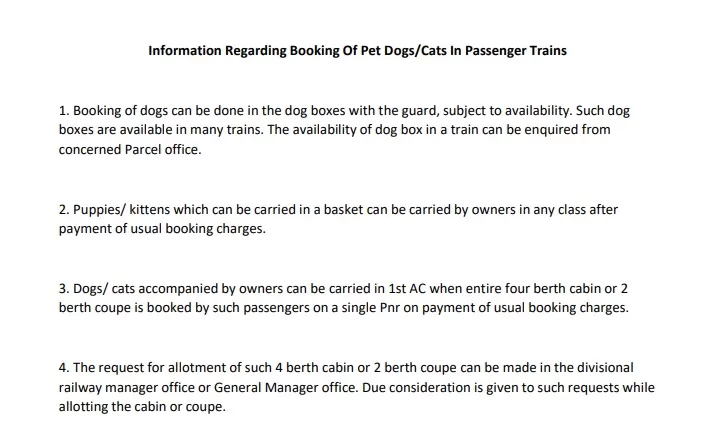
Planning to take your furry friend on a train journey? Good news — Indian Railways does allow pets on board, but there are important rules and options you need to know. This comprehensive guide covers how to travel with pets on Indian trains, including ticket booking, compartments allowed, documentation, charges, and more.
Yes! Indian Railways permits travel with pets — mainly dogs ? and cats — but only under specific conditions. There are two main ways to travel with your pet:
As Accompanied Luggage in First Class AC or First Class Non-AC Coupé
In the Brake Van (Luggage/Parcel Van) with special booking
Let’s break both down.
1️⃣ Travel with Pets in First Class AC (Coupe)
✅ Allowed In:
First Class AC (1A Coupe or Cabin)
? Rules:
Pets are allowed only if you book the entire coupe or cabin.
No objection from co-passengers is permitted — hence full compartment booking is necessary.
Limited to certain trains that have 1A coaches.
? How to Book:
Book your 1A tickets through IRCTC or offline at a reservation counter.
After ticket confirmation, submit a request to the Chief Reservation Officer (CRO) at the boarding station to allot a full coupe for pet travel.
Mention clearly that you are carrying a pet (dog/cat).
? Charges:
You must pay pet carriage charges at the parcel office before boarding.
Approx. charges for dogs: ₹30–₹60 per kg depending on train and distance.
2️⃣ Travel in Brake Van (Luggage Van)
If you can’t get a 1A Coupe or are traveling in another class:
Pets can be booked in the luggage/brake van as parcel luggage.
Owners are not allowed to accompany pets in this case.
Not suitable for small, sensitive, or nervous pets.
? Important:
Provide pet’s vaccination and health certificate.
Book pet space at the luggage office on the day of travel.
Carry a well-ventilated cage or crate for your pet.
? Documents Required
Vaccination Certificate
Health Certificate from a Registered Vet (issued within 24–48 hours before travel)
Train Ticket (Confirmed Reservation)
Application for coupe allotment (if applicable)
⚠️ Do’s and Don’ts for Pet Train Travel
✅ Do’s:
Carry water and food for your pet.
Bring a leash and muzzle (mandatory for large dogs).
Use absorbent bedding or puppy pads inside crates.
Arrive early at the station (especially for brake van bookings).
❌ Don’ts:
Don’t try to smuggle pets into Sleeper or AC coaches.
Don’t sedate your pet unless advised by a vet.
Don’t forget the required paperwork — you may be denied boarding.
?⚖️ Penalty for Rule Violation
If you carry a pet without proper booking or try to sneak them into coaches where they aren’t allowed:
You may be fined, and
The pet may be moved to the luggage van without refund.
? Special Notes
Guide dogs for visually impaired passengers are allowed free of cost with certification.
Indian Railways does not permit exotic or wild animals under the pet travel category.
? Summary Table
Mode
Allowed Class
Owner Accompaniment
Booking Required
Notes
1A Coupe (Full booking)
First Class AC
Yes
Yes
Must book entire cabin or coupe
Brake Van (Parcel Van)
Any train with van
No
Yes
Only with proper crate & papers
? Final Tips
Always plan early — 1A coupes are limited and in high demand.
Avoid traveling in peak heat for your pet’s safety.
Contact the parcel/luggage office a few days before for clarity on charges and logistics.
? Need Help?
Visit the Chief Parcel Office or Station Manager at your departure station. Or dial the IRCTC helpline: 139.
✍️ Wrapping Up
Traveling with pets on Indian trains is possible — but only if done legally and safely. With proper planning, your dog or cat can join your journey comfortably. Just make sure to follow the rules, carry documentation, and prioritize your pet’s safety.
✅ Pet Travel Checklist for Indian Trains (2025)
?️ Booking & Reservation
☐ Book tickets in First Class AC (1A Coupe/Cabin) if traveling with your pet inside the coach ☐ Submit request for full coupe allotment at the reservation counter (Chief Reservation Officer) ☐ Alternatively, confirm availability of Brake Van (Luggage Van) for pet travel ☐ Check train schedule and class availability in advance
? Documents to Carry
☐ Vaccination Certificate (updated) ☐ Health Certificate from a registered vet (issued within 48 hours of travel) ☐ Train Ticket (Confirmed Reservation) ☐ Coupe Allotment Request Letter (if applicable) ☐ Government-issued ID proof
? Pet Travel Preparation
☐ Crate or Carrier (well-ventilated, comfortable, and secure) ☐ Leash and Muzzle (mandatory for large dogs) ☐ Absorbent bedding or puppy pads ☐ Food and Water bowls and a supply for the trip ☐ Familiar toys/blanket to comfort your pet ☐ Medication, if prescribed ☐ Cleaning supplies (tissues, sanitizer, garbage bags)
? Before Departure
☐ Arrive at the station at least 90 minutes early ☐ Visit the Parcel/Luggage Office to book pet space and pay charges (if brake van) ☐ Collect and keep parcel receipt/slip safely ☐ Ensure your pet is well-fed and hydrated before boarding ☐ Avoid sedatives unless prescribed by a veterinarian
? What NOT To Do
❌ Don’t carry pets in Sleeper, 2A, or 3A coaches ❌ Don’t try to hide pets — this can lead to fines ❌ Don’t forget the documents — boarding can be denied ❌ Don’t sedate your pet without professional guidance
How to Travel with Pets on Indian Trains – FAQ Guide (2025)
Taking your pet along on a train journey in India? Whether you’re relocating or heading out for a holiday, Indian Railways does allow pet travel — but with strict rules. Here’s a complete FAQ-style guide to help you travel with your pet safely and legally.
✅ Yes. Pets such as dogs and cats are allowed to travel on Indian trains under certain conditions:
In First Class AC (1A) coupe or cabin (only if fully booked by the owner)
In the Luggage/Brake Van as registered parcel luggage
❓ Which train classes allow pets inside the coach?
Pets are only allowed inside passenger compartments in:
First Class AC (1A) Coupe or Cabin, and only if you book the entire space
You must request the Chief Reservation Officer to allot a full coupe
Pets are not permitted in:
Sleeper Class
2AC, 3AC, or Executive Chair Car
General compartments
❓ Can I book a coupe online through IRCTC?
Yes, you can book First Class AC tickets on IRCTC, but coupe allocation is manual. After booking:
Visit the Chief Reservation Officer at your boarding station.
Submit a written request for coupe allotment, mentioning pet travel.
Coupe is not guaranteed — it depends on availability and discretion.
❓ What if I’m not traveling in First Class AC?
You can still transport your pet in the Brake Van (Luggage/Parcel Van). In this case:
Your pet travels alone in a crate or cage.
You book your pet as parcel luggage at the parcel office.
Not recommended for small, nervous, or sick animals.
❓ What documents are required for pet travel?
? You’ll need:
Valid train ticket (confirmed)
Vaccination certificate of the pet
Health certificate from a registered vet (issued within 48 hours)
Owner’s ID proof
Request letter for coupe allotment (if applicable)
❓ How much does it cost to carry a pet on a train?
? Charges vary based on the mode:
In First Class AC: Around ₹30–₹60 per kg (paid at parcel office)
In Luggage Van: Charged as parcel luggage by weight and distance
No online payment is available; you must pay at the station.
❓ Is it safe to transport pets in the Brake Van?
? It’s legal, but not ideal. The Brake Van is noisy, unmonitored, and not climate-controlled. Use it only if:
You cannot get a First Class coupe
Your pet is in a strong, secure, and ventilated crate
The journey is short, and the weather is moderate
❓ Can I travel with more than one pet?
Yes, but only if:
You’re traveling in a full coupe/cabin, and
There’s enough space for both pets and crate(s)
All documents are provided for each animal
Note: Brake Vans may have space limitations.
❓ Are guide dogs allowed?
? Yes, guide dogs for visually impaired passengers are allowed free of cost, regardless of class. You’ll need:
Medical documentation
A valid ID for the person and the dog
❓ Can pets travel on all trains?
Not all trains have First Class AC or Brake Vans. Before booking:
Check whether your selected train has 1A coaches or a luggage compartment
Prefer Mail/Express or long-distance trains with suitable accommodations
❓ What items should I pack for my pet?
? Must-haves:
Crate or cage (well-ventilated and secure)
Leash and muzzle (mandatory for dogs)
Food, water bowls, and snacks
Absorbent bedding or puppy pads
Cleaning supplies
Medical kit (if needed)
❓ What happens if I carry a pet without permission?
? You may face:
Fines or penalties
The pet being moved to the luggage van
Possible denial of boarding
Never carry pets in unauthorized compartments or without proper documents.
❓ Tips for Smooth Pet Travel
✅ Do:
Plan and book early
Visit the station a day before to verify luggage procedures
Keep all documents and payment receipts handy
Choose cooler travel times for pet comfort
❌ Don’t:
Hide or smuggle pets into compartments
Forget to inform railway authorities
Sedate pets without veterinary advice
Traveling with pets on Indian trains is absolutely possible with the right planning, paperwork, and respect for the rules. With this guide, you can ensure your pet travels comfortably and legally.
RESS Portal FAQs: Answers to the Most Common Questions [2025 Edition]
The Railway Employee Self Service (RESS) Portal is a powerful tool provided by the Indian Railways to help employees manage their personal and professional details online. From viewing salary slips to checking PF balances, the RESS portal offers everything in one place. However, many users still have common doubts about using it effectively.
In this post, we’ve compiled and answered the most frequently asked questions (FAQs) about the RESS portal and app.
1. What is the RESS Portal?
Answer: RESS stands for Railway Employee Self Service. It’s a web and mobile platform launched by CRIS (Centre for Railway Information Systems) that allows railway employees to:
Answer: All serving employees of Indian Railways with a valid 11-digit Employee Number/PF Number and registered mobile number in AIMS can use the RESS platform.
4. How do I register for the RESS portal?
Answer:
Visit the RESS section on the AIMS website or use the app.
Enter your Employee Number, Date of Birth, and Mobile Number.
Answer: You must visit your Divisional Personnel Department and request them to update your mobile number in the AIMS database.
6. I forgot my RESS password. What should I do?
Answer: Click on “Forgot Password” on the RESS login page or app. Enter your Employee Number and registered mobile number, then reset your password using the OTP sent to you. ? Full guide here →
7. Can I use RESS on an iPhone?
Answer: Yes, iPhone users can access the RESS services on an iPhone.
Answer: Login to the RESS portal or app > Go to “Payslip” section > Choose the month and year > Tap on “Download” or “View”.
9. Can I view my Provident Fund (PF) statement on RESS?
Answer: Yes, under the “PF Ledger” section in the app or website, you can view year-wise and month-wise PF contributions.
10. Is RESS the same as the AIMS portal?
Answer: Not exactly. The AIMS portal is the broader system for Indian Railways accounts and personnel data. RESS is a service under AIMS that is designed specifically for employees to access personal services.
11. I’m retired. Can I use RESS?
Answer: No. The RESS portal is only for currently serving employees. Retired employees must use pension-specific portals.
12. What should I do if the RESS app is not working?
Answer:
Clear cache or reinstall the app
Check for the latest updates
If the problem persists, contact your IT department or CRIS helpdesk
13. How secure is the RESS Portal?
Answer: RESS uses OTP-based login, secure encryption, and session timeouts to protect your data. However, users should never share passwords or OTPs with anyone.
The RESS portal is a game-changer for Indian Railways employees. It saves time, simplifies HR processes, and puts all essential employee data at your fingertips. If you’re not using it yet, now’s the time to get started.
? Indian Railways- Rules for Counter Ticket Cancellation in 2025 If you booked a train ticket from the counter and gave your mobile number, you can now cancel your ticket online too! But there are a few rules and conditions you must follow. In this guide, we explain how and when you can cancel a PRS (Passenger Reservation System) counter ticket and how to collect your refund.
Read here the PROCEDURE for Cancellation of Counter Ticket Online through IRCTC website.
Counter Ticket Cancellation Rules in 2025
✅ Who Can Cancel Counter Tickets Online?
Only those who gave a valid mobile number at the time of booking.
Cancellation is allowed only in normal situations, not when:
The train is running late, or
The train is fully cancelled.
⏰ Time Limit for Online Cancellation
Confirmed Tickets:
Cancel up to 4 hours before the train’s scheduled departure.
RAC/Waitlisted Tickets:
Cancel up to 30 minutes before departure.
? Refund Rules
Refund can be collected from any PRS counter by surrendering the original ticket if cancelled within the allowed time.
If you miss the online cancellation window, you must collect your refund:
From the journey starting station, or
From nearby satellite PRS locations, as identified by Indian Railways.
? Tip: Before cancelling your ticket, check if you’ll be able to visit the journey-starting station to collect your refund.
? Special Time Windows for Refund Collection
Trains departing between 6:01 PM and 6:00 AM: Refund available during first 2 hours of PRS counters opening on the next day.
Trains departing between 6:01 AM and 6:00 PM: Refund allowed up to 4 hours after scheduled departure, during working hours.
? What Happens When You Cancel Online?
Passenger and journey details are shown on IRCTC or 139 before cancellation.
Once confirmed:
PNR is marked as “Cancelled but not Refunded”.
Seat is released.
Refund amount is displayed.
? Special Ticket Types (Passes & PTOs)
Privilege/Complimentary Passes:
Can be cancelled online.
Zero refund, but pass must be re-validated at the counter for future use.
PTO Tickets (Privilege Ticket Orders):
Charged at 1/3rd fare.
Normal cancellation charges apply.
Often, the refund is less than cancellation charges, so cancelling may not be beneficial.
Still, cancellation is allowed online.
Indian Railways is making it easier to cancel counter tickets online, but the process still involves time-sensitive rules and manual refund collection. Always check the timing and station policies before cancelling.
Yes, you can cancel a counter ticket online only if you provided a valid mobile number at the time of booking.
2. When can I cancel a counter ticket online?
Confirmed Tickets: Up to 4 hours before the train’s scheduled departure.
RAC/Waitlisted Tickets: Up to 30 minutes before departure.
3. Can I cancel a counter ticket online if the train is delayed or cancelled?
No, online cancellation is not allowed in case of:
Train running late, or
Train fully cancelled.
You must visit the station counter for cancellation in such cases.
4. How do I get a refund after online cancellation of a counter ticket?
You must physically collect the refund by surrendering the original ticket at:
Any PRS counter (if cancelled within allowed time), or
Journey commencing station or nearby satellite PRS location (if time limit is exceeded).
✅ Always check if you can reach the station to collect the refund before cancelling online.
5. What if my train departs at night or early morning?
If train departs between 6:01 PM and 6:00 AM: Refund can be collected during the first two hours of PRS counter opening on the next day.
6. What if my train departs during the day?
If train departs between 6:01 AM and 6:00 PM: Refund can be collected within 4 hours after the scheduled departure, during PRS working hours.
7. What happens after I cancel a counter ticket online?
Your passenger and journey details are shown before final confirmation.
After cancellation:
The PNR is marked “Cancelled but not Refunded”.
Seat/berth is released.
Refund amount is displayed on the website.
8. Can I cancel Privilege Pass, Complimentary Pass, or PTO tickets online?
✅ Yes, here’s how it works:
Privilege/Complimentary Pass Tickets:
Can be cancelled online.
No refund is given.
To reuse the pass, you must visit the counter to get it revalidated.
PTO Tickets (Privilege Ticket Order):
Issued at 1/3rd fare.
Normal cancellation charges apply.
Sometimes, cancellation charge > ticket value, so no refund.
Still, online cancellation is permitted.
9. Can I collect the refund from any PRS counter?
Yes, if the cancellation is done within the allowed time limits. If the time limit has passed, you must go to the journey starting station or a designated satellite location.
10. Is cancellation allowed through phone as well?
Yes, you can cancel counter tickets by calling Railway inquiry number 139, provided your mobile number was registered at the time of booking.
Here is link for Cancellation of Counter Ticket Online through IRCTC Website.