Notice: Function WP_Scripts::localize was called incorrectly. The $l10n parameter must be an array. To pass arbitrary data to scripts, use the wp_add_inline_script() function instead. Please see Debugging in WordPress for more information. (This message was added in version 5.7.0.) in /home4/railmu7v/public_html/wp-includes/functions.php on line 6170
Notice: Function WP_Scripts::localize was called incorrectly. The $l10n parameter must be an array. To pass arbitrary data to scripts, use the wp_add_inline_script() function instead. Please see Debugging in WordPress for more information. (This message was added in version 5.7.0.) in /home4/railmu7v/public_html/wp-includes/functions.php on line 6170
Notice: Function WP_Scripts::localize was called incorrectly. The $l10n parameter must be an array. To pass arbitrary data to scripts, use the wp_add_inline_script() function instead. Please see Debugging in WordPress for more information. (This message was added in version 5.7.0.) in /home4/railmu7v/public_html/wp-includes/functions.php on line 6170
Notice: Function WP_Scripts::localize was called incorrectly. The $l10n parameter must be an array. To pass arbitrary data to scripts, use the wp_add_inline_script() function instead. Please see Debugging in WordPress for more information. (This message was added in version 5.7.0.) in /home4/railmu7v/public_html/wp-includes/functions.php on line 6170
Skip to content
Signalling System enhances safety in train operations. Upgradation and replacement of equipments in use over Indian Railways is a continuous process and is undertaken based on its condition, operational needs and availability of resources.
Major steps taken for Modernisation of Railway Signalling Systems
In order to further improve safety in train operation and generate additional line capacity, modernisation of Signalling System has been taken in hand. Following major steps have been taken,
6084 (96% of total Stations) Stations on Indian Railway have been equipped with modern Electrical/Electronic Signalling Interlocking System up to 29.02.2020.
Electronic Interlocking are being adopted on a large scale to derive benefits of digital technologies in train operation and to enhance safety. So far 1913 stations have been provided with Electronic Interlocking upto 29.02.2020.
Axle Counters for Automatic clearance of Block Section (BPAC) are provided to ensure complete arrival of train without manual intervention before granting line clear to receive next train and to reduce human element. These systems have been provided on 5661 block sections upto 29.02.2020.
In order to increase line capacity to run more trains on existing High Density Routes of Indian Railways, Automatic Block Signalling is a cost effective solution. As on 29.02.2020, Automatic Block Signalling has been provided on 3207 Route km.
Enhancing Safety at Level Crossing Gates has been a major area of concern. Safety gets enhanced by interlocking level crossings with Signals. Indian Railways have provided interlocking with Signals at 11622 Level Crossing Gates to enhance the safety at Level Crossings as on 29.02.2020.
Modernisation of Signalling System is proposed to be taken up on High Density Routes of Indian Railways including Golden Quadrilateral (GQ) and Golden Diagonal (GD) Route. The work includes provision of Modern Train Control System.
As a prelude to modernisation work of signalling system on Indian Railways, four works totaling 640 Route km at total cost of ₹ 1,609 crores have been sanctioned in Supplementary Works Programme 2018-19 in following sections for extensive trials,
Tenders for the works have since been opened and are under evaluation.
Two works of Raising of speed to 160kmph on existing New Delhi – Howrah and New Delhi – Mumbai routes have been sanctioned including modernisation of Signalling and detailed estimates are under preparation.
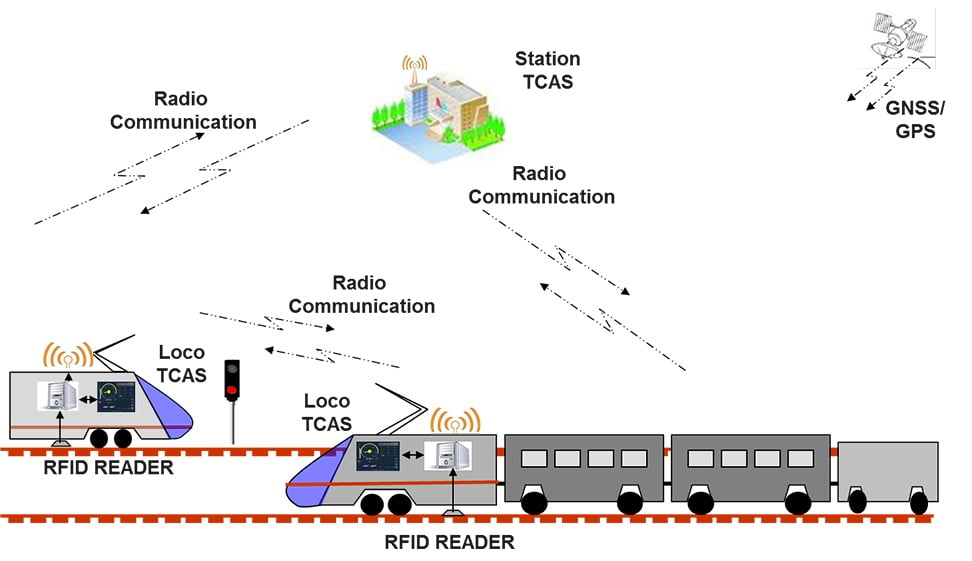
An indigenous Automatic Train Protection (ATP) System namely Train Collision Avoidance System (TCAS), has been developed by Indian Railways in association with Indian manufacturers. The system has been installed on Lingampalli – Vikarabad – Wadi & Vikarabad – Bidar section (250 Route km) of South Central Railway.
Further contract have been awarded for Train Collision Avoidance System (TCAS) works on additional 1199 Route km on South Central Railway.
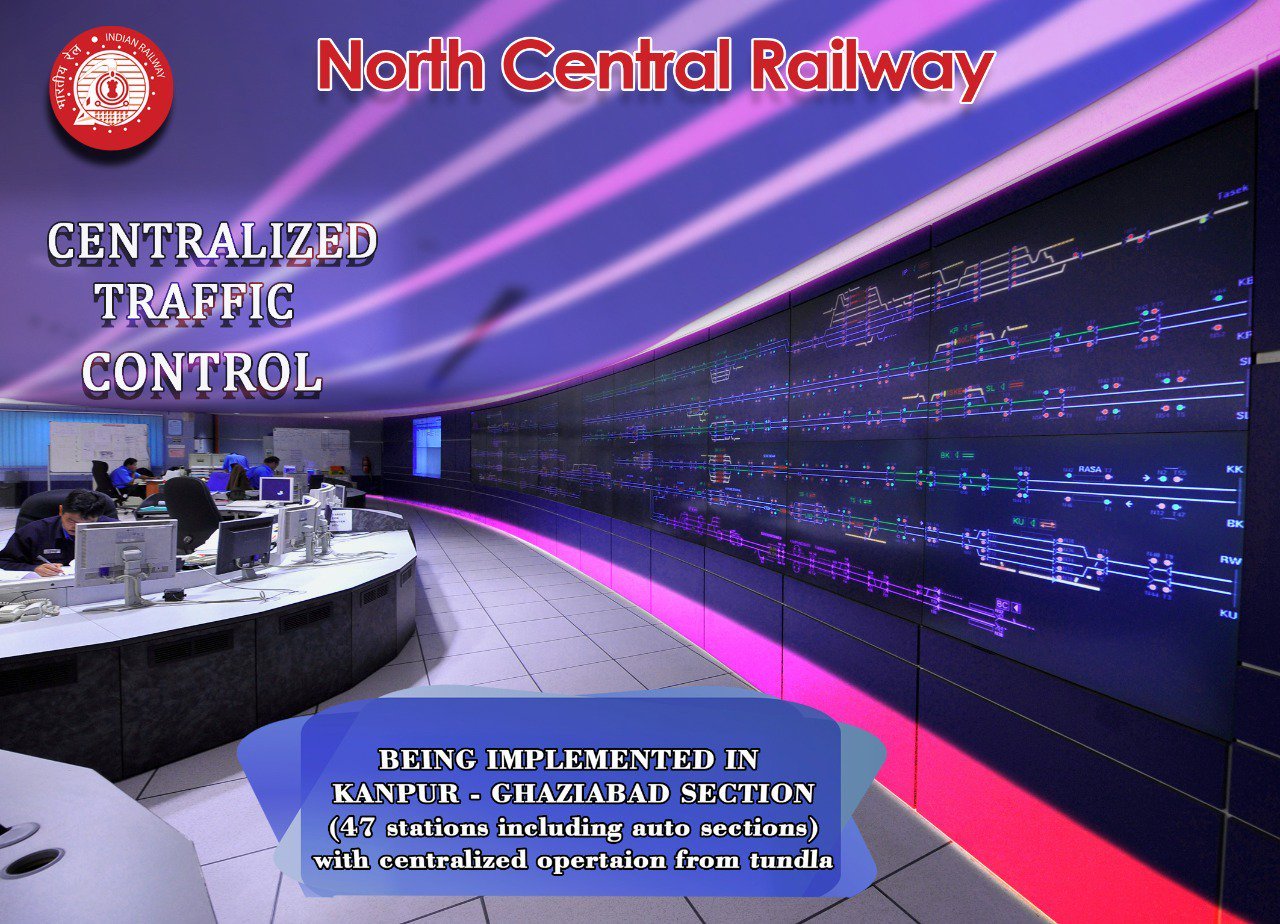
Works for implementation of Centralized Traffic Control (CTC) System to improve line capacity and efficient management of train operations from a central location covering large sections, have also been taken up.
The CTC at Tundla is operational covering 26 stations and 250 Route Km on Aligarh-Kanpur section.
Works for 12 CTCs have also been sanctioned on 8 Zonal Railways (Eastern Railway, Central Railway, Northern Railway, North Central Railway, South Eastern Railway, South East Central Railway, Southern Railway and Western Railway) covering 1829 Route Km.
Train Management System (TMS) on suburban section in Howrah Division of Eastern Railway has been commissioned on 15.11.2019 duly integrating with Control Office Application (COA) for real time train running information and chartings. It covers 22 stations over 74 Route km.
TMS work on Khurda Road Division of East Coast Railway is in progress. It covers 864 Route km with 104 stations on entire Divisions.
A work of provision of TMS for Delhi area has been sanctioned at a cost of Rs 71 CR in the works programme 2019-20.
This technological upgradation and modernisation of railway signalling systems en-route will pave safer, faster, efficient and more punctual train operations on Railway Network.
Entire GQ-GD route over South Central Railway, now fit to run at 130 Kmph Speed
A total of 2824 Kms (including Up &Down Lines) over South Central Railway Zone is now fit to run at 130 Kmph speed.
Indian Railway has started the New Year 2021 by achieving a landmark achievement by drastically enhancing the maximum speed to 130 kmph for 1,280 km length out of 1,612 Km in Golden Quadrilateral – Golden Diagonal (GQ-GD) route.
This covers the entire GQ-GD route over South Central Railway, except Vijayawada – Duvvada section, where signalling up-gradation work is in progress.
The enhanced speed limits could be achieved due to the systematic and planned strengthening of track & its infrastructure by removing bottlenecks in these sections on a fast pace. This included heavier rails, laying of 260 meters Long welded rail panels, improvement of curves and gradients among others.
Based on these improvements done by the Zone, the RDSO/Lucknow conducted oscillation trials through Confirmatory Oscillograph Car Run (COCR) consisting of instrumented coaches of all classes at 130 Kmph speed during July and October last year. During this check, in addition to track parameters, other areas like Signalling aspect, Traction distribution equipment, Locomotive& coach fitness were also checked and recorded.
Accordingly, the South Central Railway zone has received sanction to enhance the maximum speed limits to 130 kmph along the following routes:
1. Golden Diagonal (Grand Trunk) Route: 744 Route Km
i. Ballarshah to Kazipet – 234 Rkm
ii. Kazipet-Vijayawada-Gudur – 510 Rkm
2. Golden Quadrilateral Route (Chennai -Mumbai section): 536 Route Km
i. Renigunta to Gooty – 281 Rkm
ii. Gooty to Wadi – 255Rkm
Already, the maximum speed limits in the High-Density Network (HDN) between Secunderabad – Kazipet (132 Kms distance) had been enhanced to 130 kmph. Source: PIB
As such, including both the Up and Down lines in these sections, a total of 2,824 kms (1412Rkms) has now been made fit to run at a speed of 130 kmph. This covers the entire GQ-GD route over SCR, except Vijayawada – Duvvada section, where signaling up-gradation work is in progress.
It is noteworthy that despite COVID pandemic, Indian Railways has witnessed an unprecedented growth in development of infrastructure, innovation, capacity expansion of network, freight diversification. Railways has used covid challenge as an opportunity to lay the foundation for future development and next level of traveling experience for passengers.
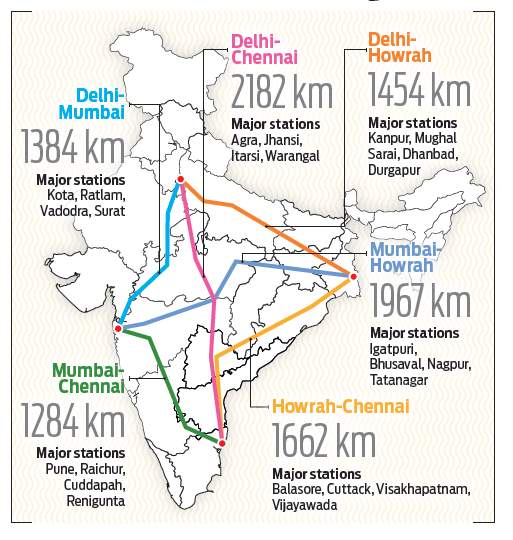
The Golden Quadrilateral & Golden Diagonal (GQ /GD) Routes are –
New Delhi – Mumbai (1384 Km) via Mathura and Vadodara
New Delhi – Chennai (2182 Km) via Nagpur, and Vijayawada
New Delhi – Howrah (1454 Km) via Kanpur and Dhanbad
Howrah – Chennai (1662 Km) via Visakhapatnam
Mumbai – Chennai (1284 Km) via Wadi and Renigunta
Mumbai – Howrah (1967 Km) via Nagpur
Length wise New Delhi – Chennai (North to South) is Longest route i.e 2182 Km, and Mumbai – Howrah (West to East) is Shortest route i.e. 1284 Km.
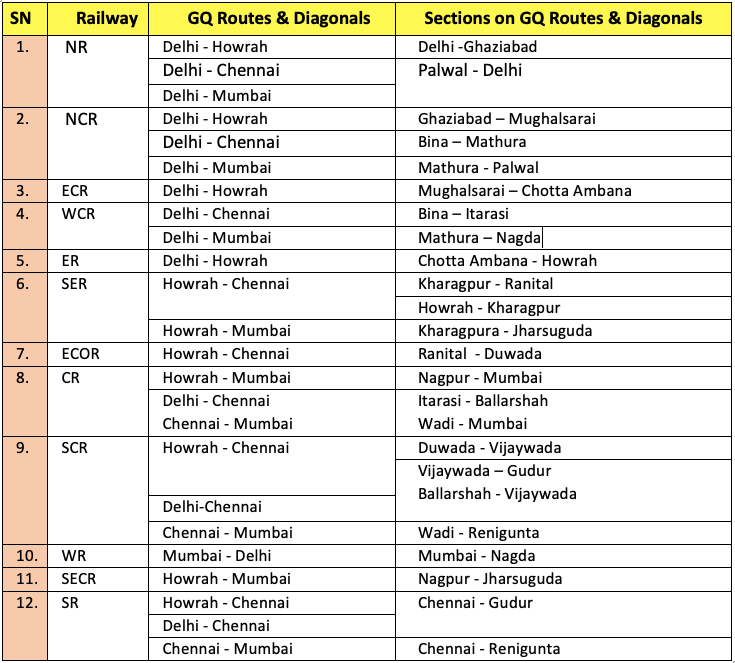
Railway wise Details of Sections on Golden Quadrilateral & Golden Diagonal Routes
Modernisation of Signalling System
Modernisation of Signalling System is proposed to be taken up on High Density Routes of Indian Railways including Golden Quadrilateral (GQ) and Golden Diagonal (GD) Route. The work includes provision of Modern Train Control System.
As a prelude to modernisation work of signalling system on Indian Railways, four works totaling 640 Route km at total cost of ₹ 1,609 crores have been sanctioned in Supplementary Works Programme 2018-19 in following sections for extensive trials,
Dedicated Freight Corridor – a game changer in Economic Development.
Rewari – Madar section on Western Freight corridor, dedicated to the Nation- 07.01.2021
Dedicated Freight corridor, whose Rewari – Madar section on Western corridor, was dedicated to the Nation by Prime Minister Shri Narendra Modi today, is going be the game changer in economic development of the country.
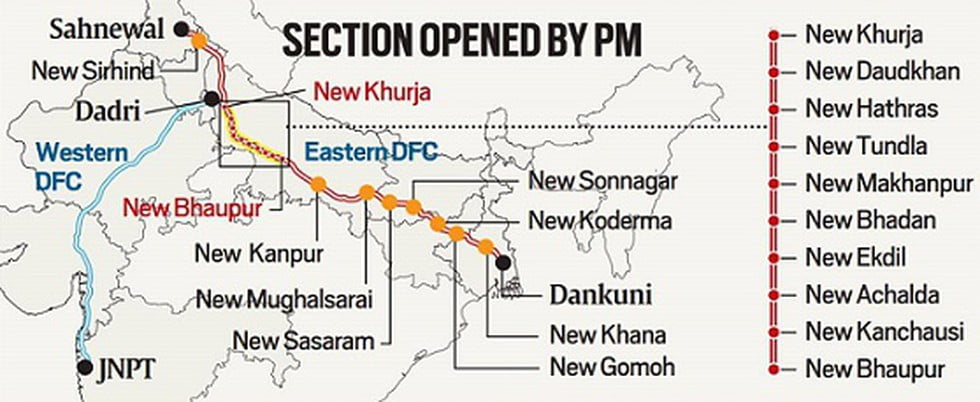
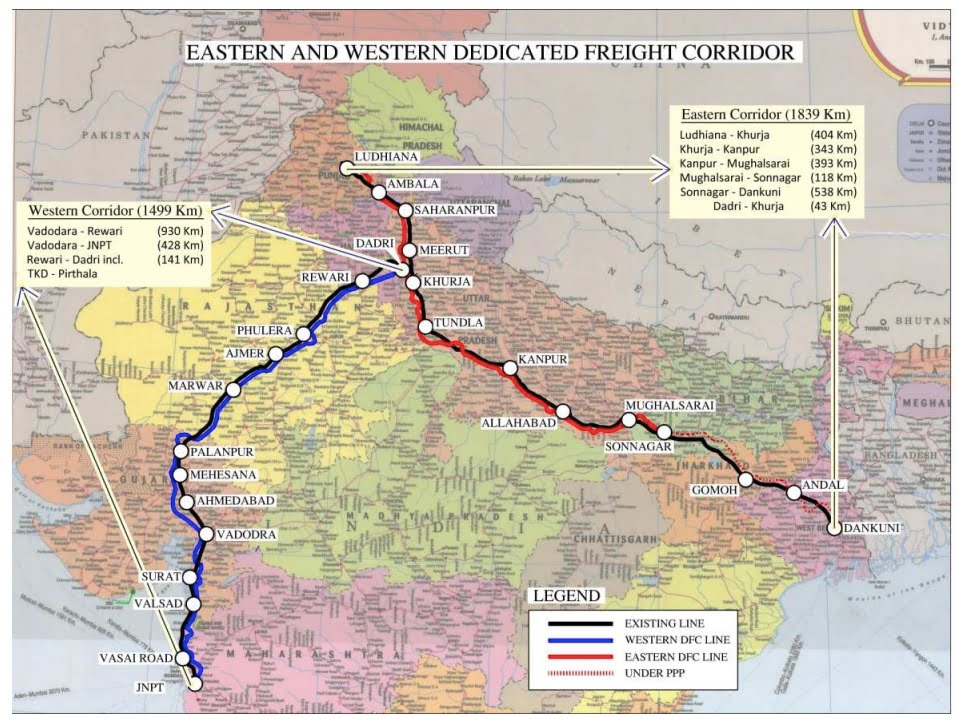
Dedicated Freight Corridor Corporation of India is constructing the Western DFC (1506 Route km) and Eastern DFC (1875 route km including Sonnagar-Dankuni PPP Section). The EDFC starting from Sahnewal near Ludhiana (Punjab) will pass through the states of Punjab, Haryana, Uttar Pradesh, Bihar and Jharkhand to terminate at Dankuni in West Bengal. The Western Corridor connecting Dadri in Uttar Pradesh to Jawaharlal Nehru Port (JNPT) in Mumbai will traverse through the states of UP, Haryana, Rajasthan, Gujarat and Maharashtra of WDFC.
306 km Rewari – Madar section: Details
● This section falls in Haryana State (for approx. 79 Km in Mahendragarh& Rewari districts) and Rajasthan State (for approx. 227 Km in Jaipur, Ajmer, Sikar, Nagaur& Alwar districts).
● Approx 40% of WDFC is in Rajasthan
● Approx 250 km of DFC is in Haryana state
● This section contains 16 major bridges and viaduct (1 viaduct & 15 major bridges), 269 minor bridges, 4 Rail Fly Overs, 22 Road Over Bridges & 177 Road Under Bridges eliminating 148 Level crossings.
● There are 9 newly built DFC stations in this section, six crossing stations (i.e. New Dabla, New Bhagega, New Sri Madhopur, New PacharMalikpur, New Sakun and New Kishangarh) and three junction stations (i.e. New Rewari, New Ateli and New Phulera).
In which six are Crossing stations viz.
New Dabla,
New Bhagega,
New Sri Madhopur,
New Pachar Malikpur,
New Sakun and
New Kishangarh
Other three Junction stations are
New Rewari,
New Ateli and
New Phulera.
● Total value of Contracts including Civil, Electrical and S&T is Rs. 5800 crore in this section excluding land.
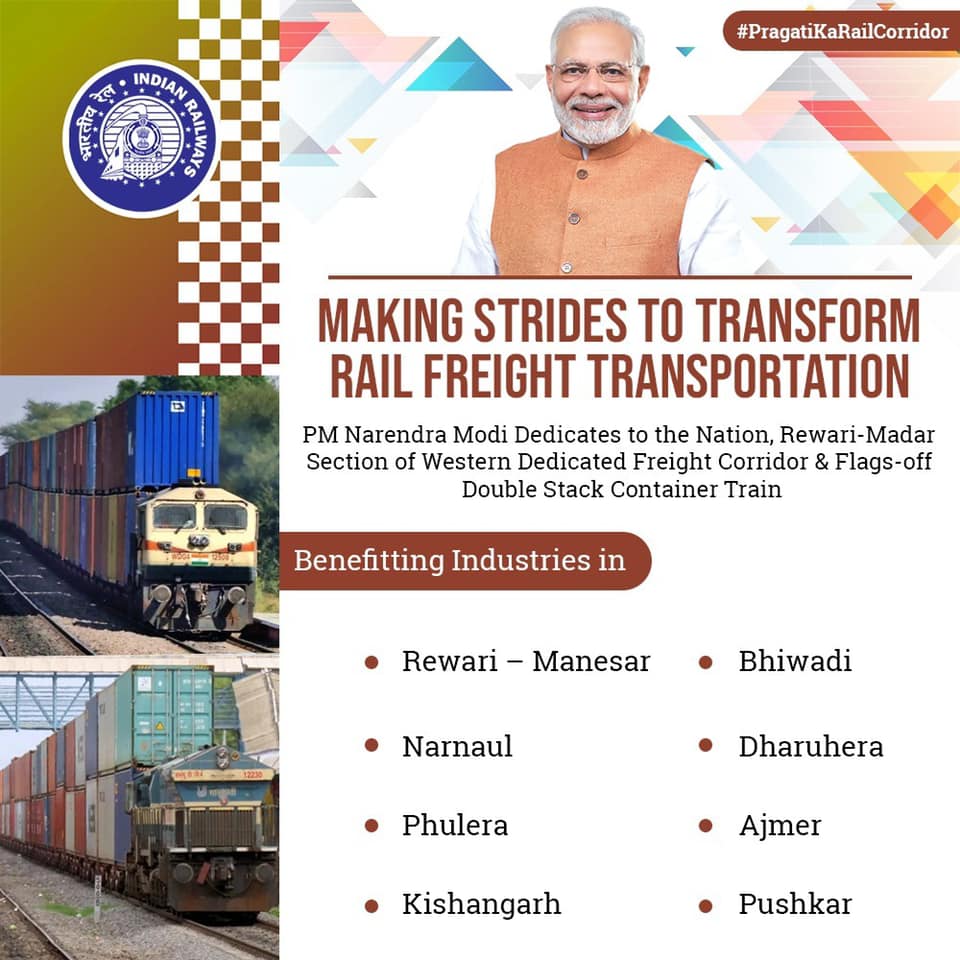
● The opening of this stretch will benefit various industries in Rewari – Manesar, Narnaul, Phulera & Kishangarh areas of Rajasthan, Haryana and National Capital Region. .
● In addition to this, the container depot of CONCOR at Kathuwas will also come on the DFC map and get advantage in terms of faster throughput.
● The ports of Gujarat like Kandla, Pipavav, Mundhra, Dahejetc will have an uninterrupted connectivity to the Northern parts of India.
● With the dedication to the Nation of the 351-km Bhaupur-Khurja section, and construction of connecting link between Khurja – Boraki-Dadri- Rewari, seamless movement between WDFC & EDFC can ensue.
● DFCCIL had conducted an trial-run of Indian Railways (IR) freight trains on this section. ,
● The Track Recording Car of RDSO had conducted Oscillation trials of BOXNS Wagons at 110 Kmph.These wagons have a Tare weight of 19.85 ton and a carrying capacity of 80.15 ton. These wagons have a 14% more weight carrying capacity than the wagons being currently used on Indian Railways.The DFCCIL infrastructure is well placed to utilise the carrying capacity of these wagons. Currently, Indian Railways freight trains can carry 61 -71 ton weight per freight carriage at an approximate speed of 60 kmph.The newer, advanced wagons can carry weights upto 81 ton per wagon at an approximate speed of 100 kmph. The newer wagons are safer and modern too.
● Trial runs of BLCS-A and BLCS-B wagon prototype have also been completed in this section. These wagons have enhanced axle load of 25 ton and been designed for DFCCIL by RDSO’s wagon department. The design will maximize capacity utilization and uniform distributed and point loading. These wagons on a long-haul double stack container train on the WDFC at an speed of 100 kmph..
● DFCCIL will run freight train at the maximum speed of 100 km/per hour as against the current maximum speed of 75 kmph on Indian Railway tracks whereas the average speed of freight trains will also be increased from existing speed of 26 kmph on Indian Railways lines to 70 kmph on Dedicated Freight Corridors (DFC).
A. Main objectives of DFCCIL
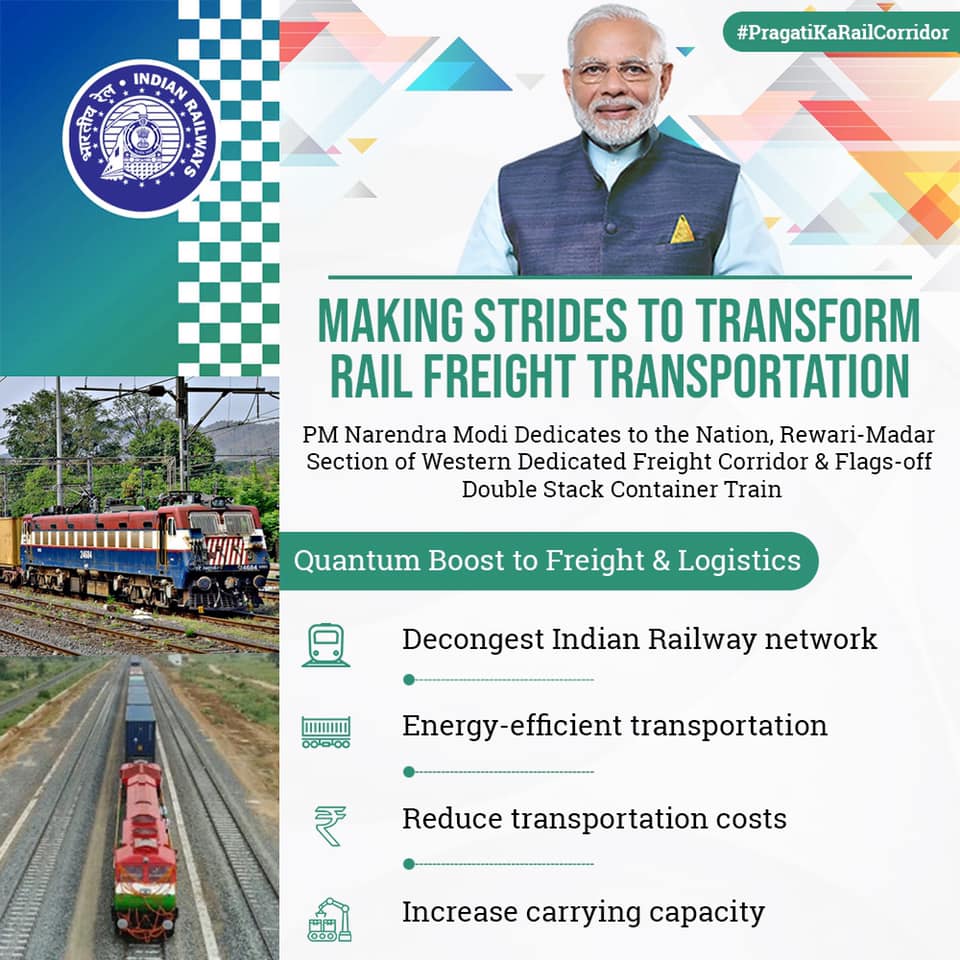
1. Decongest the existing Indian Railway network.
2. Increase the average speed of goods trains from existing 25 to 70 kmph.
3. Run Heavy Haul trains (higher axle load of 25/32.5 Tonne) & overall load of 13,000 Tonne.
4. Facilitate the running of longer (1.5km) and double stack container trains.
5. Connect the existing ports and industrial areas for faster movement of goods.
6. Energy efficient and environment friendly rail transport system as per global standards.
7. Increase the rail share from existing 30% to 45%.
8. Reduce the logistic cost of transportation
B. Innovations and State-of-the-art Technology:
1. Heavy and long Haul train operation of 25 Axle ton with having provision of 32.5 Ton axle load for the First time in India.
2. Double stack containers in Western DFC
3. Double line electric (2 X 25 KV) track to undertake higher haulage at higher speeds
4. Automated New Track Construction (NTC) machine which can lay track at the speed of 1.5 km per day.
5. Automated Wiring train for Overhead Equipment Work (OHE) capable of wiring upto 3 km per shift.
6. Train Protection and Warning System (TPWS) for safe and efficient operation
7. Elimination of road level crossing
8. Developing Multi Modal Logistic Hubs and integration with Delhi-Mumbai Industrial Corridor & Amritsar-Kolkata Industrial corridor.
Details of World First electric loco hauled Double Stack 1.5 km Long container
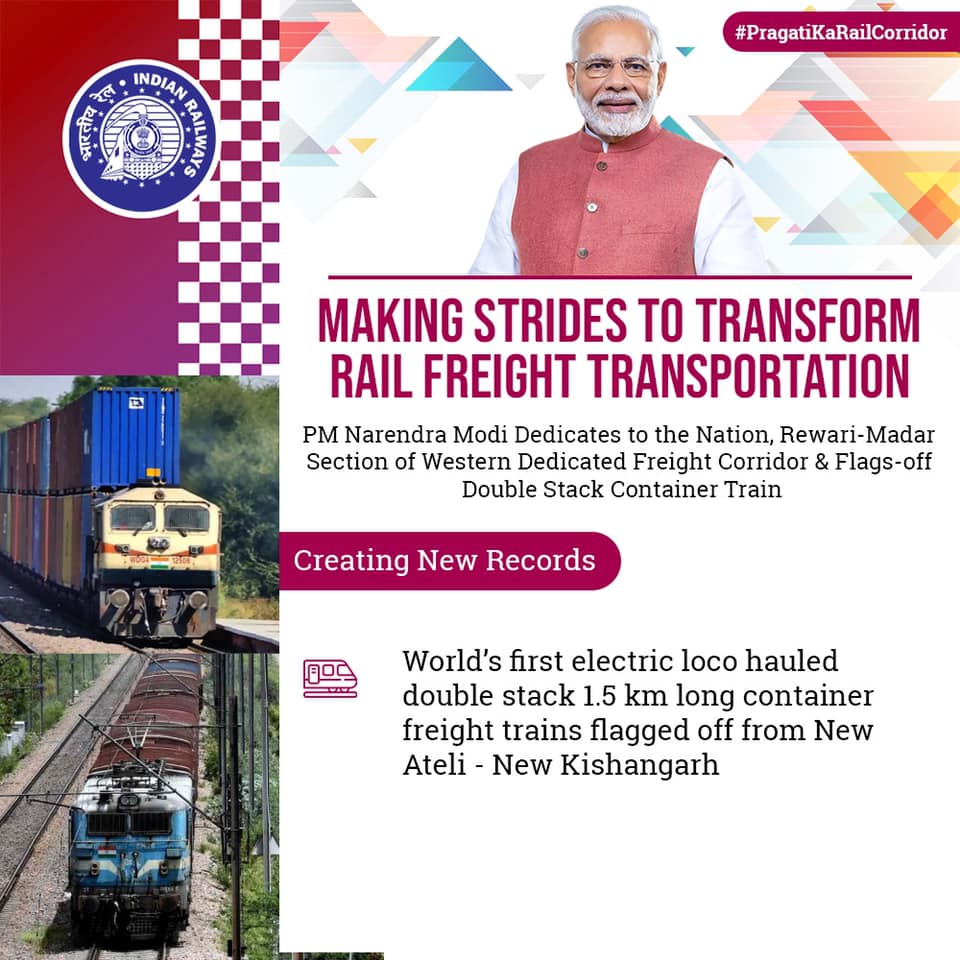
Details of World First electric loco hauled Double Stack 1.5 km Long container Freight trains flagged off from New Ateli and New Kishangarh Stations of high rise 7.5 meter OHE section of WDFC
Front loco of both the trains were flagged off today by Hon’ble Prime Minister is WAG 12 Loco manufactured at Indian Railways make in India factory at Madhepura, Bihar.
The WAG -12 electric super powered double-section locomotives of 12,000 HP are capable of hauling 6000 tonnes at a top speed of 120 kmph. They are planned to be deployed for operations on major freight routes, including the Dedicated Freight Corridors (DFCs), transforming the heavy freight transportation landscape of India.
These locomotives manufactured at Madhepura are of 12,000-horsepower with a twin Bo-Bo design, engineered to run at a speed that is twice as faster than regular locomotives and are built to carry 6000 tonnes of goods in one go. Equipped with Insulated Gate Bipolar Transistors (IGBT) based propulsion technology, the WAG 12B uses regenerative braking, reducing energy consumption. With 1676 mm of Broad Gauge, these e-locos are designed to take smooth turns even at the sharpest of curves.
The second loco which is attached in the middle and working as a piped loco of the long haul train is WAG 9 of 6000 HP built from Chittaranjan Locomotive Works (CLW), West Bengal, India.
In a first, double stack 1.5 km long electric train had run in the DFCCIL Newly commissioned 7.5 meter high OHE Section. In one train, 360 Ten Feet Container Equivalent Units (TEU) are moving which is equivalent to 270 high capacity Road Trailer trucks.
Details of Train Flagged off from New Ateli Station of WDFC
● This train is partly loaded from Kathuwas Container siding of CONCOR and partly loaded from Garhi siding of Gateway Logistics. The 1.5 km long trains consist of 90 BLC Wagons and two brake vans have a gross weight of 4941 tons destined to Mundra port in Gujarat, hauled by WAG12 12000 HP manufactured at Indian Railways make in India factory at Madhepura, Bihar and WAG9 locomotive manufactured at Chittaranjan Locomotive Works, West Bengal.
● Container Details: Container loaded with iron artware, aluminium artware, decorated laminated sheets, wooden hardware, lamps, furnishing items, auto parts, steel products, tiles .
● Loading Points : Concor Multimodal Logistics Park, Kathuwas and ICD GarhiHarsaru (Gurugram) Gate way Rail
● Destination Details: Iron artware and aluminium artware and lamps loaded from Moradabad area going to USA & Germany, furnishing items of Gurugram to UK, auto parts from Sonepat to USA, Steel products from Hisar to South & East Africa, Tiles from Bahadurgarh to Croatia, wooden artware, lamps and decorative laminated sheets to Dubai & Indonesia.
Details of Train Flagged off from New Kishangarh Station of WDFC
● Half of the long train is loaded from Pipavav port and other half is loaded from Mundra post. The rake consists of 90 BLC wagons and two brake vans have a gross weight of 5966 ton, hauled by WAG12 12000 HP manufactured at Indian Railways make in India factory at Madhepura, Bihar and WAG9 locomotive manufactured at Chittaranjan Locomotive Works, West Bengal.
● Container Details: Container loaded with Destined for TKD (Tughlakabad Container Depot of Concor) and DER (Dadri Container Depot of Concor). Major commodity are Spare parts, Electric parts, Machine, Spray parts, Knitting Machine, Polyester fabric. The Origin of the major containers is United Arab Emirates. Other items are PVC items, paper, polymers, ethylene, auto components, copper tubes, furniture and aluminium coil and are loaded from Gulf countries and Far East Line ( Indonesia and Singapore).
● Loading Points : Pipavav and Mundra Port, Gujarat
● Destination Details: Concor Multimodal Logistics Park, Khatuwas
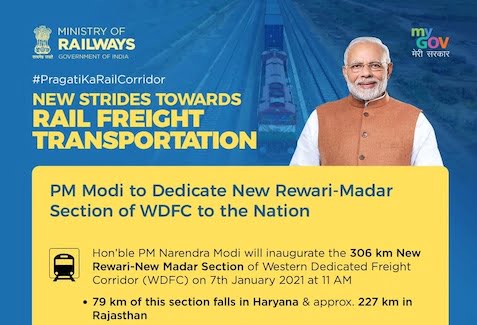
– PM to dedicate New Rewari – New Madar section of Western Dedicated Freight Corridor to the Nation on 7 January
– PM to also flag off world’s first Double Stack Long Haul 1.5 Km long Container Train hauled by electric traction
DFCCIL to open 306 Km New Rewari – New Madar Section
Prime Minister Shri Narendra Modi will dedicate to the nation the 306 Km New Rewari – New Madar Section of the Western Dedicated Freight Corridor (WDFC) on 7th January 2021 at 11 AM via video conferencing. Prime Minister will also flag off the world’s first Double Stack Long Haul 1.5 Km long Container Train hauled by electric traction from New Ateli -New Kishangarh during the event. Governors and Chief Ministers of Rajasthan and Haryana along with Union Minister Shri Piyush Goyal will also be present at the occasion.
New Rewari – New Madar Section of WDFC
The New Rewari – New Madar section of the Western Dedicated Freight Corridor is situated in Haryana (approx. 79 Km, in Mahendragarh and Rewari districts) and Rajasthan (approx. 227 Km, in Jaipur, Ajmer, Sikar, Nagaur and Alwar districts).
It consists of nine newly built DFC stations…
In which six are Crossing stations viz.
New Dabla,
New Bhagega,
New Sri Madhopur,
New Pachar Malikpur,
New Sakun and
New Kishangarh
Other three Junction stations are
New Rewari,
New Ateli and
New Phulera.
The opening of this stretch will benefit various industries in Rewari – Manesar, Narnaul, Phulera and Kishangarh areas of Rajasthan & Haryana and will also enable better usage of the container depot of CONCOR at Kathuwas. This section will also ensure seamless connectivity with the western ports of Kandla, Pipavav, Mundhra, and Dahej situated in Gujarat.
With the inauguration of this section, seamless connectivity between the WDFC and EDFC will be achieved. Earlier the 351-km New Bhaupur- New Khurja section of the EDFC was dedicated to the nation by the Prime Minister on 29th December 2020.
Double Stack Long Haul Container Train Operation
Double Stack Long Haul Container Train Operation will have an enhanced axle load of 25 tons. It has been designed for DFCCIL by RDSO’s wagon department. Trial runs of BLCS-A and BLCS-B wagon prototypes have been completed. The design will maximize capacity utilization and uniform distributed and point loading. These wagons on a long-haul double stack container train on the WDFC can carry four times in terms of container units compared to the current traffic on Indian Railways.
The average speed of freight trains will increase from existing speed of 26 KMPH to 70 KMPH.
DFCCIL will run freight trains at the maximum speed of 100 km/per hour as against the current maximum speed of 75 kmph on Indian Railway tracks whereas the average speed of freight trains will also be increased from existing speed of 26 kmph on Indian Railways lines to 70 kmph on DFC.
New Khurja- New Bhaupur section (351 KM long) inaugurated on 29.12.2020.
Shri Narendra Modi, Hon’ble Prime Minister inaugurated the 351 Km New Khurja- New Bhaupur section of Eastern Dedicated Freight Corridor on 29.12.2020. Meeting the objectives, the new section is witnessing seamless transportation of major freight commodities at a speed above 90 kmph on this newly inaugurated section. So far, 53 freight trains have been operated on this new section till 03rd January, 2021.
New Khurja- New Bhaupur section (351 KM long) of Eastern Dedicated Freight Corridor inaugurated on 29.12.2020.
53 Freight trains have run on this new section till 03rd January, 2021.
Between New Khurja – New Bhaupur (Down Direction) = 32 trains, with Best Speed achieved = 93.70 kmph
Between New Bhaupur – New Khurja (Up Direction) = 21 trains, with Best Speed achieved = 85.98 kmph
After the commissioning of this new section, Coal, Jute, Petroleum, Container, Iron & Steel and other minerals are primary commodities moving towards NCR and Punjab & Haryana area whereas Rice, Wheat and Food grain products from Punjab and Haryana area, Fertilizer, Steel, Coal loadable empty wagons etc are moving towards eastern India.
It is noteworthy that in the inaugural run, two freight trains were flagged off, 1.5 KM Long Haul 9400 Gross Ton Train loaded with Food grain from Mullanpur & Faridkot of Ludhiana, Punjab between New Khurja and New Bhaupur and 1.5 KM Long Haul 10420 Gross Ton Train loaded with Power House Coal from Chruri Siding Ray, Ranchi, Jharkhand & Dudhichua Wharf Siding, Singrauli, Madhya Pradesh between New Bhaupur and New Khurja of DFC network. On the return journey after unloading, the above rake achieved a speed of 90 kmph over DFC.
Planning of DFCCIL: 2800 Route KM by June 2022
In the first phase, DFCCIL is constructing the Western DFC (1504 Route km) and Eastern DFC (1856 route km including PPP section of Sonnagar-Dankuni Section. The EDFC starting from Sahnewal near Ludhiana (Punjab) will pass through the states of Punjab, Haryana, Uttar Pradesh, Bihar and Jharkhand to terminate at Dankuni in West Bengal. The Western Corridor connecting Dadri in Uttar Pradesh to Jawaharlal Nehru Port (JNPT) in Mumbai will traverse through the states of UP, Haryana, Rajasthan, Gujarat and Maharashtra of WDFC & EDFC (excluding the Sonnagar – Dankuni PPP section) i.e. 2800 route Km will be commissioned by June 2022.
Ease of doing business with Railway gets a solid boost
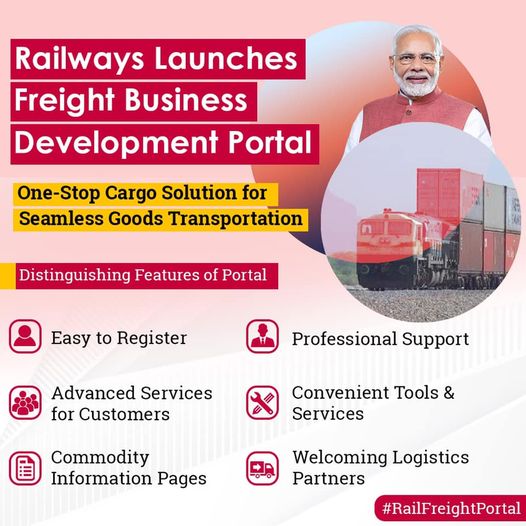
Shri Piyush Goyal, Minister for Railways, Commerce & Industry, Consumer Affairs and Food & Public Distribution launches Indian Railways’ Freight Business Development Portal.
In a paradigm shift, First of it’s kind dedicated Freight portal to ensure… –customer centric operations , –reduce the costs for logistics providers, –provide online tracking facility for suppliers and also -simplify the process of goods transportation.
“One Stop – Single Window” solution Portal
Freight Business Development Portal is a “One Stop – Single Window” solution for all the needs of Freight customers.
The new portal will be game changer in ensuring in ease of doing business with Railways.
The portal aims to provide ease of doing business, to bring more transparency and to provide professional support.
Indian Railways is the backbone of the country’s logistics sector. During 2020, when most of the activities were under lockdown, Indian Railways was providing relentless services in Freight transportation in the country. Indian Railways achieved highest ever loading continuously in Sept, Oct, Nov and Dec 2020.
Indian Railways has embraced a “Freight on Priority” policy by pushing for an aggressive customer-centric approach to expand the freight carried not only from the traditional segments but also by attracting new customers to its fold.
In its commitment to take level of customer services to new heights, Shri Piyush Goyal, Minister for Railways, Commerce & Industry, Consumer Affairs and Food & Public Distribution has launched today (i.e. 05.01.2021)a Freight Business Development Portal as one stop solution for all the needs of freight customers.
The Minister said that Indian Railway is an invisible thread which connects the length and breath of India. During the lock down, Railway showed it’s resolve in delivering the essential supplies to the nation in most challenging times and keep national supply chains running. The new portal will be game changer in ensuring in ease of doing business with Railways. The portal will ensure that best services are available to the clients. The Minister said that last 6 years have seen an extra ordinary development in all spheres of Railway operations under the leadership of PM. Indian Railway is getting future ready. The commitment of Railways to further improve the services is unflinching. Greatness of Railways would not just be in being better than someone else but being the BEST.
The portal can be accessed by logging on to Indian Railways web site
Freight Business Development portal has been designed to replace physical processes with online ones to minimize the need of human to human interaction. The Portal has been specially designed and developed keeping in mind the varied needs of all existing as well as new customers with focus on ease of doing business, to bring more transparency and to provide professional support.
Benefits to the Customers
The Portal has been specially designed and developed keeping in mind the varied needs of all existing as well as new customers with focus on ease of doing business, to bring more transparency and to provide professional support.
The event was attended by Chairman & CEO Railway Board, heads, business leaders and officials of multi modal logistics service providers, commodity sectors like foodgrains, steel, auto , salt etc and other stake holders .
The industry participants congratulated the Railways for taking the initiative to offer various incentives to commodity and goods suppliers during covid times. They said that the new portal is great step in line with PM’s digital India mission and would not only greatly improve the ease of freight operations but would also enable reduce the costs as well.
The distinguishing features of the Portal are as below:
a) New to Rail
This portal welcomes all the prospective customers of Indian Railways, introducing our freight business and listing various benefits, guiding them to search the most suitable terminal with detail of various terminal facilities and logistics services available, assisting them to choose the right wagon, presenting the expected charges and estimated time for their planned freight transportation. A new customer can register on this portal and place demand for wagons in the most convenient way.
b) Existing Customers
Our prestigious freight customers are our most valuable assets, we’re committed to offer them the best-in-class services, the personalization and vital information that plays a key role in their business developments, sustenance and expansions. The personalized dashboard of Freight Business Portal shall bring you the single view, which gives you access to your entire business with Indian Railways, your outstanding indents, on-run consignments, status of various interactions, facility to apply for various services and raising concerns. Live Track your on-run consignments through our GIS views, single click applications for various services: discount schemes, diversion, rebooking, demurrage and wharfage waivers, stacking permissions and many more. Get to know about rake allotments and pendency/maturity of indents at various freight terminals.
c) Commodity Pages
The portal has commodity pages on major commodities transported by Railways: Coal, Minerals and Ores, Food Grain, Flour & Pulses, Cement & Clinker, Chemical Manure, Iron and Steel, Petroleum products, Container services, Automobile and more.
One can find most suitable terminals suitable wagon, freight charges, expected transit time and incentive schemes for a selected commodity, that handle your commodity near you, in your district or state. Introducing you with different types of wagons that carry your commodity and their loading preferences, presenting variety of incentive schemes to facilitate your logistics requirements and flexibility of two-point loadings/unloadings.
d) Tools and Services
Your business is of utmost importance for us, we value your time and are committed to offer you the frequently accessed tools and services to provide direct access to vital information.
Get access to various tools and services for planning your optimum freight transportation with Indian Railways. Our rate slabs for various commodity movements, wagon catalogue, terminal selector, smart calculator and track & trace. Information on various important services like timetabled movements, mini rake services and approved two point rake combinations are just a click away now.
e) Logistics Partners
Indian Railways invites and welcomes the partnerships in Indian Railways freight operations across the country. You may join our network through investments in Private Sidings, Private Freight Terminals or Railways Owned Goods Sheds to make railways, a part of your supply chain. Investments in rolling stock could fetch you numerous benefits like assured availability and incentives in freight charges. We invite aggregators, truckers, warehouse owners and labour providers to offer their services for our 9000+ freight customers at 4000+ freight terminals.
f) Professional Support
Indian Railways is always committed to provide professional support to our valued customers. The customers can contact Indian Railway officials on phone or in writing. The customers can send their suggestion, query or complaint to Indian Railways through contact us option. For every request received in writing, a unique request ID is sent to the customer to track the status of the request. Indian Railways will be happy to serve queries of the customers.
It is important to note that Freight figures continue to maintain the high momentum in terms of earnings and loading in the month of December 2020 for Indian Railways. On mission mode, Indian Railways’ Freight loading for the month of December 2020 crossed last year’s loading and earnings for the same period.
In the month of December 2020, Indian Railways loading was 118.13 million tonnes which is 8.54% higher compare to last year’s loading for the same period (108.84 million tonnes).In this period Indian Railways earned Rs. 11788.11 crores from freight loading which is also Rs. 757.74 crores (6.87%) higher compare to last year’s earnings for the same period (Rs. 11030.37 crores).
Indian Railways has taken series of steps taken by to boost Freight loading like setting up of Business Development Units (BDUs) at Railway Board, Zonal Railway and Divisional levels. Multi-disciplinary teams from BDUs have been reaching out to customers to attract new business by providing compelling value-for-money logistics solutions. The BDUs have scored several early successes by attracting new business from customers who had never used rail in the past. Also, a number of concessions/ discounts are also being given in Indian Railways to make Railways Freight movement very attractive.
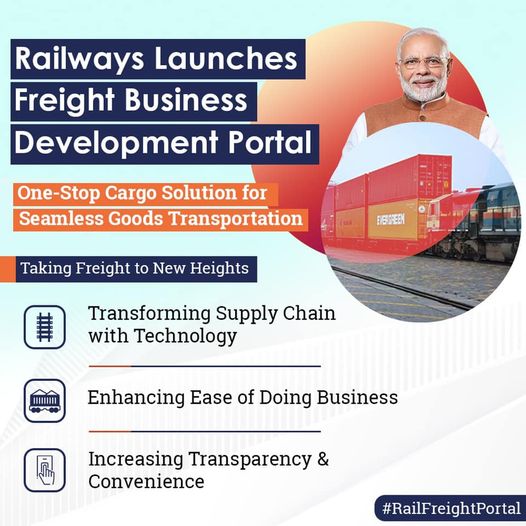
Hon’ble Minister Shri Piyush Goyal launches Indian Railways’ Freight Business Development Portal. One stop cargo solution for seamless Goods transportation.
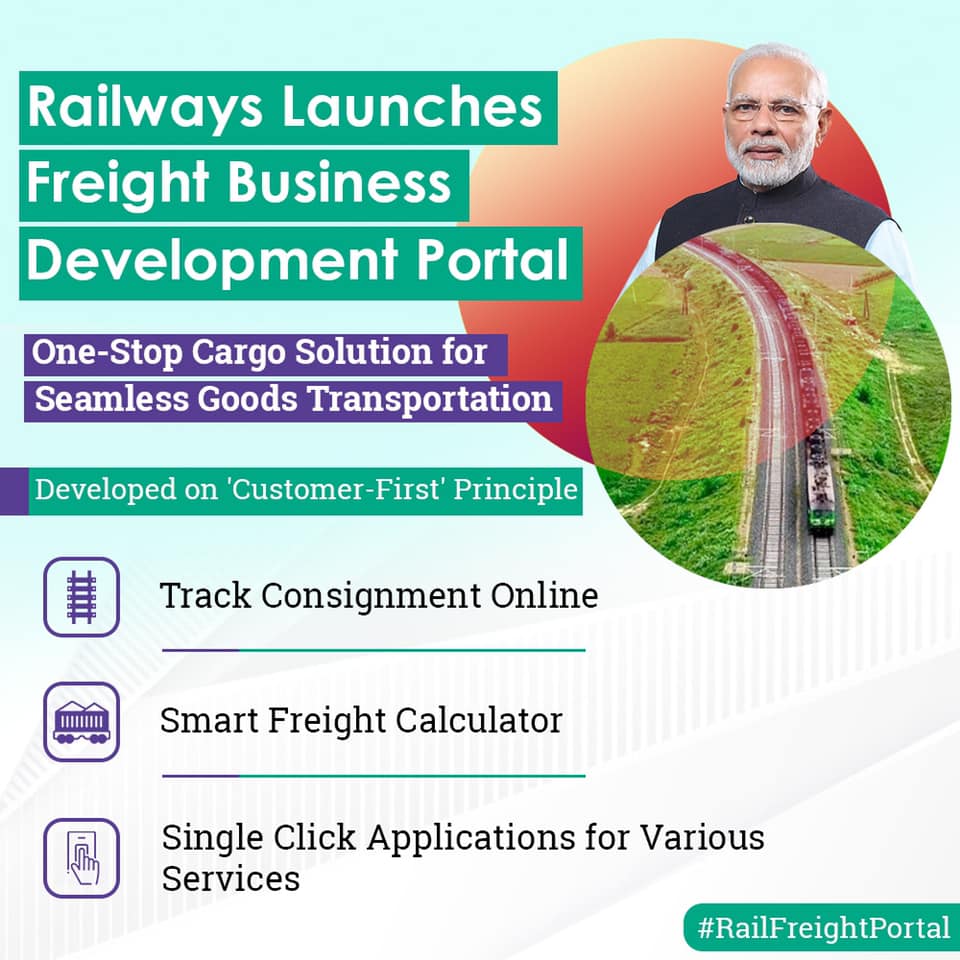
Developed on “Customer First” principle, Freight Business Portal will help to:-
Track consignment online
Smart Freight Calculator
Single Click Applications for various services.
Transforming supply chain with technology
Enhancing Ease of Doing Business
Increasing transparency and convenience.
Distinguishing Features of Freight Business Development Portal:-
New Khurja- New Bhaupur section (351 KM long) of Eastern Dedicated Freight Corridor inaugurated on 29.12.2020.
53 Freight trains have run on this new section till 03rd January, 2021.
Between New Khurja – New Bhaupur (Down Direction) = 32 trains, with Best Speed achieved = 93.70 kmph
Between New Bhaupur – New Khurja (Up Direction) = 21 trains, with Best Speed achieved = 85.98 kmph
In the first phase, DFCCIL is constructing the Western DFC (1504 Route km) and Eastern DFC (1856 route km including PPP section of Sonnagar-Dankuni Section. The EDFC starting from Sahnewal near Ludhiana (Punjab) will pass through the states of Punjab, Haryana, Uttar Pradesh, Bihar and Jharkhand to terminate at Dankuni in West Bengal. The Western Corridor connecting Dadri in Uttar Pradesh to Jawaharlal Nehru Port (JNPT) in Mumbai will traverse through the states of UP, Haryana, Rajasthan, Gujarat and Maharashtra of WDFC & EDFC (excluding the Sonnagar – Dankuni PPP section) i.e. 2800 route Km will be commissioned by June 2022.
In the month of December 2020, Indian Railways loading was 118.13 million tonnes which is 8.54% higher compare to last year’s loading (108.84 million tonnes) for the same period.
Indian Railways earned Rs. 11788.11 crores from freight loading which is also Rs. 757.74 crores (6.87%) higher compare to last year’s earnings (Rs. 11030.37 crores).
Indian Railways loading was 118.13 million tonnes which includes-
50.67 million tonnes of coal,
15.31 million tonnes of iron ore,
6.13 million tonnes of foodgrains,
5.23 million tonnes of fertilizers,
4.3 million tonnes of mineral oil and
7.46 million tonnes of cement (excluding clinker).
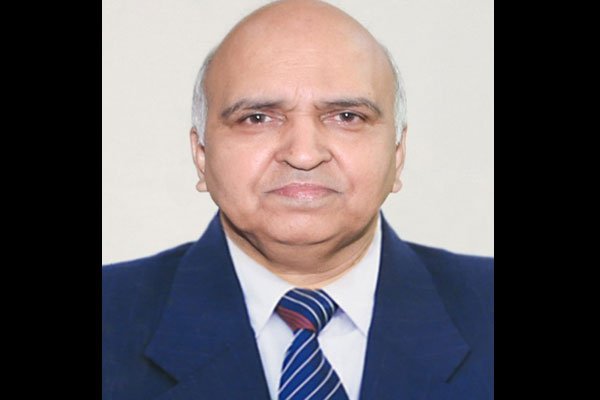
Shri Suneet Sharma, has taken over the charge of new Chairman (CRB) & Chief Executive Officer (CEO), Railway Board (Ministry of Railways) and ex-officio Principal Secretary to Government of India.
Shri Suneet Sharma takes over the charge of new Chairman & CEO of Railway Board
Shri Suneet Sharma, has taken over the charge of new Chairman (CRB) & Chief Executive Officer (CEO), Railway Board (Ministry of Railways) and ex-officio Principal Secretary to Government of India.
The appointments committee of the Cabinet has approved the appointment of Shri Suneet Sharma as Chairman (CRB) & CEO of Railway Board.
Prior to this, Shri Suneet Sharma worked as General Manager, Eastern Railway, GM MCF Raebareli, CME DLW Varanasi, DRM Pune, ADRM CST Mumbai, CWM Parel Workshop Mumbai.
Shri Suneet Sharma joined the Indian Railways in 1979 as a Special Class Apprentice while he was studying engineering at IIT Kanpur. A graduate in Mechanical and Electrical Engineering he has more than 40 years of experience serving in the Indian Railways in various capacities. He has done stints in Operational working, maintenance in Sheds, Depots and Workshops.
He was Chief Workshop Manager, Parel workshop in Mumbai where he was instrumental in manufacturing narrow gauge locomotives for hill railways. He also restored old steam narrow gauge locomotive for the heritage Matheran line near Mumbai. During the 2006 Mumbai suburban train blasts, he was part of the team which put the suburban network on track within a few hours after the terror attack.
As ADRM, Mumbai CST, he is credited with increasing the services of the suburban network, which is considered the life-line of Mumbai. During the 2008 Mumbai terror attacks, he was part of the team that managed the aftermath of the attacks at Mumbai CST, Central Railway.
As DRM, Pune he was instrumental in adding infrastructure which brought about operational efficiency.
As Chief Mechanical Engineer diesel locomotive works Varanasi he was team leader for starting electric locomotive production. Conversion of diesel to electric locomotives took place under his leadership in record time and for the first time anywhere in the world.
As General Manager Modern Coach Factory, Raebareli he set a record by doubling the out turn of the much required modern passenger coaches in one year.
As General Manager Eastern Railway, he took initiative in increasing the speed of goods trains to a record level and for completing a number of infrastructure projects of new lines and electrification which not only resulted in operational efficiency but developed the local areas.
He is known for bringing about systemic changes for ease of working and administrative reforms.
During the course of his career, he has won many professional awards. As General Manager (Modern Coach Factory Raebareli) and Chief Mechanical Engineer (Banaras Locomotive Works)) the factories won the award for best production units.
Suneet Sharma has attended professional training in Germany and France and he has done an advanced leadership and management course at Carnegie Mellon University in USA. He has visited Iran as a consultant for manufacture of locomotives.
He is an avid sportsman and has played Billiards and Snooker at competitive level. He is also a keen golfer and a badminton and squash player.
RB Letter No.2018/TransCell/Health/CGHS (eOff.No.3270783), Dt: 28/ 12/2020
Subject : Improvement of Health Delivery System & Emergency Treatment in Railway Empanelled Private Hospitals
Several representations have been received from Railway Medical Beneficiaries including retired officials regarding problems being faced during treatment in emergency at empanelled Hospitals. In order to improve the Health Delivery System on Indian Railways and streamline the treatment in emergency at Railway empanelled hospitals, following have been approved:
No requirement of prior referral: Railway medical beneficiaries (serving/ retired) under emergency condition can get admission in any railway empanelled hospital without any prior referral. The empanelled hospital should not insist on referral from railway hospitals or demand advance in emergency conditions and the hospital will provide cashless/ Credit medical facilities to patients.
The emergency conditions are defined in Memorandum of Understanding between CGHS empanelled hospitals and Government of India (CGHS Authorities) (Annexure-I) or as amended by CGHS from time to time and same will be applicable in Indian Railways.
The valid UMID Card/ CTSE Card issued will be treated as identification as Railway Medical Beneficiary. Railways have to make sure that these cards are accepted in the empanelled hospital under the jurisdiction empanelment.
Situation may arise where Railway hospital, after scrutinising admission report submitted by empanelled hospital, finds that the patient is not suffering from an emergency. In such cases the patient can continue to avail treatment at the empanelled hospital, if so desired, by paying CGHS rates or hospital rates, whichever is less on the patient’s cost.
The nature and appropriateness of the emergency is subject to verification, which may be verified, inspected or medically audited by the nominated authority on random basis at its own discretion.
The Hospital will intimate all instances of patients admitted as emergencies (without prior permission) to the Railway authorities, at the earliest and within 24 hours and Railway will revert within next 24 hours, otherwise it will be treated as deemed approval. The empanelled hospital will clearly mention/ certify the emergency condition as per MoU.
Railway Hospital as well as empanelled hospital will share the contact number and email address for communication for this purpose and will ensure to put on the website of Railways as well as of the hospital. The documents and approvals will be shared on the email to save the time and difficulties faced by the patients. The empanelled Hospital will not insist to patients to get the approval of referral/ extension from the Railway Hospital. Same will be coordinated and approved on the contact number and email by the empanelled Hospital and Railway Hospital.
Railway hospitals shall refer to the empanelled hospital for appropriate duration as per the package. In case of additional stay for treatment, same procedure will be followed as per Para 6 & 7 above.
Also, the empanelled hospitals will provide the necessary treatment in OPD or otherwise to valid Railway Medical Beneficiary at the CGHS approved rates or hospital rates, whichever is less for the treatment in non-referral and non-emergency case at Railway Medical Beneficiary’s cost.
Zonal Railways shall include provisions for conditions given from 4.1 to 4.9 above, in their MOU with the referral hospitals and also include that refusal to provide treatment to bonafide railway medical beneficiaries in emergency cases without valid ground would attract disqualification for continuation of empanelment. Also, MoU to be updated including removal of ambiguities accordingly.
DMTR (Daily Material Transaction Report): User Depot Module
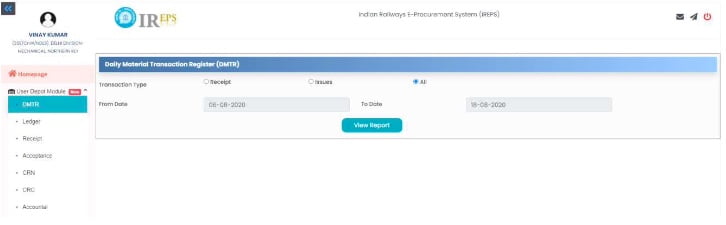
DMTR is summary of list of all the finalized transactions on a particular day. Here is the User Manual for viewing/printing DMTR report on UDM Module of Indian Railways.
On clicking DMTR Tab on Left side Panel, following Screen will open:
3.2 Viewing DMTR reports
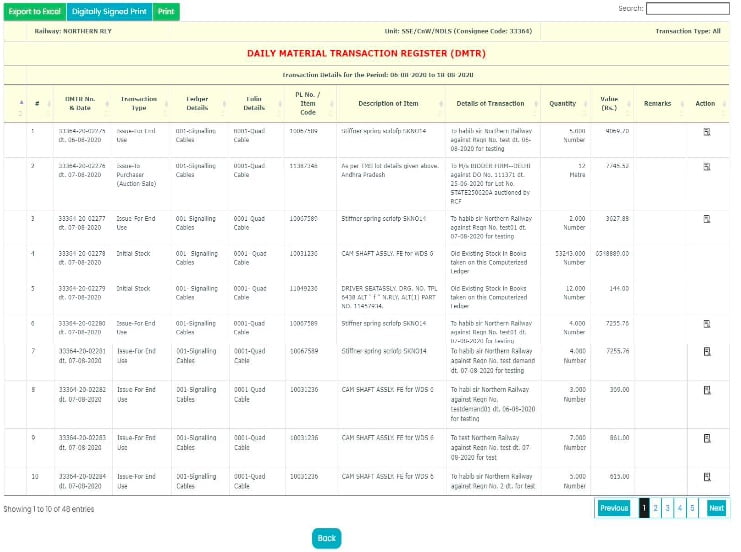
User may select Transaction Type and the Time Period for which DMTR is required as per his requirement. We have set default Transaction Type as All and the Time Period as last three days from the current date. On clicking View Report, following DMTR will get opened:
3.3 Search & Print facility of DMTR
Search facility can be used to search a particular transaction. Hyperlinks have been provided to view various types of documents. Also, by clicking icon available under Action Header, User can view further details / documents. Facility to take Print / Digitally signed Print / Export to Excel the DMTR is also there using the Tabs available at top Left Hand side of Page.